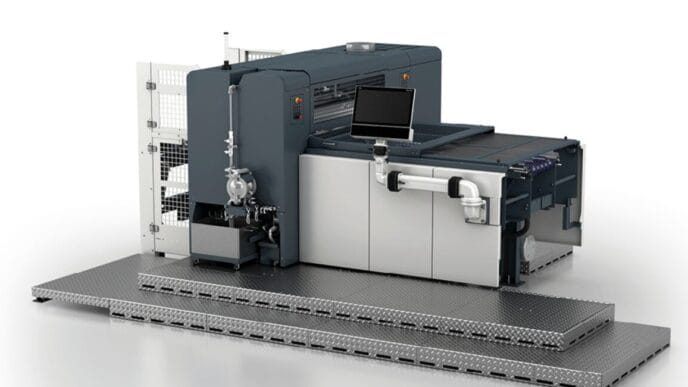
3D printers are now part of the machine park at Optima in Schwäbisch Hall. The company has set up a 3D printing centre specifically for this future technology and presented a roadmap.
3D printing will massively change special machine construction. „Machine parts that used to take a week to produce can now be printed in a much shorter time,“ says Optima Production Manager Volker Freisinger. Optima has around half a million euros into the new 3D printing centre at the Schwäbisch Hall site called Additive Innovation Centre invested.
The Additive Innovation Centre has been in operation since July 2019 and went into production at the end of 2019 following a test phase and employee training. It comprises a 3D printing lab and a Training and construction area, which was christened the Innovation Space. Since December 2019, employees from key positions have been trained there for a 3D-compliant design trained.

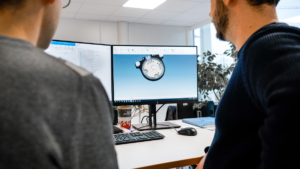
3D printing process increases flexibility
The Consumer demand for specific products is changing faster and faster. Social media and e-commerce are accelerating this development. This affects all market segments for which Optima develops machines: Pharmaceuticals, paper hygiene, consumer goods and medical products. In order to counteract this trend, new, Agile and flexible processes and technologies required.
„With additive manufacturing technology, we are therefore supporting our customers in terms of flexibility,“ says Michael Weber, Service Manager of Optima consumer GmbH.
Machine, format and spare parts can be produced much more quickly. In addition, the entire manufacturing process can be Better price-performance ratio realise, especially with complex components. Now Design solutions possible that could not be realised before. Existing parts can be modelled on examples in nature. Lighter, more stable and material-saving design than before - for example through honeycomb structures. The Sustainability is becoming increasingly important - after all, no chips or waste are produced during manufacture.
All common printing processes are possible
At the Additive Innovation Centre All common 3D printing processes for use. For the quick production of Prototypes Optima uses the Fused deposition modelling (FDM) process, which has been used successfully in the automotive industry for many years, and the Selective laser sintering (SLS) process. The SLS process enables a large Variety of materials, colours and finishes. A partner company brings advanced SLS processes with a wide range of post-processing options to the team. These include, for example, the Colouring and smoothing the components.
Optima has also invested in the advanced Multi-jet fusion technology which can produce parts faster than the SLS process. The breakthrough of SLS and multi-jet fusion printing technologies has paved the way for companies to Industrial application of 3D printing paved the way - far beyond the production of prototypes.
Source: Optima