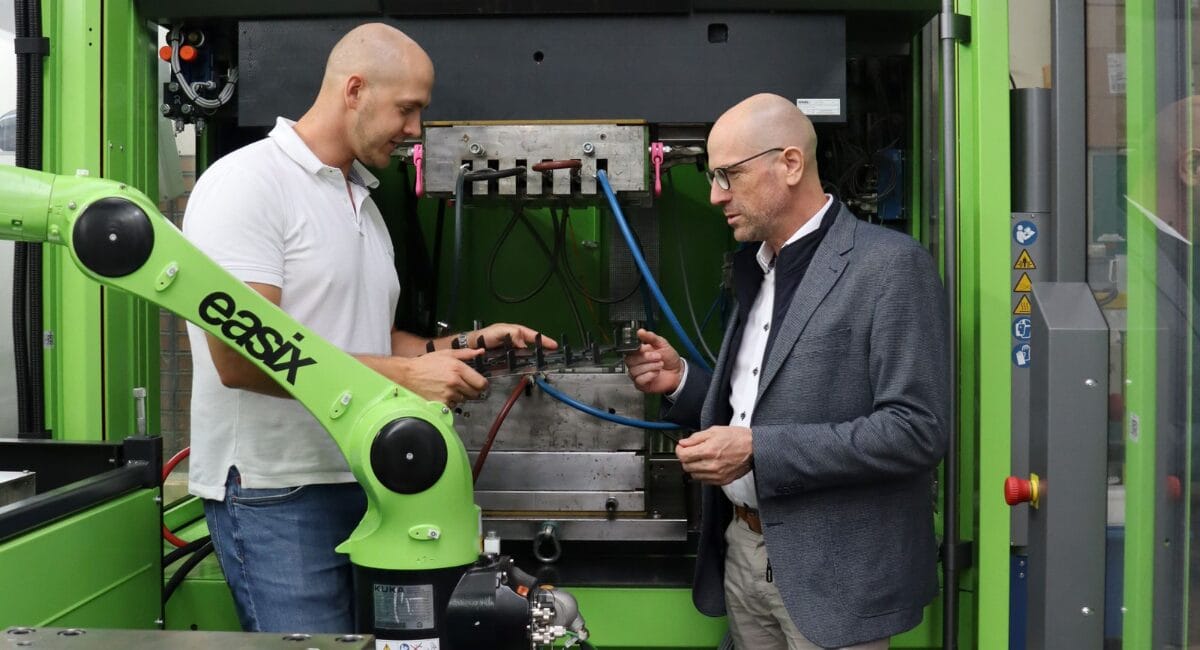
The Engel Group, supplier of injection moulding technologies, has provided Rosenheim Technical University of Applied Sciences with a modern injection moulding cell for upcycling research.
The system is to be used in teaching and research at the university and consists of an Insert 500V/130 vertical injection moulding machine, an infrared oven and the Easix KR-10 articulated arm robot. Processing of thermoplastic, recyclable composites and the use of natural fibres.
One focus of research at Rosenheim Technical University of Applied Sciences is fibre composites, with the „Wood-based bioeconomy“ project in particular focusing on the production and processing of new materials made from cellulose fibres and polypropylene (PP). „The TH Rosenheim is of great importance in research and development, particularly in the area of developing sustainable injection moulding solutions and new materials,“ says Dr Johannes Kilian, Head of Process and Application Technology at the Engel Group. „The collaboration is of great importance to us, as the university is not only known for its research strength in the field of plastics processing, but also for its practice-orientated training. Our injection moulding cell makes it possible, Integrate innovative technologies and digital solutions directly into teaching and also to test a wide range of applications for their recyclability.“ Rosenheim Technical University of Applied Sciences is heavily involved in research into sustainable materials, particularly in the field of natural fibres as reinforcing materials for thermoplastics.

„The new facility puts us in a position to carry out practical investigations and further research the use of sustainable materials in technical applications and the construction industry.“
Prof. Dr.-Ing. Norbert Müller, Dean of Studies for the Plastics Technology and Sustainable Polymer Technology degree programmes.
The construction industry in particular is an important sector for Rosenheim Technical University of Applied Sciences, where further research and development into the recycling of materials is necessary and in which Recyclable material systems based on natural fibre-reinforced plastics offer great potential for innovation offer. By using fibre reinforcements in combination with a polymer matrix, injection moulded parts can be produced that have high strength and low weight at the same time.
Digitalisation also plays a central role in research at Rosenheim University of Applied Sciences. By using Engel's iQ process observer, the university gains valuable data that allows conclusions to be drawn about other applications through semantic processing. This is an important Step towards machine learning and AI-supported applications in plastics processing. „Digital process monitoring opens up new opportunities to make production processes more efficient and sustainable,“ explains Norbert Müller. TH Rosenheim will continue to expand this area, as the combination of digital technologies with practical projects offers enormous potential.
In addition to supporting teaching and third-party funded research, the creation of Engel also for direct R&D co-operations used. Companies and institutions that collaborate with the TH Rosenheim can use it to test technologies and trial new applications.
SourceAngel