The pressure on the food and packaging industry is growing: a shortage of skilled labour, volatile markets, rising costs and ambitious sustainability targets are challenging companies. However, this situation also opens up opportunities for innovation, efficiency and new business models. Those who organise their production for the future now will gain sustainable competitive advantages. The vision: a smart, resilient and networked „Factory of the Future“.
What is often still seen as a vision of the future is already being realised by progressive manufacturers: networked machines, data-driven decision-making processes, automated quality assurance. The food industry is currently at a turning point - with new requirements that offer great potential. This is not just about technological innovations, but about a fundamental change in how food will be produced, processed and packaged in the future.
While the shortage of well-trained specialists will become even more acute in the future, regulatory hurdles and social expectations regarding sustainability and transparency will continue to rise. The key for manufacturers lies in a reorientation away from rigid structures towards networked and adaptable production. How can we imagine a „Factory of the Future“ that can meet these requirements?

Causes of change in the industry
Demographic change is turning the industry upside down: according to the EU Commission, over 75 per cent of companies are experiencing problems recruiting qualified employees, particularly in technical professions. While there is a shortage of young talent, many employees will be retiring in the coming years. The skills gap is also widening due to the increasing demands on technical expertise. At the same time, sustainability is becoming a business-critical factor, driven by new legal framework conditions such as the EU Green Deal and the Packaging Ordinance (PPWR), but also by the consumer behaviour of increasingly aware customers.
Global crises have also exposed the fragility of global supply chains in recent years: Flexibility, quick changeovers to alternative raw materials, adaptable production lines and digital transparency across the entire value chain are increasingly becoming key factors. The economic environment has also changed: Energy and raw material prices are rising and inflation is putting additional pressure on margins, highlighting the need for efficiency improvements. This overall picture of developments is bringing new priorities into focus for manufacturers: only through automation, digitalisation, sustainable processes and resilience can production be secured in the future.
These factors have triggered a dynamic that necessitates fundamental changes in production. The „Factory of the Future“ - a production environment that meets the requirements of tomorrow through intelligent technologies, a high degree of automation and networking - represents a strategic response that manufacturers can use to react to these challenges.
Principles of the „Factory of the Future“
In order for companies to master this change, a strategic architecture is required in addition to a clear vision. There are five basic pillars that are considered crucial for the production of tomorrow:
- Industrial Internet of Things (IIoT): Data is more valuable today and in the future than ever before. In the „Factory of the Future“, sensors link plants and processes to form self-learning systems. The resulting real-time data enables optimised maintenance intervals, minimises downtimes and is a prerequisite for autonomous processes. This networking forms the basis for autonomous production systems.
- Automation with AI: AI-supported systems don't just take on tasks, they think for themselves: from quality assurance to troubleshooting. Intelligently networked machines react independently to minor deviations and ensure that these are rectified. Modern automation systems that combine sensor technology and AI therefore offer far more than traditional efficiency gains. They help to bridge expertise bottlenecks caused by the shortage of skilled labour and ensure consistently high standards without the need for an operator to manually intervene in processes.
- Data-based decisions: The transformation in production begins with transparency: edge and cloud computing make large amounts of data analysable and therefore relevant for decision-making. Not only can optimised processes be developed on this basis, but new business models can also emerge.
- Flexibility and scalability: Adaptable systems, open interfaces and adaptive production lines enable fast product and format changes, while also offering the option of expansion without complex conversions. This is a clear advantage, especially in uncertain times. Modular systems offer future-proofing through flexibility and scalability.
- Sustainability as an economic strategy: The „green factory“ is not a marketing strategy, but makes economic sense: intelligent control systems reduce the consumption of resources and waste can be minimised through a circular economy. Those who implement sustainability in a smart way create ecological and economic room for manoeuvre.
The five pillars of the „Factory of the Future“ combine technical progress with strategic business objectives to create an integrated concept. For example, Syntegon supports manufacturers and start-ups in integrating various automation concepts into their specific production environments.
Redefined - the role of people
It's not just machines and processes that are changing: technological progress is also fundamentally transforming the world of work in production. Away from physically demanding routine activities and towards value-adding tasks: Employees are becoming decision-makers who use digital support to analyse processes and carry out cross-system optimisations. Assistance systems and intuitive interfaces help to master complexity and better utilise potential.
While these changes are creating attractive new jobs, new requirements such as data expertise and the ability to analyse are also coming into focus. The new world of work combines the efficiency and precision of automated systems with the decision-making skills of employees. This combination offers the key to sustainable, economical and future-proof production.
The path to smart production
The transformation to the „Factory of the Future“ is a process - not a switch that can be flipped from one day to the next. A structured start is crucial, as is determining the current situation, analysing potential and prioritising. For all investments, it is important to assess the costs, benefits and strategic importance.
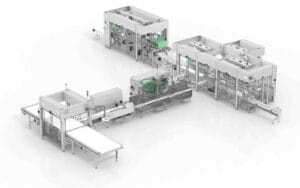
The intelligent retrofitting of existing systems is a pragmatic first step and at the same time an effective lever. Upgrades can also be used to integrate existing machines into a networked production environment without the need for extensive new investment from the outset. Step by step, systems and production lines are created that can also grow with the challenges in the long term: technologically, economically and organisationally. New technologies can thus be integrated on an ongoing basis.
Employees are a key success factor. Their early involvement, knowledge and acceptance determine whether transformation succeeds. Syntegon supports its customers in this process as a strategic partner with more than 160 years of experience, technological expertise and a focus on measurable results.
Innovation as a continuous process
The „Factory of the Future“ is not the goal: it is the path to greater resilience, sustainability, flexibility and customer proximity. Autonomous production lines are already a reality in some companies, while self-optimising processes are on the verge of a breakthrough. Sustainability, energy efficiency and data-driven services have long been more than just dreams of the future.
Bio-based packaging materials, energy self-sufficient production systems and closed resource cycles are key areas of development. Predictive maintenance and flexible production capacities on demand are already changing value chains today. Syntegon is actively working with its partners and customers to turn these visions into reality in production environments. The aim is to create intelligent solutions that are economically viable, sustainably effective and technologically pioneering.