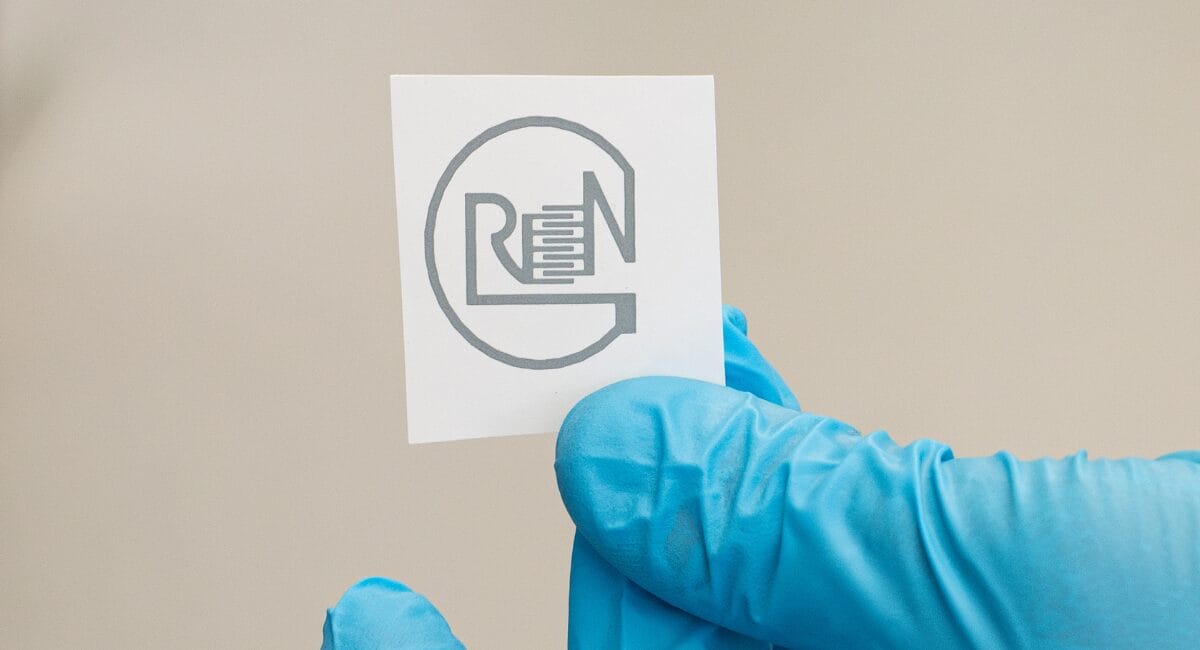
In Switzerland, researchers from Empa, EPFL and CSEM have developed a smart and „green“ sensor label that measures temperature and humidity in real time - and can also recognise whether a temperature threshold has been exceeded. The electronic label itself is completely biodegradable.
In the four-year Greenspack project, the researchers have developed a smart label that measures the temperature and relative humidity and can «remember“ when a certain temperature threshold has been exceeded. The small sticker not only silicon-free, but also completely biodegradable. The project was funded by the Swiss National Science Foundation (SNSF) and Innosuisse as part of the Bridge Discovery programme.
Conductors with memory
The smart label needs neither a battery nor a transmitter to do its job. Rather it works in a similar way to an RFID chip. It contains printed strips of conductive materials that form circuits. If these circuits are exposed to an electromagnetic field, for example by a label reader, a resonance is created that can be deciphered by the reader. The clever thing about this is that the conductivity and capacitance of the individual circuits and therefore their resonance change depending on the ambient temperature or humidity. This change provides information about the current temperature and humidity. without any complicated measurement technology.

The researchers also wanted to give the label give a kind of memory. If the temperature of 25° is exceeded, a tiny element in one of the conductor tracks melts, irreparably interrupting the circuit. The next time the label is read, it will show: This consignment was once too warm.
This technology relieves the supply chain and reduces its CO2 footprintPotentially damaged goods are recognised earlier and do not have to be sent on. If the delivery has simply become less durable due to the effect of temperature, it can be redirected to a closer location, for example.
„Depending on the materials we use, we can also set the temperature threshold differently. Labels for frozen goods, for example, would be conceivable.“
Gustav Nyström, Head of the Empa Cellulose and Wood Materials Laboratory
Biodegradable and sustainable
The vision of the researchers is to to be composted at the destination or sent for cardboard recycling. For the substrate, the Empa researchers have developed a material that made from a biopolymer and cellulose fibres consists of. To print the conductive tracks, they used a specially developed ink that contains the biodegradable metal zinc.
Source: Empa