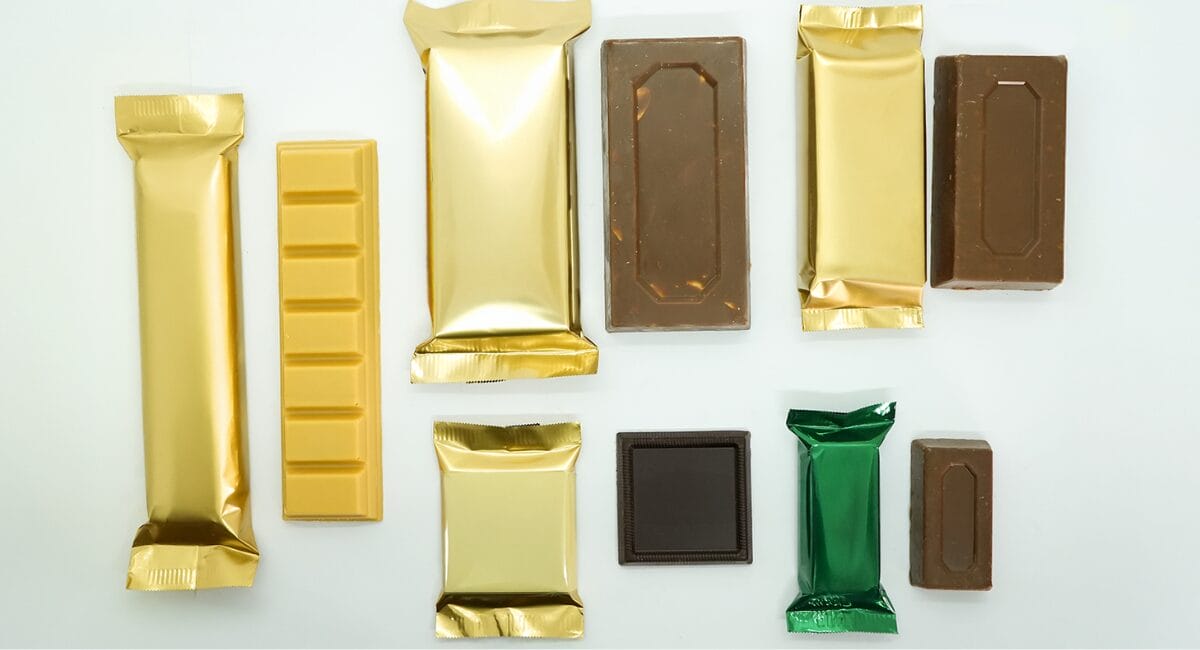
Recently voted „Most Trusted Brand“, a local manufacturer of premium chocolate from the South Pacific region is committed to the highest standards in the processing and packaging of its products. The cocoa beans are roasted, refined and processed in the company's own factory. The requirements in terms of packaging technology are just as demanding.
The company was looking for a particularly flexible packaging solution for different product formats that would also enable optional secondary packaging in flow-wrapping to increase the variety of formats, investment security and seasonal responsiveness. Theegarten-Pactec from Dresden developed a particularly versatile overall system: with a total of three FPC5 machines, distributed over two packaging lines, it allows the customer exceptionally flexible and future-proof production.
Designed for demanding packaging tasks, the FPC5 with a processing capacity of up to 1,500 products per minute (including moulded or coated bars, tablets and chocolates) enables precise and efficient primary packaging in flow packs. The packaging speed is up to 120 metres per minute, making it ideal for the highest throughputs. Thanks to its modular design, it can be quickly converted to different product formats.

The chocolate manufacturer is now also benefiting from this, having finally opted for three FPC5 high-performance packaging machines, which have been integrated into two parallel lines. The two packaging lines each consist of an FPC5 for primary packaging, which are designed to process five different product formats. Both lines are directly connected to the moulding line and each has a downstream cartoner for secondary packaging.
Three central application scenarios
As a practicable solution for products that are not directly cartoned, the first scenario envisages the ejection of small-format products via a retraction flap. These are packed at a speed of 900 products per minute, collected in collection boxes (big bags) and fed manually to the vertical flow-wrapping machines for secondary packaging in flow-wrapped bags.
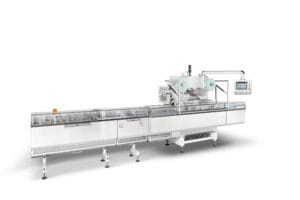
The second application scenario is ideal for formats with standard requirements. This involves the individual packaging of chocolate bars in tubular bags with subsequent direct connection to the downstream cartoner. Here, for example, long bars can be packed at a speed of 500 products per minute or small chocolate bars at 700 products per minute. The solution is particularly suitable for compact, tight-fitting packaging at high cycle rates. The desired packaging quality is achieved by modern, intelligent and highly efficient control algorithms in the machine control system. They consistently prevent position errors and recognise faulty products in an emergency, which are then ejected.
In the third scenario, individually wrapped bars are transferred 90 degrees via a transfer wheel to a second FPC5, where they are grouped as three-packs and packed into flow packs with the long side leading. Only complete multipacks are produced in the production process. In conventional systems, even a faulty individual product at the interface to the secondary packaging machine can lead to incomplete groups being ejected. Theegarten-Pactec's intelligent grouping solution prevents this: It compensates for empty cycles on the primary packaging machine and only transfers complete product groups to the secondary packaging process. Speeds of 700 individual products per minute or 233 group packs per minute are achieved here. The three-packs are then fed back to the cartoner via a belt behind the packaging machine, where the individual bars are otherwise packed into display cartons.
Less effort, more format
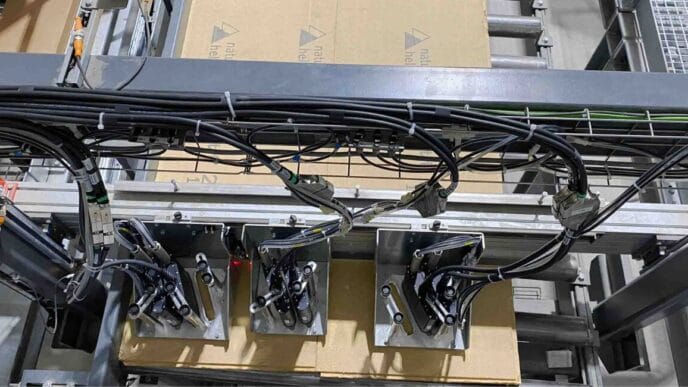
For the particular flexibility of the multi-format solution, Theegarten-Pactec opted for a combination of manual counter adjustment with setpoint specification. The required settings for each product format, such as the width and height of the belt guides, the position of the print mark sensor and the sealing unit, are stored as product recipes in the touch panel. When changing the format, the operator loads the required format via the display. The new target values are then activated on the respective spindles. Visual feedback from red to green helps the operator to carry out the changeover completely and correctly without manual remeasurement. The deliberately chosen manual solution is not only more economical than a fully automatic adjustment via motors, but also more robust and requires less maintenance, which is particularly advantageous for frequent cleaning intervals during format changes.
Another technical highlight is the integrated transfer wheel for the case packer, which can be operated actively or in stand-by mode as required. This allows individual and collective packaging to be combined efficiently without interrupting the production flow. In addition, air cooling of the infeed belts has been implemented in order to optimally protect the temperature-sensitive chocolate.