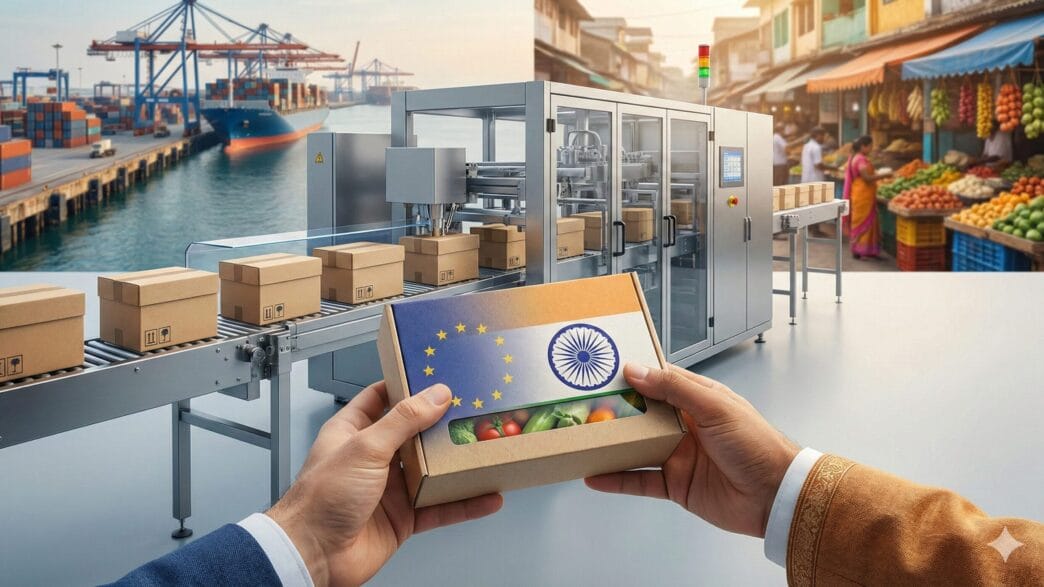
It is done. After almost two decades of tough negotiations, the EU and India signed the free trade agreement, often referred to as the „mother of all deals“, in January 2026. For the German packaging machinery industry, this opens the doors to one of the world's most dynamic markets wider than ever before. Where are the tariffs really falling, which bureaucratic hurdles are replacing the tariff barriers and how is „Made in Germany“ now positioning itself against the Chinese competition? A comprehensive analysis for the industry.
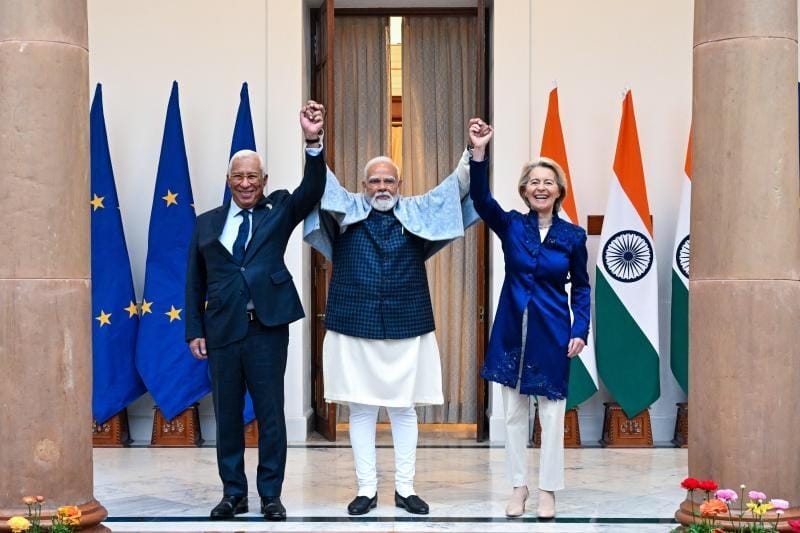
When EU Commission President Ursula von der Leyen and Indian Prime Minister Narendra Modi signed the paper in New Delhi on Tuesday (26 January), it was more than just a diplomatic act. It was, as Modi put it, the birth of a free trade area of two billion people. At a time when protectionist tones from the USA under a new Trump administration are unsettling the global economy and China's aggressive export policy is flooding the markets, this deal sends a powerful signal: diversification is the order of the day.
But what does the political climate mean in concrete terms for a medium-sized manufacturer of filling systems from Baden-Württemberg or a specialist in blister packaging from North Rhine-Westphalia? The answer is: enormous opportunities, coupled with new homework. India is no longer just a „market of the future“. With a forecast market volume in the packaging industry of over 200 billion US dollars, the subcontinent is the present.

The customs hammer: end of the 44 per cent hurdle
For the mechanical engineering industry, the centrepiece of the agreement is the elimination of customs duties. Until now, exporting to India has often been a calculation exercise with many unknowns. Customs duties on machinery and equipment varied greatly, but were often in the range of 7.5 to 15 per cent. If various taxes and the social welfare surcharge were added, exporters were often faced with effective charges of well over 20 per cent, and in peak cases even up to 44 per cent according to EU data sheets.
The new agreement radically shaves these peaks. According to the published key points, customs duties will be eliminated on more than 96 per cent of traded goods. For the mechanical engineering industry, this means
- Immediate zero setting: For many critical components and high-tech equipment that India urgently needs for its own industrialisation („Make in India“), the tariffs will fall when the agreement comes into force.
- Transition periods: Transitional periods of 5 to 10 years are planned for more sensitive areas in which India is setting up its own production.
For German manufacturers, this is a direct margin boost.
„In the past, we had to be so technologically superior that we could justify the price disadvantage of 15 to 20 per cent compared to local or Chinese suppliersWhen this price premium disappears, we are suddenly playing in a completely different league.“
Sales manager of a southern German packaging machine manufacturer
The market: Why India needs packaging technology now
To understand the scope of the deal, you have to look at the situation on the ground. India is undergoing a transformation that is increasing the need for Processing and Packaging massively. Three main factors are decisive here:
1. the fight against waste (food processing)
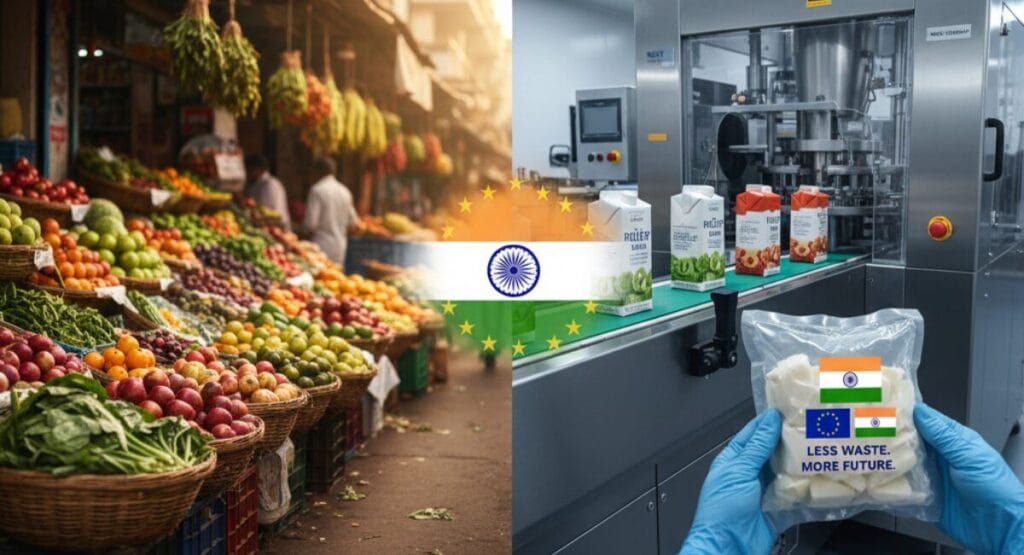
India is one of the largest agricultural producers in the world, but still loses a significant proportion of its harvest due to poor processing and packaging. The Indian government is pushing ahead with the expansion of food processing („mega food parks“). This is where German technology comes into play: aseptic filling, MAP (modified atmosphere packaging) and sorting systems are needed to extend the shelf life of dairy products, fruit and vegetables.
2. the pharmacy of the world (Pharma)
India is the world's largest supplier of generics. But the requirements are increasing. Western markets demand the highest standards in serialisation, track & trace and anti-counterfeiting. The Indian pharmaceutical sector is growing at a double-digit rate (CAGR of over 10 %). In order to remain exportable, Indian pharmaceutical giants are upgrading their lines with high-end packaging machines - traditionally the domain of German suppliers such as Uhlmann, Romaco and Optima. The free trade agreement now makes it much easier to import these complex lines.
3. the organised retail revolution
The shift from the traditional „kirana store“ (corner shop) to supermarkets and booming e-commerce (quick commerce is huge in Indian metropolises) requires standardised, robust and stackable packaging. The demand for secondary and end-of-line packaging machines - cartoners, palletisers, wrappers - is growing exponentially.
Reactions: „Game changer“ with footnotes
The official enthusiasm is great. The Association of German Chambers of Industry and Commerce (DIHK) speaks of a „real game changer“. The VDMA, which has had its own offices in India for over 20 years, also sees a long-standing demand fulfilled. Karl Haeusgen, VDMA President, emphasised the „dynamic development“ and the record level of exports that could already be observed in 2024/2025 in the run-up to the agreement.
But a glance at the business press, for example at n-tv or analyses of the Handelsblatt, also shows scepticism. The term „fairy tale of the mother of all agreements“ is doing the rounds. Why? Because free trade in 2026 is no longer what it was in the 90s. It's no longer just about tariffs.
The problem of non-tariff barriers to trade (NTBs)
While customs duties are falling, India is creating hurdles elsewhere. One example that is causing headaches for the mechanical engineering industry is the „Quality Control Orders“ (QCO). The Indian Ministry of Heavy Industries is increasingly demanding BIS (Bureau of Indian Standards) certification for imported components - from steel products to electric motors.
Experts warn: If customs duties fall, but every imported screw and conveyor belt requires Indian certification, which takes months and costs thousands of euros, the advantage is gone. Here, the agreement must prove in the technical annexes that it also enables mutual recognition of conformity assessments (e.g. CE marking), at least in part. Initial analyses of the text of the agreement point to dialogue formats, but not to automatic recognition of all EU standards.
Sustainability as a new point of friction?
Another aspect that is relevant to the packaging industry is the chapter on sustainability. The EU is pushing for green standards (Green Deal, CBAM). India has issued its own, sometimes very strict plastic bans („Single Use Plastic Ban“), but their implementation is often erratic.
This is an opportunity for machine manufacturers: systems that can process mono-materials, run thinner films or handle fibre-based packaging are in high demand in India. The large Indian FMCG companies (such as ITC, Tata Consumer Products) are under pressure to improve their plastic balance. German technology, which enables material savings, is now becoming more attractive in terms of price thanks to the FTA and is encountering a market that is being forced to become more sustainable through regulation.
The China component: „China Plus One“ becomes real
This agreement cannot be understood without looking at China. Many Indian companies are actively looking for alternatives to Chinese machines, partly due to political pressure and partly for quality reasons. The FTA gives the Europeans the necessary ammunition here.
„We are seeing a massive ‚China Plus One‘ strategy among our customers in India. They used to buy the high-end line from us and the standard line from China. Now that tariffs are falling, they are recalculating. When the price difference melts away, the German longevity (total cost of ownership) wins.“
Area Sales Manager of a packaging machine manufacturer
What to do now: Checklist for export managers
For companies in the packaging industry, the deal gives rise to specific fields of action:
- Check HS codes: As soon as the final customs lists are published, export departments must check which category their machines fall under (HS 8422 and following) and whether the duty exemption applies immediately or in stages.
- Rules of Origin: The agreement will have strict rules of origin. Only machines that are manufactured to a significant extent in the EU will benefit. Anyone who installs too many components from China and only assembles them in Germany could come away empty-handed. Documentation of the supply chain will be crucial.
- Expand service presence: More machines on the market mean more service requirements. Indian customers expect fast support. The FTA also facilitates the trade in services and the secondment of technicians, which makes it easier to set up local service hubs.
- A look at the standards: Indian BIS standards must be proactively monitored. Do not rely on the CE standard being sufficient.
Conclusion: A marathon, not a sprint
The agreement between the EU and India is a milestone, but not a magic wand. It eliminates the biggest cost block - customs duties - and creates political security in an uncertain world. For the German packaging machinery industry, which is a global technology leader, India is the logical growth market to compensate for weaknesses in other regions (stagnation in Europe, uncertainty in China/USA).
The Indian packaging industry is growing rapidly, the hunger for automation is great and the „Made in Germany“ label is held in high regard. If companies manage to overcome the remaining bureaucratic hurdles and offer price-sensitive but high-quality solutions („good enough quality“ vs. „over-engineering“), 2026 could indeed go down in history as the year in which the sleeping giant India woke up for the German SME sector.
The deal has been signed. The work starts now.