Avoiding packaging waste and increasing recycling - this was the aim of the new Packaging Act, which came into force at the start of 2019. The REPASACK take-back system founded by the German Paper Sack Industry Association (GemPSI) has been living this model for a quarter of a century: 20,000 tonnes of kraft paper sacks are recycled in the REPASACK system in Germany every year.
One third of these are paper bags for chemical substances. The company sorts and cleans the sacks and then processes them into a high-quality secondary raw material, which is used in other paper products. This conserves resources and is good for the environment.
REPASACK was founded more than 25 years ago by the GemPSI as well as by domestic and foreign sack paper manufacturers.

„On the one hand, we wanted to make it easier for manufacturers, retailers and bottlers to fulfil their statutory take-back and recycling obligations in accordance with the Packaging Ordinance“
„Secondly, we wanted to bundle the material flow of kraft paper bags to ensure that the valuable, long kraft paper fibres are reprocessed by type and not recycled with other, lower-quality paper fibres. The advantage of this is that we obtain a high-quality secondary raw material that can be used proportionately as a substitute for the primary raw material in other kraft paper products such as carrier bags.“
Alfred Rockenfeller, GemPSI Chairman
REPASACK recycles 20,000 tonnes of kraft paper bags every year from industry and commerce - that corresponds approx. 100 million units. If you laid them next to each other, you could wrap them around the earth about two and a half times. Around 33 million of these are paper bags for chemicals.
Recycling of chemical bags
Isn't it questionable to reuse fibres from paper bags in which chemicals have been transported? „Not at all,“ says Sven Korsten, authorised signatory at REPASACK.
„Not all chemicals are harmful to humans and the environment. Many are even contained in food or are suitable for use in food. However, to minimise any risk, all the paper bags we collect are thoroughly cleaned. Removing adhering product residues from the used paper sacks is a basic prerequisite for returning the kraft sack paper fibre to the paper cycle.“
Sven Korsten, authorised signatory of REPASACK
Especially for this purpose, REPASACK has developed a worldwide Unique cleaning system designed: In one Shredder 24 cutting crowns are used to cut bales weighing up to one tonne from paper sacks into palm-sized shreds. For cleaning purposes, these then run over a series of Flip-flop screens, Chopper fans and Paper separators. In this purely dry-mechanical process, residual materials are reduced from an average of 17 per cent (based on the empty bag weight) to a uncritical quantity reduced.
Separate collection for recycling
For optimum disposal of the filling material residues, the used Paper bags strictly separated after three defined Product groups processed in the cleaning plant: Building materials, food and animal feed and chemical products. Paper sacks for hazardous substances and sacks with strongly colouring residual contents, such as pigments, are already being cleaned. Separated at the place of collection, to prevent contamination of the subsequent secondary raw material.
They are then sensibly thermally recycled. Paper bags laminated with plastic or aluminium are also excluded from mechanical recycling. The following generally applies: The higher the grade purity, the better the recyclability.
Return ticket for the bags
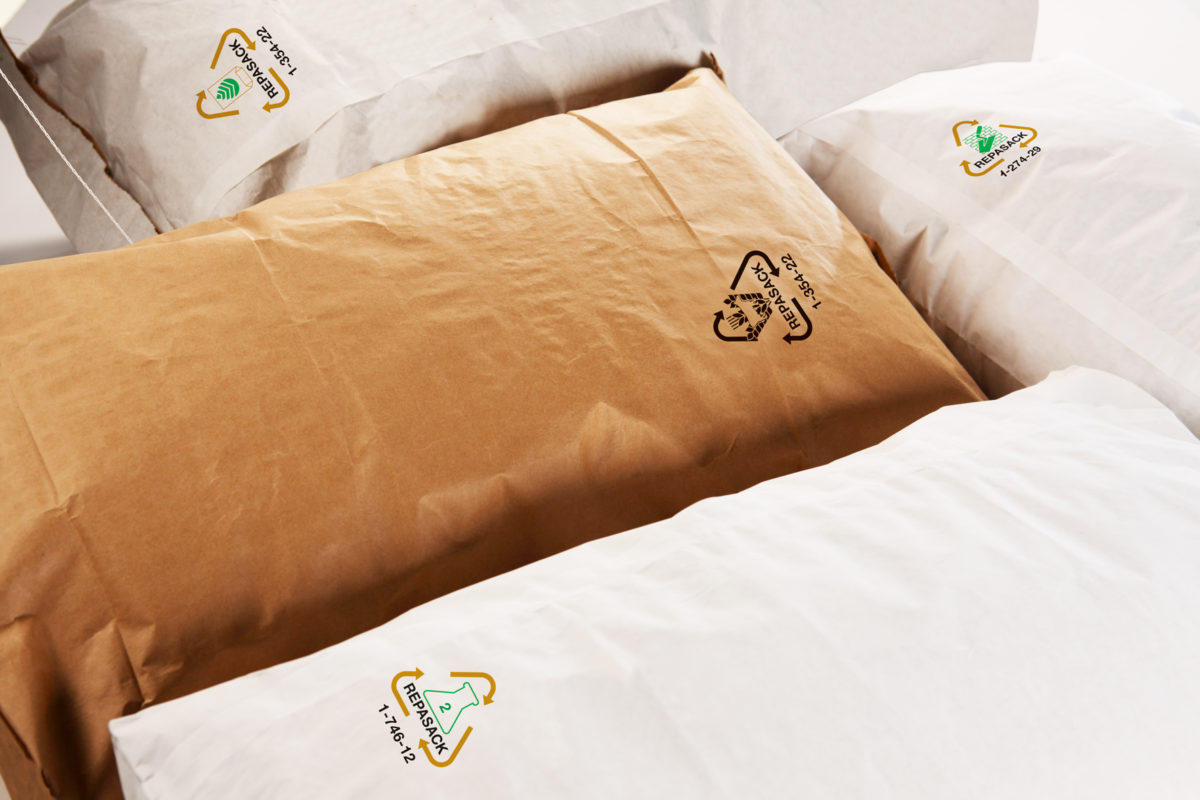
The accepted bags must be labelled with the corresponding REPASACK symbols be labelled. A REPASACK symbol must be printed on the bag before it can be taken back at one of the collection points in Germany. 350 acceptance and collection centres, which are on average only 15 kilometres away from the end customer. Against payment of a Licence fee companies in the filling industry can have the symbol printed on the paper bags.
This is how they fulfil the legal requirements in Germany, without having to worry about recycling their paper sacks themselves. Your customers, the commercial end users, can dispose of the empty sacks with the REPASACK symbol free of charge. return to the system. In addition, the bags must fulfil certain criteria in order to be accepted: They must dry and emptied and may also No foreign substances included.
Advantage for the climate
At the end of the cleaning process, the clean paper shreds, free of impurities, fall into a chute, where they are finally pressed into large bales again and delivered to Paper mills and processed into new kraft paper packaging. This in turn can be sold to the Recycling so that the secondary raw material is recycled several times is managed. This has a positive impact on the environment.
„Recycling paper bags contributes to climate protection, as CO2 and other greenhouse gases saved“
„We came to this conclusion in a study for REPASACK, in which we compared the environmental effects of recycling with the primary production of kraft paper bags made from virgin fibres.“
Dr Markus Hiebel, Head of the Sustainability and Resource Management Department at the Fraunhofer Institute UMSICHT
Accordingly, an average of 220 kg greenhouse gases are saved by recycling one tonne of kraft paper bags. In relation to the quantity of chemical bags recycled annually in the REPASACK system, these are 1,467 tonnes of greenhouse gases or around 12.2 million car kilometres that were not driven. This corresponds to 304 circumnavigations of the earth at the equator.
High relevance for the packaging industry
„Kraft paper bags are very easy to recycle“
„The recyclability of packaging should be taken into account by its distributors, especially in light of current legislation in Germany. Otherwise they could face higher licence fees in the future.“
Sven Korsten, authorised signatory of REPASACK
In addition to good recyclability, paper bags offer other advantages such as high product protection, fast filling speeds and high cost efficiency.
Further information on the German Paper Sack Industry Association and paper sacks as cost-efficient and environmentally friendly packaging can be found at here.
Source: Gemeinschaft Papiersackindustrie e. V.