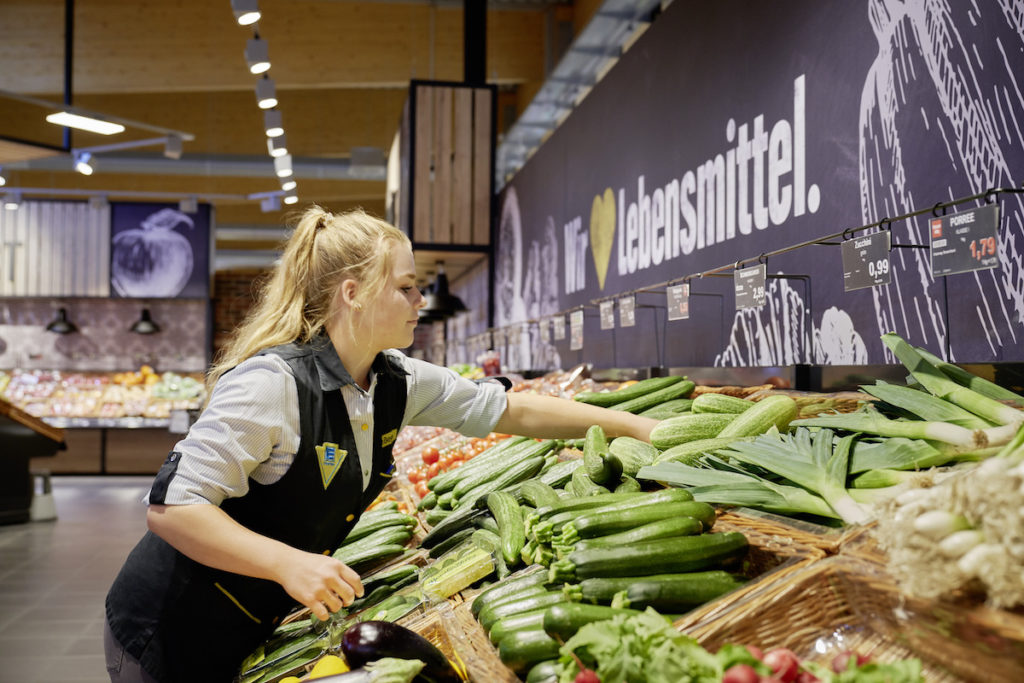
From now on, EDEKA will only offer all cucumbers unpackaged, thus saving 94 tonnes of plastic per year. Netto Marken-Discount will follow suit in mid-September, saving around 80 tonnes of plastic per year.
"Eliminating plastic packaging for cucumbers is a further step in the context of our Sustainability commitments to avoid plastic waste. We are actively working to continuously optimise our range and reduce packaging."
Christina Stylianou, Head of Corporate Communications at Netto Marken-Discount
Cardboard tray solutions for tomatoes
Tomatoes are also becoming increasingly popular in EDEKA stores. More often loose or in cardboard trays instead of plastic. However, the EDEKA Group is optimising all products with regard to their packaging, not only for fruit and vegetables, but across the entire own-brand range.
Here, too, Netto is following the competition and is now replacing its organic vine tomatoes with 2.2 million plastic trays with more environmentally friendly cardboard trays.

"We use three levers: Wherever possible, we do without plastic. At the same time, we promote Reusable solutions and, thirdly, increase the proportion of recycled materials. But we also want to raise awareness of the fact that every individual has a choice when shopping."
Markus MosaChairman of the Management Board of EDEKA Head Office
Under the Motto "unpacked" EDEKA is focussing on the topic of plastic packaging on all channels. By the end of September, the three EDEKA strategies Reduction, reuse and recycling presented using specific product examples.
Reducing plastic through alternatives
While Netto has the largest range of loose fruit and vegetable products in the discount sector, EDEKA is currently the leader in terms of Plastic quota in the fruit and vegetable departments concerns. And this rate will continue to fall:
With immediate effect, EDEKA Fruchtkontor, which supplies fruit and vegetables to retailers nationwide, will completely dispense with the Plastic filmwhich was previously used to shrink-wrap some of the cucumbers. EDEKA has also created facts for other high-turnover products:
For example, vine tomatoes alone produce 5.4 million plastic trays replaced by cardboard trays. Another example: the labelling of many types of fruit and vegetables with labels or laser printing (Smart branding) can be around Saving 50 tonnes of plastic per year.
Since 2017, Netto Marken-Discount has been selling first food retailer in Germany Fruit and vegetable products with this natural product label. This saves on organic ginger and organic cucumber alone 65 tonnes of plastic per year.
Pointing the way!

Both companies offer an environmentally friendly alternative to disposable plastic bags for fruit and vegetables and loose baked goods in the form of recyclable, washable reusable nets. In three and a half years, EDEKA has already used over 100 million conventional knot bags saved.
Netto & WWF: a strong partnership for more sustainability
Since 2015, together with the WWF, the aim has been to use all of Netto's own-brand products for to do without packaging or, where this is not possible, to reduce them better. recyclable or increasingly from recycled material.
[infotext icon] You can find more information on the two grocery shops' plastic reduction programme at http://www.edeka.de/weniger-plastik and http://www.netto-online.de/ueber-netto/Fuer-weniger-Plastik.chtm [/infotext]Source: EDEKA Zentrale AG & Co. KG and Netto Marken-Discount AG & Co. KG