Bosch connects factories for the future and generated sales of over 750 million euros with Industry 4.0 solutions in 2019 - an increase of 25 per cent compared to the previous year.
16 June 2020
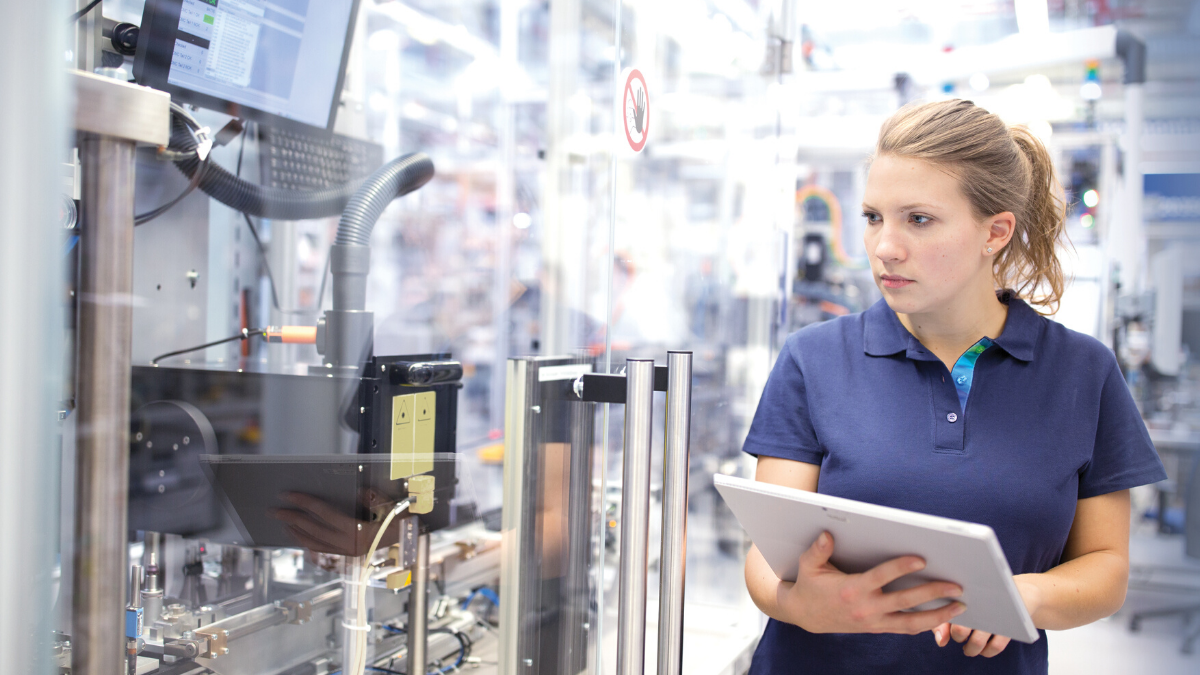
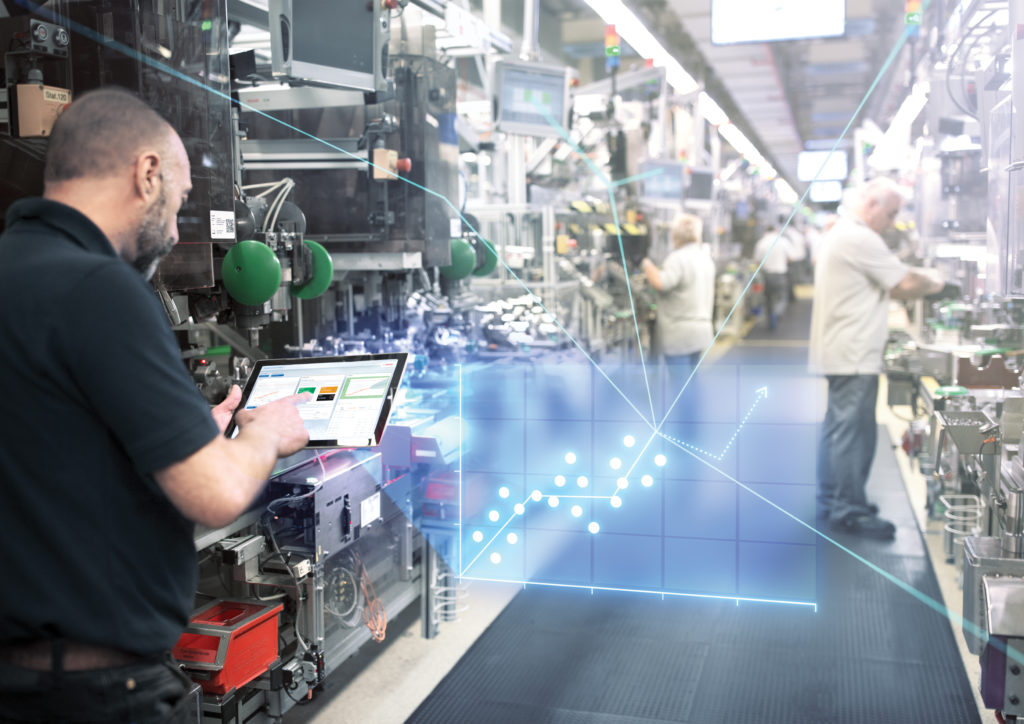
Intelligent production: networked solutions ensure transparency and flexibility in the factories as well as reliable operation. (Image: Bosch)
Bosch connects factories for the future and generated sales of over 750 million euros with Industry 4.0 solutions in 2019 - an increase of 25 per cent compared to the previous year.
Crises expose weaknesses. The corona pandemic reveals the The value of networked production and logistics. The Internet of Things (IoT) helps the industry to react more flexibly to failures than before, as the utilisation and status of each individual machine can be tracked in real time, and there is no need to worry about Transparency across the supply chain.
„Networking can make companies less vulnerable, especially in exceptional times like these, and help them to navigate safely through the crisis,“ says Bosch Board of Management member Rolf Najork, responsible for industrial technology.
In this way, shift handovers can be mastered digitally where physical proximity becomes a challenge due to the risk of infection. Systems and machines can be monitored and maintained remotely, without the need for a technician to be on site. Intelligent software tracks goods and transport from anywhere, ensures replenishment. All this is possible thanks to Industry 4.0. Networked solutions make production and logistics simpler, more efficient, more flexible - and at the same time more robust.
Bosch is an IoT pioneer. Since 2012, the company has been working on networking production and logistics - both in its own plants and in those of its customers. This is paying off. In 2019, Bosch generated over 750 million euros in sales with connected solutions for manufacturing and logistics - and growth of 25 per cent compared to the previous year.
Industry 4.0 boosts productivity in factories
In the factory of the future, only the floor, walls and ceiling are static and solid, Everything else is variable and flexible. Depending on requirements, the factory of the future is constantly reinventing itself. To manufacture thousands of different products and variants down to a batch size of one, without costly retrofitting of systems - that is the vision. To achieve this, Bosch is focussing on connectivity.
The projects bring progress and deliver measurable added value: With the help of Industry 4.0, it is possible to increase productivity at individual sites by up to 25 per cent.
Rolf Narjork, Member of the Board of Management of Robert Bosch GmbH and Chairman of the Board of Management of Bosch Rexroth AG (Image: Martin Stollberg/ Bosch)
„If you want to remain competitive, you have to network. Industry 4.0 is a historic opportunity. The potential is enormous. We not only improve the productivity of factories, but also enable companies to react quickly and adequately to changes.“ Rolf Narjork, Managing Director Bosch
An additional boost is promised by the Use of artificial intelligence. AI-based solutions for the predictive maintenance of machines, for quality control or to improve manufacturing processes are moving into focus. For example, AI is used in highly complex chip factories such as Bosch's in Reutlingen in the detailed planning of production in order to control the wafers through more than 500 processing steps in a time and cost-saving manner. This alone increases wafer throughput by five per cent, and the investment pays for itself after just three months.
From individual projects to comprehensive implementation
Six out of ten industrial companies with more than 100 employees in Germany are already using Industry 4.0 applications. This is the result of a recent study by the industry association Bitkom. However, in many cases these are still likely to be individual projects. According to estimates by the German Engineering Federation (VDMA) eight out of ten existing systems in Germany are waiting to be networked.
„We still have room for improvement in the industry. But we have the levers we can turn. Now it's a matter of bringing Industry 4.0 to the masses,“ says Najork.
Companies cite high investment costs as the biggest obstacle to the implementation of Industry 4.0 (Bitkom, 2020). In fact machines can also be retrofitted with communication technology and sensors. This can be a successful entry into the Industrial Internet of Things. As has already been Small investments in large systems Bosch Rexroth in Erbach, Germany, demonstrates how this can pay off: the plant there has spent a total of 25,000 euros on sensors and light barriers on production lines and achieved annual savings of around 200,000 euros.
Measurable added value: Industry 4.0 increases productivity at individual locations by up to 25 per cent. (Image: Bosch)
Combining economy and ecology with networked solutions
As a leading IoT company, Bosch has all the necessary Core competences to shape Industry 4.0. The portfolio includes software packages for maintenance, monitoring and logistics, robotic systems for production and transport, retrofit solutions for existing machines and assistance systems for employees.
Bosch is now launching a new Software-based, 5G-capable control technology, which is open for third-party applications. ctrlX Automation puts an end to „isolated solutions“ in the factories; over 30 data protocols can be utilised. The new control technology from Bosch Rexroth will become the control centre of the factory of the future.
With the further developed Nexeed Industrial Application System Bosch Connected Industry offers more than just „the app store for production and logistics“. The various software applications can be ordered, used and combined as required. All machine data is available in a standardised and clear format, ensuring greater transparency and efficiency in the factory.
How economy and ecology can be harmonised is illustrated by the Bosch Energy Platform. Once connected, it is possible to track, analyse and control the power consumption of each individual machine. The result: factories become more economical, require less energy and have lower CO2 emissions. Networking makes an important contribution on the road to climate-neutral production.