Thanks to their technical functional properties, printing inks make it possible to realise all three principles of the circular economy: reduce, reuse and recycle packaging.
28. June 2020
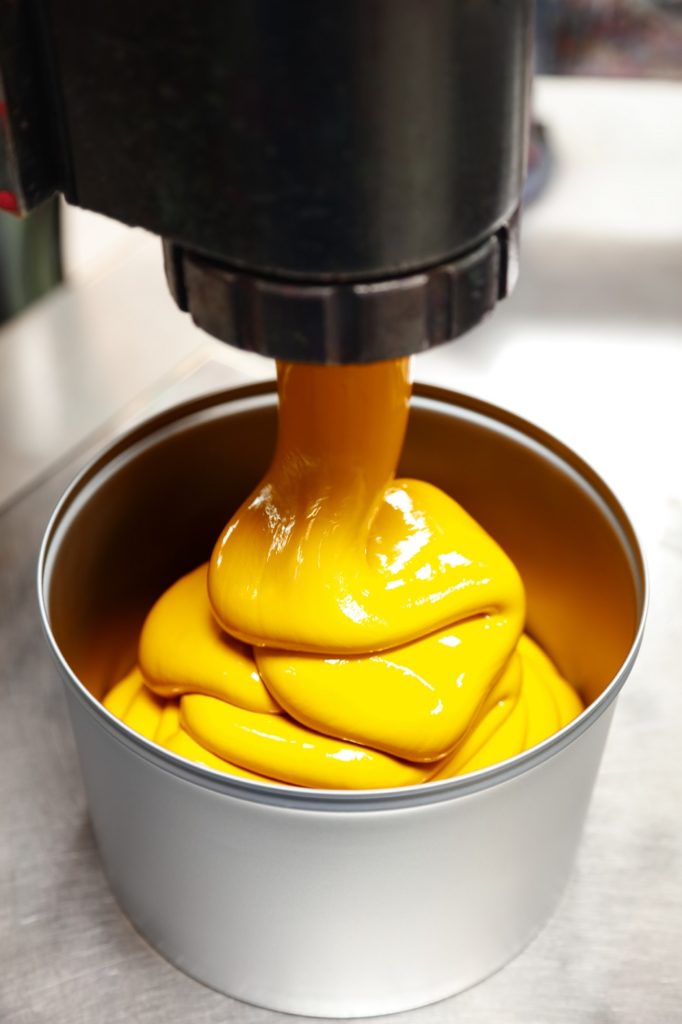
Printing inks and coatings make it possible to realise all three principles of the circular economy: reduce, reuse and recycle packaging. (Image: Siegwerk)
As one of the world's leading manufacturers of colour solutions for packaging printing, Siegwerk focuses on continuously improving the environmental footprint of its products and actively driving the transition to a circular packaging industry.
But what contribution can printing inks and coatings make to creating a circular economy? Firstly, their technical functional properties enable the realisation of all three principles of the circular economy: Reduce, reuse and recycle packaging. Alina Marm is Head of the Circular Economy Hub at Siegwerk responsible for driving the company's transition towards a circular economy:
(Image: Siegwerk)
„When switching from plastic to paper, but also from multi-plastic to mono plastic, printing inks and coatings help to maintain the necessary functionality of the packaging. Special sealing lacquers for processing the packaging and barrier lacquers to protect the packaged goods are key here.“ Alina Marm, Head of Circular Economy Hub at Siegwerk.
However, successful recycling is also the topic of deinking packaging The removal of paints and varnishes before the recycling process plays a key role in this. There is currently no established deinking infrastructure in Germany. This is a challenge for the entire industry. The Siegburg-based printing ink manufacturer is therefore already working with partners along the entire value chain on pilot projects for selected material flows and recycling technologies. .
Siegwerk paints are suitable for solvent-based recycling
Together with the Plastics recycling company APK this spring, for example, Siegwerk tested a series of LDPE film samples printed with the company's inks. The aim of the series of tests was to clarify whether the Siegwerk inks could be used with a solvent-based recycling process such as APK's Newcycling® technology can be removed from the polymer matrix.
„We consider the entire packaging life cycle, from design and production through to recycling. We are therefore delighted that Siegwerk's printing inks are clearly suitable for solvent-based recycling and that a much-discussed challenge for the recycling of flexible packaging has been overcome.“ Ralf Leineweber, Head of Global Technology Development at Siegwerk.
In addition, Siegwerk also uses its expertise for deinking in today's established mechanical recycling processes in order to significantly improve recyclate quality.
Design 4 Less & Design 4 Recycling
„Every recyclable packaging application places different demands on printing inks and coatings, and we see the need to utilise all the levers of the circular economy,“ says Alina Marm. Design 4 Lesssolutions allow packaging elements to be omitted, make the switch to reusable systems attractive and avoid the use of non-renewable raw materials.
For reusable systems, for example, a high level of colour stability can be used to reuse packaging by ensuring that the packaging design remains intact over several usage cycles. At the same time, there may be other packaging information, such as the best-before date, which must be removed and reapplied after each cycle.
Siegwerk also supports increasing the proportion of renewable raw materials in the packaging. With the Colour series UNIBio for example, the company offers water-based printing inks that achieve a proportion of renewable raw materials of almost 80 per cent. They are already being successfully printed on cups and fast food packaging.
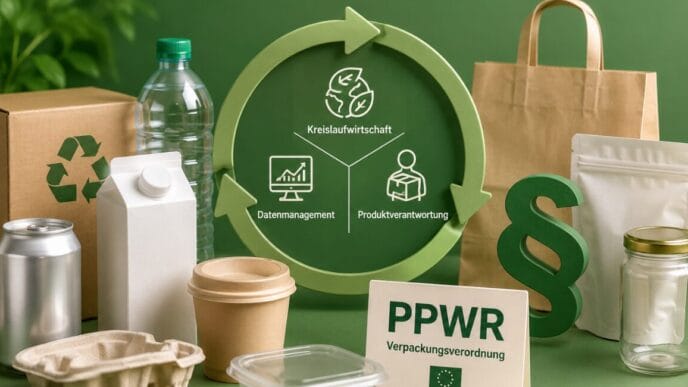
Every recyclable packaging application places different demands on printing inks and coatings. (Image: Siegwerk)
Design 4 Recycling-In turn, the aim of these solutions is to increase the recyclability of packaging. These include PVC-free ink and coating solutions, surface printing solutions for monoplastic packaging and UV/LED offset inks with good deinking properties for paper.
The central theme in Siegwerk's development work is Barrier coatings for recyclable paper and monoplastic packaging. „In combination with colour systems, we see enormous potential for paper packaging to make a significant contribution to recyclability.“ The continuous increase in the proportion of renewable raw materials in colour and coating systems also contributes to this.
However, the company considers solutions that enable packaging to be composted to be a niche solution. This usually requires an infrastructure for industrial composting. „That's why we talk to our customers about suitable applications, for example for our water- and solvent-based colour solutions that are compostable in accordance with DIN EN 13432. If used correctly, composting can be a building block towards a circular packaging strategy.“
Working together towards a circular economy
„For us, the focus is always Product and consumer safety of packaging is our top priority. We want to enable packaging that is safe for its intended use and at the same time fulfils the requirement for recyclability. That's why we always adapt our colour and coating solutions individually to customer-specific requirements,“ Alina Marm continues.
In line with this approach, Siegwerk has already developed a large number of customised development projects for packaging solutions, which follow the closed-loop model. Newly developed PVC-free paints and varnishes with improved chemical and mechanical resistance has been successfully used for mono-material packaging. New Nitrocellulose (NC) colours were used for a detergent stand-up pouch. This represents a completely new, modular Packaging structure made from monomaterial and has good recyclability.
„In addition to innovations, a sustainable, circular packaging industry also requires above all new forms of collaboration along the entire value chain,“ concludes Alina Marm. „For this reason, we are contributing our expertise in the field of printing inks to various industry initiatives, such as CEFLEX and the Circular Economy Initiative Deutschland (CEID). Here, we exchange ideas with experts from other areas and pool expertise along the value chain.“