Sometimes you have to turn things upside down to find the best solution. This is exactly what the Saarland distillery Eckerts experienced when it came to packaging its spirits more gently. Automation specialist Project A&E designed and implemented an "overhead solution" to protect the tax seals.
A small piece of torn paper - should something like that cause a beverage manufacturer really big problems? With the Distillery Eckerts from Tholey in the Saarland. Year after year, tens of thousands of euros were lost. The reason: bottles with tax stamps were Damaged by tulip gripper and could no longer be sold. They became rejects, as foreign food chains labelled spirits exclusively with a perfect tax seal The fact is that, unlike in Germany, such tax seals are mandatory in some countries. Manually checking every seal on every bottle was also highly inefficient.
"Eckerts has been around since 1890 and stands for quality. The follow-up costs due to the damage were enormous. We needed a special solution without a tulip grab but with a high nominal capacity," emphasises Tobias Erb, operations manager, authorised signatory and member of the management board. The family business is now in its fifth generation of distilling:
The product range extends from classic herbal schnapps and liqueurs to modern trendy drinks and fine brandies that are stored for years in barrique, sherry or oak barrels.

Overhead packaging solution without touching the tax seal
Tobias Erb immediately had the Project A&E from Kranenburg in North Rhine-Westphalia in mind when it came to the new concept: "As a company that has grown over the years, we have a lot to offer. No room for bulky standard solutions. There is also the threat of enormous additional costs, as adjustments have to be made afterwards. With customised solutions from Team Jansen, on the other hand, we have planning security: in terms of time, quality and budget."
Customised solutions are indeed the domain of Johannes Jansen, Managing Director of Project A&E. Together with his partner Stefan Opgenorth and more than 90 employees, he develops customised machines for customers in Germany and abroad. "For Eckerts, we have a Overhead packaging solution constructed. First, the bottles are grouped into six. Then the carton is placed over the bottles from above," reports Jansen proudly. "Our Propac 2400 machine achieves an output of over 14,000 bottles per hour at Eckerts. In order to deliver this output, we also developed a Carton erector with a cycle output of 40 cartons per minute."
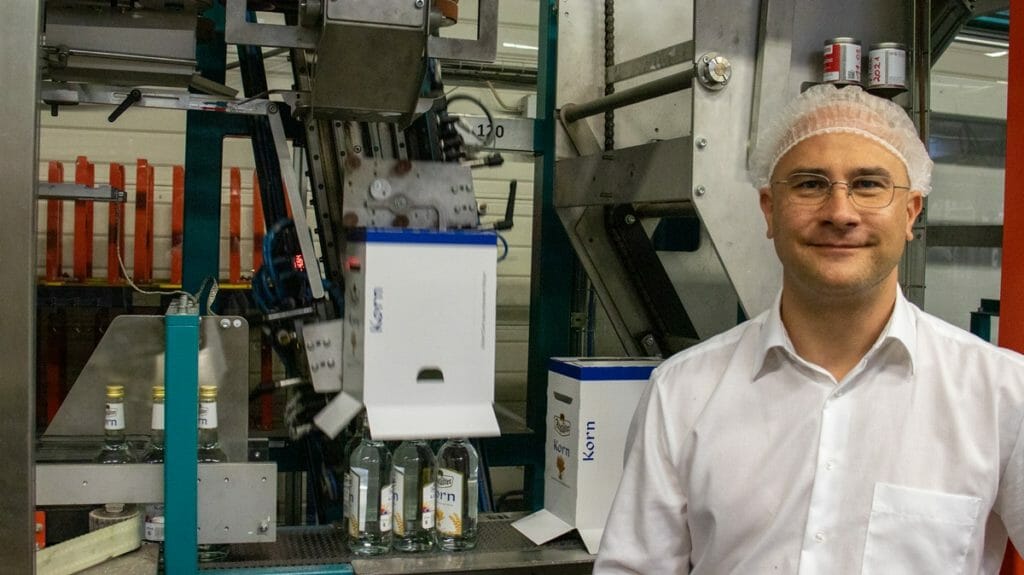
This special erector was necessary, adds Tobias Erb, as otherwise two standard machines would have had to be purchased. Other options such as the "wrap around system" were not in demand. "Because we wanted to stick with already glued cardboard blanks that only needed to be closed at the top and bottom."
Closing the cartons from below in throughfeed
The Kranenburgers were confronted with many technical challenges. How do I group the bottles into packs of six? How do you transport a carton that is only closed at the top but open at the bottom? How can the carton and bottles be sealed from below during the ongoing process?
The 32-year-old Ingo Rathmann is a design manager and a native of Project A&E GmbH. He had already worked as a trainee for the automation specialist ten years ago. The company from North Rhine-Westphalia specialises in sophisticated packaging solutions that often involve very individual customer circumstances This expertise is in demand in the beverage, food and hygiene industries, among others.
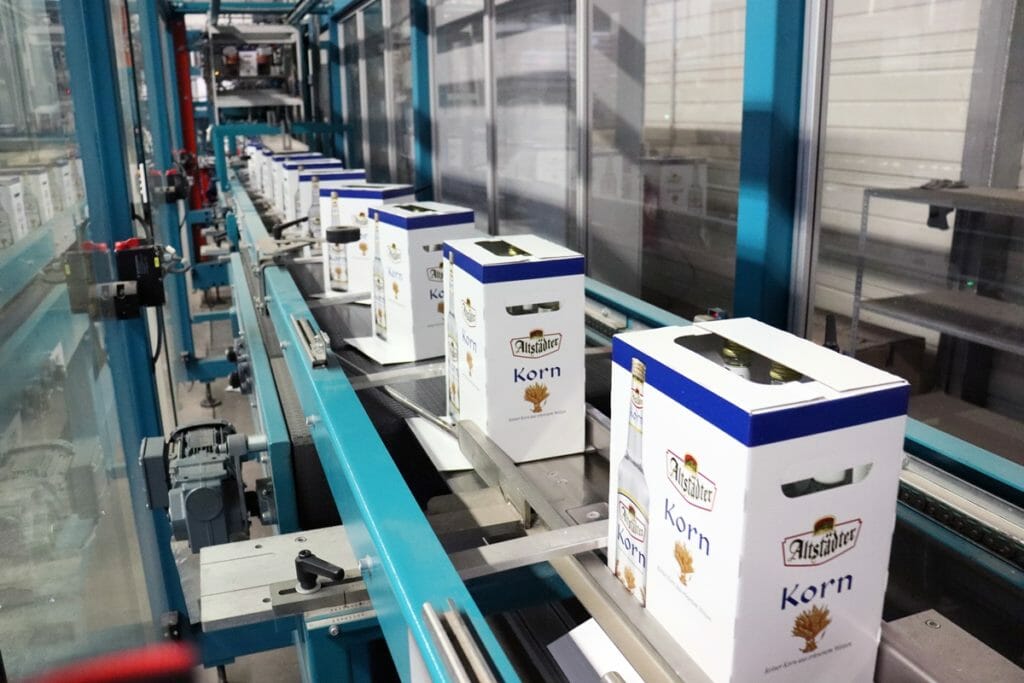
As design manager for the Eckerts project, Rathmann can explain the processes: "The biggest challenge was continuously - i.e. without stopping - to close the carton under the bottles. It now only moves over a kind of 'metal strip' that is narrower than the carton. This allows the flap to be folded under the products. There is a small gap at the end of the metal strips where the flap is placed under the bottles."
Special process of soil prefolding
However, a special bottom pre-folding process was necessary for this overhead packaging solution: "The bottom flaps, which normally always stand straight down, first had to be folded inwards. 90 degrees to the side 'pre-folded' so that the carton can later be placed far enough over the bottles." This process takes place in the upper part of the machine.
Rathmann explains what happens in the lower part of the machine: "At the bottom, we have to form the bottles that come out of the bottle stream into packs of six and get them under the carton. To do this, we use a combination of two processes: firstly, the single-stroke stars, which ensure that six products are always separated from the next group of six at a certain distance. Then we push the products together with so-called carriers so that we then have a free-standing pack of six bottles. While the products are transported on the conveyor belt, the cartons are placed over the bottles." Now the special process begins, in which the cartons that have already been sealed at the top are now also sealed from below.
Ingo Rathmann's enthusiasm for his job is clear to see: "Our customers give us so many opportunities. Challenging and diverse projects", he says. A bottling line for up to 2,000 bottles per hour, which combines a bottle rinser and a contactless filler without any format parts, was also "super exciting". Where was this realised? At Eckerts in Tholey, at the request of Tobias Erb.