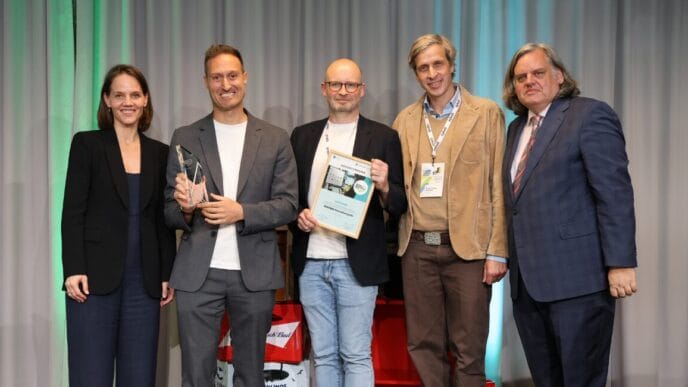
Once again, our packaging journal TV live focussed on sustainability. In the second round, we continued the discussion with Dr Stefan Kunerth, Technical Operations Director Western Europe at the Coca-Cola Company, Martin Sauter, Head of Sales at Gerhard Schubert GmbH, and packaging consultant Carolina Schweig. This time, the focus was on beverage packaging.
17 May 2022
Once again, our packaging journal TV live focussed on sustainability. In the second round of the live talk, we continued the discussion with Dr Stefan Kunerth, Technical Operations Director Western Europe at the Coca-Cola Company, Martin Sauter, Head of Sales at Gerhard Schubert GmbH, and packaging consultant Carolina Schweig. This time, the focus was on beverage packaging.
The drinks of the Coca-Cola Company are offered in a variety of different containers: made of glass or recycled PET, as reusable or disposable bottles, in many sizes and with different levels of labelling. Packaging plays an important role in the beverage group's sustainability strategy.
New bottle made from 100 per cent recycled PET for the classic. (Image: Coca-Cola)
„For us, sustainability means, above all, that we use the keep packaging placed on the market in circulation“, says Stefan Kunerth, who took over the newly created position of Technical Operations Director Western Europe in April and is therefore responsible for 13 countries - including Germany, the UK and France. „This means that either they are refilled as often as possible as reusable bottles, or they are recyclable as disposable packaging and can be collected and returned.“
All brands are to be converted to rPET
The ambitious goal for disposable bottles: All brands are to switch to recycled PET. The first three brands will do so this year. „The Vio brand is just the beginning of our journey towards 100 per cent rPET.“ However, rPET has already been used in bottles for years and the proportion has been gradually increased. At the end of 2021, the share of recycled material in PET returnable bottles in Germany is already around 70 per cent.
Regardless of whether disposable or reusable: 99.9 per cent of the Coca-Cola bottles and cans placed on the market are labelled.„In Germany, 97 per cent of our deposit containers are returned and recycled. This puts us in a very good position compared to the rest of Europe,“ says Kunerth.
An important aspect of packaging design is the Optimisation of packaging weights. It's not just PET bottles that have been made of less material in recent years; there are now also ways to make glass lighter and yet more robust. „We are working a lot on the topic of material savings. But if I save too much material and a reusable bottle no longer achieves the desired number of rotations, then the effect in terms of sustainability is lost.“
Consumers must value sustainability
Carolina Schweig takes a critical view of the sustainability strategy. „The question is, what does Coca-Cola stand for and how is this broken down to packaging level? It's not about the paper bottle on the one hand and the plant bottle on the other, about recyclate or reusable packaging that may not have the necessary circulation time. It would be better to think it through from the top and say: we want to reduce greenhouse gases with the sustainability strategy. Then the solutions are clearer, also for the market. When we talk about sustainability, we are talking about an economic principle. So it's about building sustainable business skills that will still work in 20 years“ time." It is important that all sustainability measures are so efficient that consumers understand, recognise and appreciate them when they make a purchase.
(Image: Wolf Lux)
„We are active in a wide variety of areas, and it's not just about packaging, but also about products. We already have clear action plans in all areas, which we have defined globally and which we are also breaking down locally. Of course, there are different approaches that we are pursuing and trying out. But it is the responsibility of every manufacturer to do just that. We make it very clear what we stand for: Through the topic of packaging, we are trying to minimise the negative impact on the climate, CO2-emissions, but also to reduce water consumption and the use of resources. This includes increasing the proportion of recycled PET, but also investing in our reusable system.“ Stefan Kunerth
Increase turnaround times
The turnaround times in reusable systems need to be increased, says Carolina Schweig: „This is also about efficiency and the question: Why am I investing energy and time in improving single-use packaging just to increase recycling a little, when much greater efficiency could be achieved with the same effort in the reusable sector?“
For the beverage group, both systems - Disposable and reusable - their raison d'être. It is therefore the order of the day, optimise both systems, says Stefan Kunerth. „For example, we are investing considerable sums - around 150 million euros in the last two years - in our returnable systems and have launched new one-litre and now also 0.4-litre returnable glass containers on the market. And with a Reusable quota of over 35 per cent in our portfolio, we have nothing to hide in the non-alcoholic soft drinks market in Germany.“
Optimise packaging processes, save material
Sustainability is also a key issue at the company Gerhard Schubert. „The sustainability debate today is predominantly a discussion about materials,“ says Sales Director Martin Sauter. „For us, however, it's about the Flexibility in the packaging process, The materials used naturally also play a major role in this. However, in addition to the material, we are focussing on sustainable, intelligent packaging processes and in particular on packaging design. It's not enough to simply change the material from plastic to cardboard.“
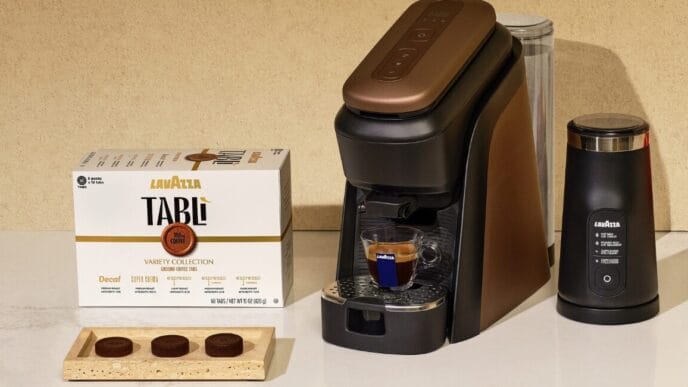
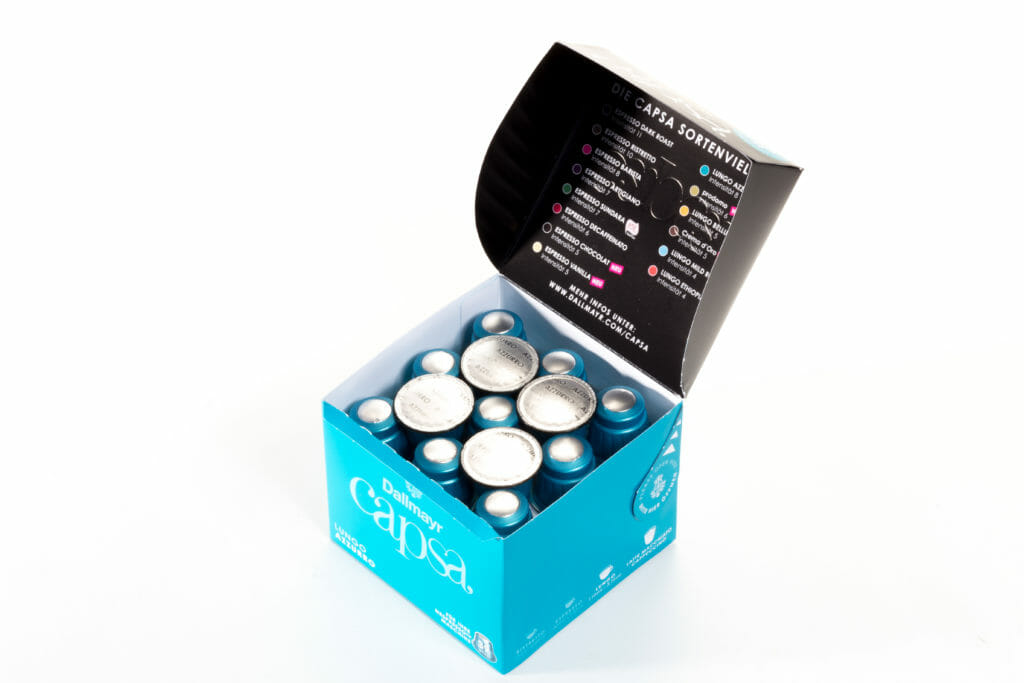
Schubert also develops material-saving solutions for coffee capsules. (Image: Gerhard Schubert GmbH)
Take packaging size, for example: Sustainable packaging that uses less material is in demand. But saving often also means making packaging smaller.
„As the distribution channel today is still primarily the stationary trade, manufacturers naturally want to attract attention at the point of sale, so a certain pack size in relation to the product and also the price plays a major role. One of our customers packs its milk portion packs in a carton in a disorganised manner. The pouring process requires a certain pack size so that the process can be automated. We have now developed a variant in which a predetermined order from the filling process is maintained in the packaging process through automation. This means that the same content fits into packaging that is 40 per cent smaller.“ Martin Sauter
Schubert has optimised the packaging for coffee capsules for another customer. „We developed a box with a resealing mechanism for a nested format for 16 capsules, which volume reduced by 20 per cent could be used. On the shelf, it still plays to its advantage thanks to its greater height. So you don't necessarily have to lose attention at the point of sale with smaller packaging.“
More self-confidence in communication
Reducing material and transport volumes is definitely the right way to go, says the Packaging consultant.
(Image: C.E.Schweig)
„This is in the spirit of the circular economy and should be done and communicated more often. For example, the closures on cosmetics packaging are often significantly larger than they need to be to be functional. If you save material on the closure, you should communicate this and emphasise sustainability. This can definitely be a unique selling point. So: don't just talk about doing without, but communicate a new, more sustainable design with pride.“ Carolina Schweig
Schubert is already on the right track with its sustainability strategy, according to Carolina Schweig. „There is a Genuine rethinking of packaging instead. For online retail, for example, you can then get genuinely sustainable shipping packaging that doesn't require the packaging of the packaging.“
Unpackaged and refill systems are popular
Refill systems, which are becoming increasingly popular, promise new experiences at the point of sale. Rice, pasta or even cleaning products can be filled by consumers themselves. But it's not yet possible to tap Coca-Cola with a reusable bottle, is it?
„With our new freestyle technology customers can actually mix their own personalised drink from concentrates at a vending machine. The cups are still available from vending machines, but tests are already underway in the UK with refillable bottles that customers bring with them. The packaging-free presentation of our products is therefore already part of our business today.“
Prototype paper bottle: an experiment
In the discussion about sustainability and the substitution of plastic, there is currently no getting round the topic of paper bottles in the drinks sector. Coca-Cola is also trialling them. However, anyone who believes that Coke and co. will be available in paper bottles everywhere in the future is likely to be disappointed. Stefan Kunerth: „Our paper bottle is a prototype, and we are only shedding light on another facet of how drinks could be packaged. Although the paper comes from sustainable resources, an inner layer of plastic is currently still required. It's just a development step with which we are testing the possibilities that could open up with this type of packaging material. The first market test on a very small scale should show whether such a concept is accepted by consumers and works at all in the supply chain. We will continue to work on this and see whether this type of packaging might be suitable for other types of beverage in the future and also fulfil our requirements in terms of sustainability and CO2-emissions, water consumption and sustainable sourcing of raw materials like our other packaging. But at the moment we say: It could be a way."
It was only because big players like Coca-Cola were able to drive innovation that the rPET bottle or refillable PET bottle was ultimately made marketable. Today, many others use this technology. Stefan Kunerth: „We have this responsibility and also the obligation to try out new things, For us, this is also part of our sustainability strategy: developing new things, seeing whether they work and being transparent about them.“






„As the distribution channel today is still primarily the stationary trade, manufacturers naturally want to attract attention at the point of sale, so a certain pack size in relation to the product and also the price plays a major role. One of our customers packs its milk portion packs in a carton in a disorganised manner. The pouring process requires a certain pack size so that the process can be automated. We have now developed a variant in which a predetermined order from the filling process is maintained in the packaging process through automation. This means that the same content fits into packaging that is 40 per cent smaller.“ Martin Sauter