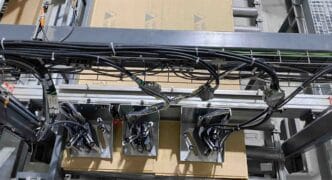
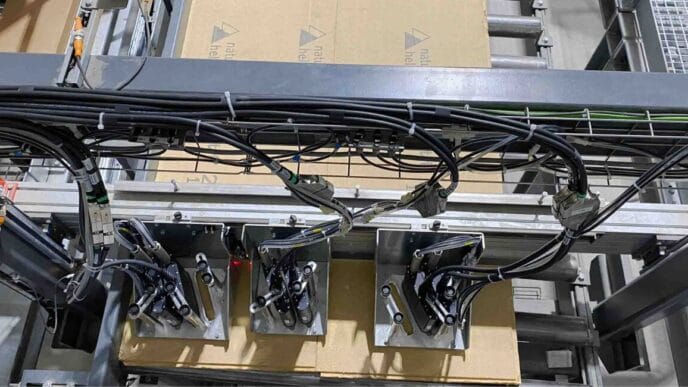
High motion dynamics and flexibility are the success factors of modern machine concepts. This is where a wireless communication infrastructure can provide the basis for implementing innovative machine designs and optimised production processes: IO-Link wireless technology enables real-time control of machines and continuous wireless data acquisition from hundreds of sensors and actuators within a machine area.
Modern, high-performance systems are expected to allow for quick product changes, changes to processes or production steps, adapt to changes in production volumes and at the same time impress with low downtimes. A Increasing production efficiency with consistently high process and product quality is therefore crucial to a company's competitive success. The use of forward-looking and sustainable technologies is increasingly becoming an additional indicator of a company's success.
High-performance wireless communication
The triumphant advance of IO-Link technology, which began twelve years ago, can also be categorised in this way. With IO-Link, the first standardised I/O technology was developed worldwide that enables Bidirectional communication between the sensors/actuators and the control level is possible. The success is also based on the simple wiring of the sensors and actuators with a standard cable.

The IO-Link wireless specification was published by the IO-Link consortium as an extension of the IO-Link standard (IEC 61131-9) at HMI, Hannover Messe Industrie, in March 2018. The high-availability, wireless communication solution is designed for high-performance applications and fast movements.
This is because wired communication solutions reveal their limitations in many motion control solutions. Not only can unplanned downtime occur due to maintenance work, but wired solutions also do not offer the full flexibility and agility required for many automation solutions. IO-Link Wireless enables the Seamless and manufacturer-independent connection the sensor/actuator field level with the automation system level in a machine: sensors and actuators now communicate wirelessly with the fieldbus masters. Maintenance-prone data cables are no longer required, and completely new applications become possible.
The company Coretigo with headquarters in Netanya, Israel has played a key role in the specification of the IO-Link wireless standard and specialises in the development of IO-Link wireless components, devices and complete solutions. Eran Zigmann, CEO and co-founder of Coretigo, is convinced that wireless IO-Link radio technology will prove to be a key technology in factory automation and for flexible communication in the machine. „We see a great potential for industrial applicationsn, as secure, highly available, deterministic, standardised and interoperable communication contributes significantly to the flexibility, modularity, cost efficiency and adaptability of a machine or system,“ says Zigmann.
IO-Link wireless in packaging machines
This is how the Belgian Mechanical engineering company Cloostermans-Huwaert from Hamme has been developing solutions for state-of-the-art and adaptive packaging machines together with Cortigo since 2019. The Belgian company specialises in customised and turnkey project solutions. The Belgian Anheuser-Busch InBev brewery group has recently started using IO-Link wireless technology. Its integration into production now allows for increased agility, flexibility and modularity, which were previously unattainable with fast-moving and rotating machine components that require real-time control and monitoring. IO-Link Wireless proves itself here as Particularly suitable for the construction of linear transfer systems, where cables previously restricted the movements of grippers and vacuum pumps, for example.
But what about reliability in practical use? Martin Reich, Director Business Development for the DACH region at Coretigo, explains that IO-Link Wireless was designed specifically for use in machines that are operated in harsh production environments.
„Our IO-Link wireless solutions guarantee the reliability of wired communication. It is a million times more reliable than conventional wireless systems such as Wi-Fi or Bluetooth. IO-Link Wireless is specified for deterministic applications in the control segment and has a typical wireless range of twenty metres for control applications, with a latency of five milliseconds between the IO-Link Wireless Master and the field devices. For data collection applications with higher latency times, a wireless range of over 100 metres is achievable,“ says Reich.
In addition, the IO-Link wireless system solutions provide the designer with a multitude of new degrees of freedom in machine and system construction.
From wired to wireless in 30 seconds
To ensure a rapid market launch of IO-Link Wireless, Coretigo has developed the TigoBridge developed. It can be used to convert all IO-Link devices available on the market into a wireless device in just a few seconds,“ explains Martin Reich. To do this, the TigoBridge is connected to the IO-Link device port of a sensor or actuator. To power the IO-Link device, the open end of the bridge is connected to a 24-volt power supply. The bridge can now be connected to a master (pairing). After pairing, the bridge behaves transparently for the user or programmer so that there is no difference in the control system between wired or wireless IO-Link devices.
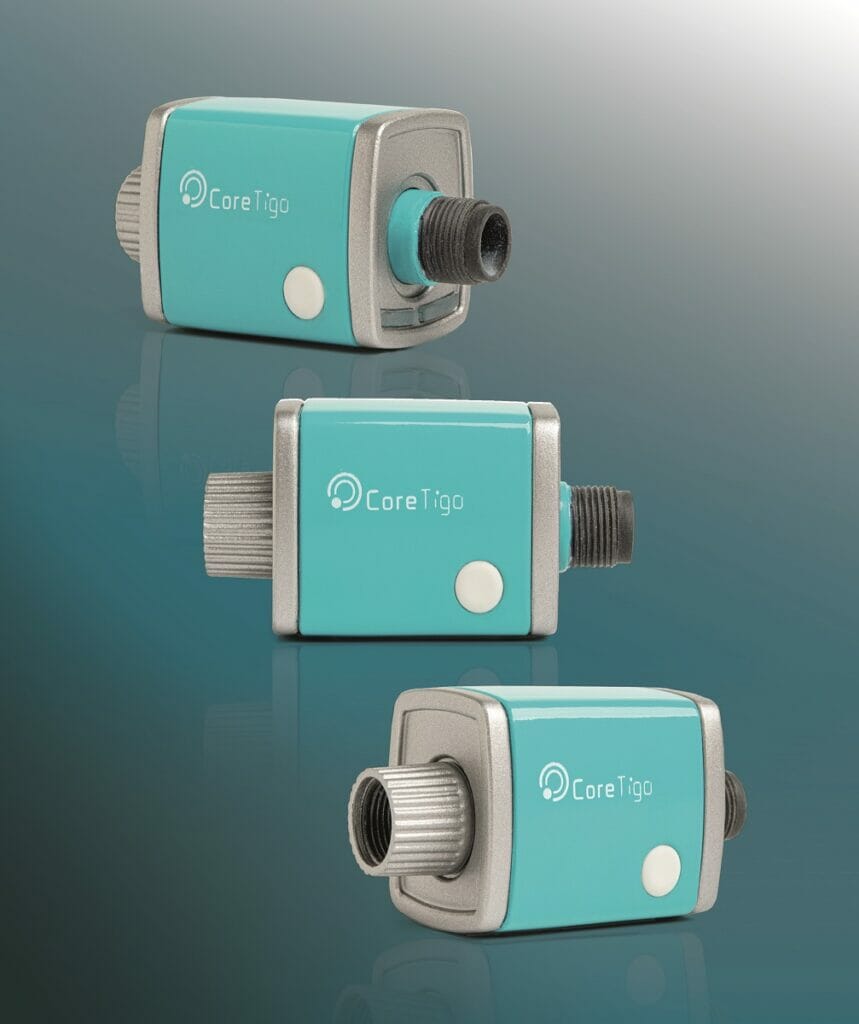
„With the TigoBridge, we can convert all IO-Link sensors and actuators available on the market, as well as conventional digital or analogue sensors and actuators, into an IO-Link wireless device in just a few minutes using an IO-Link hub. The number of sensors is virtually unlimited, as the IO-Link wireless topology can be expanded modularly within the machine, system and factory,“ explains Martin Reich. This means that existing systems can be retrofitted or converted, e.g. to collect data in order to obtain a continuous overview of the system status. This is particularly important for the Preventive maintenance This is important in terms of the availability of the systems due to predictable maintenance intervals.
„Linear transfer systems with independently travelling product carriers are a key element in the design of new machines, such as packaging machines,“ adds Martin Reich. Until now, integrated functions on these product carriers have been limited as they do not support real-time communication with the sensors and actuators.
„Goods carriers equipped with IO-Link Wireless receive their control tasks and specifications for adapting the production processes from the central PLC during operation. Stopping for individual assembly steps, machine changeovers, setups and conversions is no longer necessary. Our customers are already using the standard systems available on the market for the continuous power supply of the product carriers,“ comments Martin Reich. And he summarises: „Here, two complementary technologies complement each other to form a new system solution."
Guest author Inge Kamenz is Head of Public Relations DACH at Coretigo