Linerless and ecolabelling for a better eco-balance
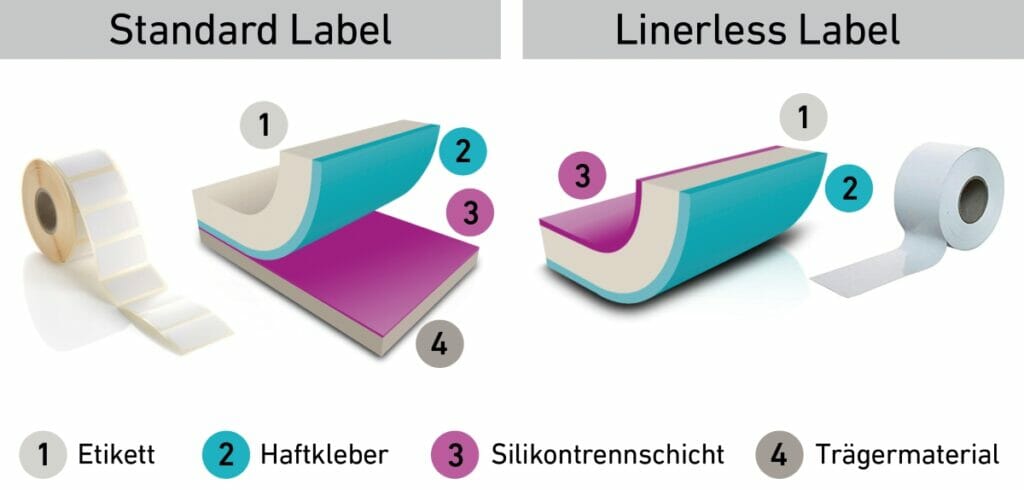
The new linerless labelling technology from Logopak completely eliminates the need for separator material between the rolled-up label webs. This not only saves waste, but also enables cost savings of around ten per cent.
29 October 2021
With its WoldoClean brand, the company Woldoshop relies on eco-labelling to underline the ecological focus of its products. (Image: Woldoshop)
The new linerless labelling technology from Logopak completely eliminates the need for separator material between the rolled-up label webs. The benefits: less waste, more efficient and flexible labelling processes, reduction of CO2 in production, logistics and disposal as well as cost savings of around ten per cent.
If you want to make industrial labelling processes consistently sustainable, you can use Eco-labelling solutions improve its eco-balance in an efficient way. The paradigm shift in labelling technology that goes hand in hand with the new, fully automatic Logomatic 410 Linerless eco-labeller, for example, is largely based on a joint development by Evonik and Logopak. The two companies have jointly developed the special Tego RC 730 silicone coating for the top side of the linerless label material. It guarantees a Reliable and trouble-free dispensing of labels. This in turn makes it possible to completely dispense with the previously required separating carrier material.
Thanks to the special silicone coating for the top of the label, the previously required release liner can be completely dispensed with. (Image: Logopak Systeme)
Complex savings potential
The calculation for eco-labelling sounds simple. But there is much more to the equation. It is one thing that eco-labelling eliminates the need for the full length of backing material and does not require costly disposal. The other is that at the same time Length per roll up to 60 per cent longer is. This means that the rolls can be changed at longer intervals. In addition, the user also has to procure fewer label rolls for a certain labelling volume.
The example of e-commerce illustrates the advantages. In Germany alone, online retailers send over one billion parcels a year, and the trend is rising. Linerless labelling can save several hundred lorry transports in procurement and replenishment logistics thanks to the longer running length and labelling capacity per roll alone. At the same time, linerless labelling avoids over 1,000 tonnes of waste and almost 5,000 tonnes of CO2 in the production, recycling and incineration of carrier material.
(Image: Logopak Systeme)
„The production of linerless labels is currently the fastest growing market segment in the industry.“ Steffan Gold, Managing Director Logopak Systems
The example of e-commerce illustrates the advantages. In Germany alone, e-commerce sends over one billion parcels a year, and the trend is rising. One Waste-free labelling can save several hundred lorry journeys in procurement and replenishment logistics thanks to the greater length and labelling capacity per roll alone. At the same time, linerless labelling avoids over 1,000 tonnes of waste and almost 5,000 tonnes of CO2 in the production, recycling and incineration of carrier material.
The first industry to implement linerless labelling solutions with Logopak years ago was the beverage industry, followed by the pharmaceutical and paper industries. During this time, a high level of expertise in carton, packaging, small consignment and pallet labelling was developed. The company brought this expertise to the development of the new silicone coating with.
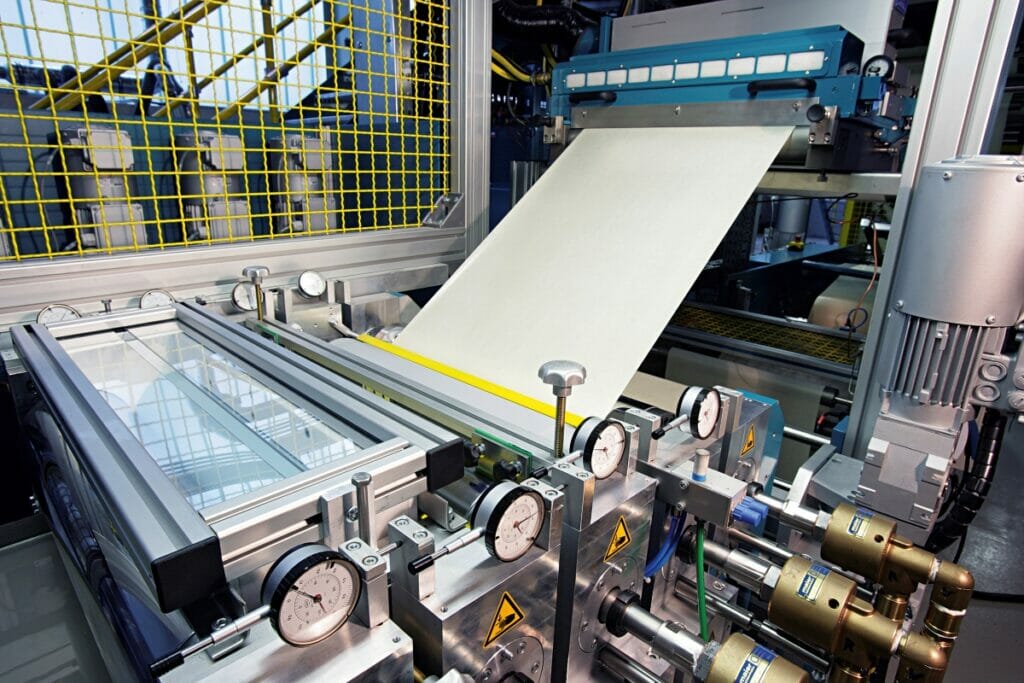
Silicone coating and UV curing on thermal paper replace the release liner. (Image: Logopak Systeme)
As an essential ingredient in a three-component release coating mixture, the barrier properties of the special acrylate enable the Use of non-precoated thermal papers in linerless applications. While the solvent-free release coating allows very good printing results with the required barcode readability, it offers very stable release properties over time and optimum compatibility with the pressure-sensitive adhesive of the linerless labels.
Benchmark for linerless labelling
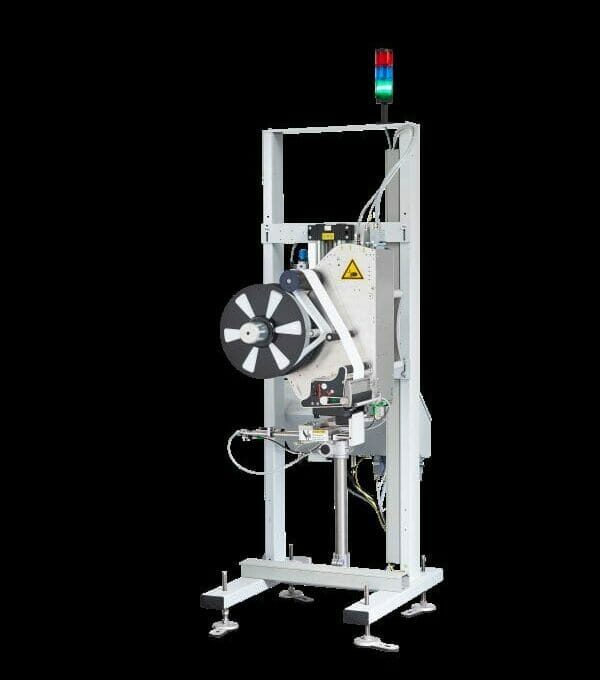
With the Logomatic 410 Linerless, Logopak has mastered a number of technical challenges. The labelling system, which was initially developed for labelling secondary and shipping packaging, has a print engine as a quick-change system with a completely redesigned cutting unit. It is the first of its kind to be open at the side and further simplifies the operation of the labelling system. Another key function is the print head roller. A new rubber compound has been developed for this, which enables reliable machine handling of the linerless labels. Customers can also change the print roller on this print head quickly and easily themselves if required.
The fully automatic Logomatic 410 Linerless labelling system from Logopak (Image: Logopak Systeme)
The Linerless technology from Logopak enables a new level of flexibility in labelling without any loss of speed. The Logomatic 410 Linerless can be used to cut labels with label widths of up to 105 millimetres and a media run length of up to 1,000 metres to exactly the length required for labelling the product and specified by the print job.
Arrived in many industries
Although still relatively new, the latest eco-labelling technology with the Logomatic 410 Linerless labelling system has already made a name for itself in the Food industry and in Distribution and dispatch centres successfully gained a foothold. A leading German wholesaler for sanitary and building technology relies on this solution, as does an online retailer for mountain sports equipment. A well-known brand manufacturer that offers and sells items for everyday household needs as well as for the catering trade and bulk consumers also relies on eco-labelling.
Another online retailer for cleaning agents, care products and hygiene products under the WoldoClean brand, Woldoshop, has opted for the Eco-labelling especially as Logopak's systems emphasise the ecologically oriented image of the company and its products. The same applies to a medium-sized German chocolate manufacturer whose cocoa and raw material procurement is sustainability-certified, which operates climate-neutral chocolate production and supports partners in countries in the southern hemisphere as part of verified climate protection projects. Its packaging is 90 per cent plastic-free and 45 per cent of the film material used is based on renewable raw materials and is biodegradable.