The trade magazine for the packaging industry
1,000 tonnes of grain are ground every day in Switzerland's largest mill. To turn flour, semolina and flakes into muesli, bread or soups, Swissmill's products need to reach the customer safely. Since switching to an adhesive system, the mill only needs a quarter of the wrapping film previously used for its pallets - and saves time. A practical report.
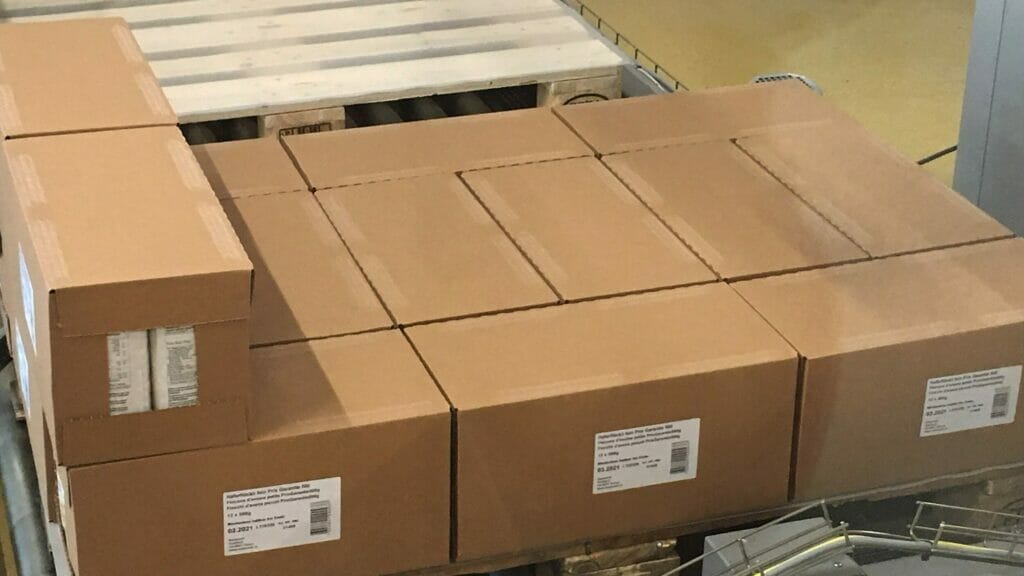
Some mills grind slowly. The one at Swissmill never comes to rest. From morning to night, the oat and hulling mill produces flours, semolina and flakes, which are then turned into cereals, soups and baked goods. Over 200,000 tonnes of grain are ground into more than 100 different products at the company headquarters in Zurich.Erwin Waldvogel, manager of the oat and hulling mill at SwissmillThe company specialises in the professional production and packaging of cereal flakes. On its packaging line, the flakes are filled into 500 gram film bags for private labels and packed in 12-packs in a secondary carton. At the end of the line, a palletising robot stacks 84 cartons in seven layers crosswise onto a pallet.
They now often no longer have to go to the nappy-changing station, which is a little further away.
Like many other companies, until last year the mill in Zurich only used wrapping film to safely stabilise its pallets for transport by truck or rail. Since Swissmill introduced pallet stabilisation from Robatech the wrapping station remains unused in three out of four cases, because the use of the film could actually be reduced by 75 %.

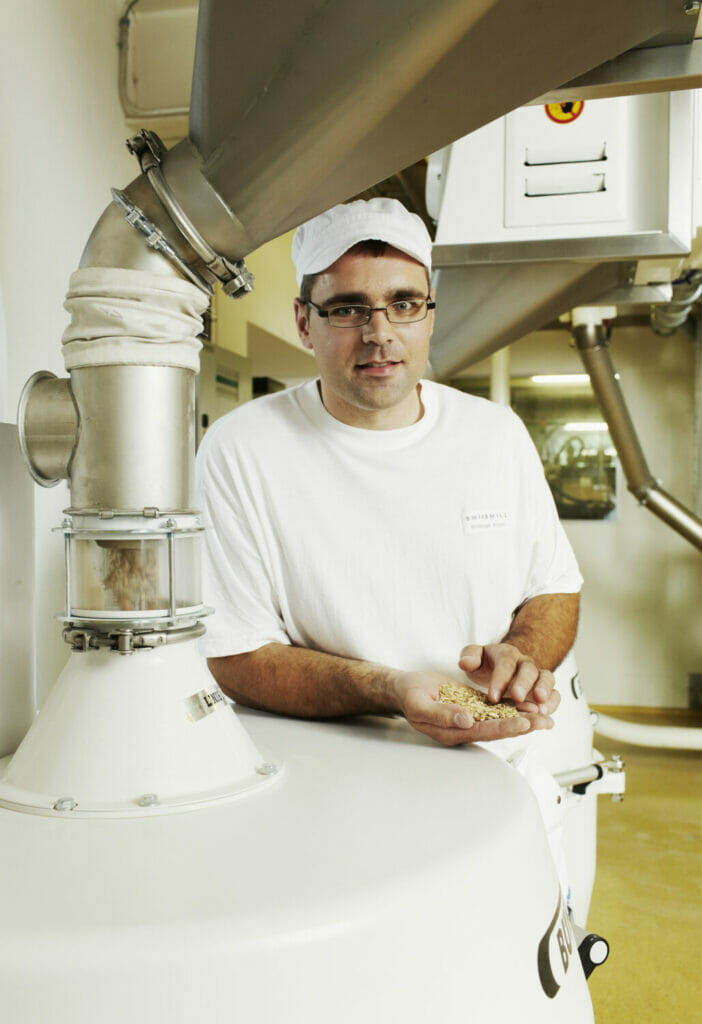
"With the manual spray application, we were able to test the AntiSlip Gluing pallet stabilisation quickly and easily. The changeover from wrapping film to fully automatic hot melt application was just a small step."
Erwin Waldvogel, Manager of the Swissmill oat and hulling mill
When Robatech presented its system to Swissmill in 2019, Erwin Waldvogel immediately recognised the Savings potential of the system. "Two weeks later, Robatech brought me a test system for hot melt application with a hand gun. I was quickly able to see for myself how well the PSA-based hot melt adhesive stabilised the collated cartons on the pallet," recalls the head of the oat mill. "Depalletising the cartons was also easy." Shortly afterwards, the logistics partners tested the transport safety of the pallets and gave the green light.
A short time later, Swissmill decided to purchase a fully automatic pallet stabilisation. Martin Berli, Area Sales Manager Switzerland at Robatechis delighted: "The test systems make it easier for our customers to make investment decisions. Buying a new system straight away is not so easy. However, if applicants can show positive test results, it's a different story: They have valid arguments."
Since the beginning of 2020, two AX spray heads have been applying two adhesive curls directly to the top of the cereal flake collection packaging. The boxes in the last layer are not sprayed. This is ensured by the Integrated palletising function in the control electronics of the Concept melter. It communicates directly with the control system of the palletising robot.

But not everything went smoothly at the beginning. One customer complained that some of the deliveries had collapsed cartons in the lower pallet layer. What had happened? It is well known that even when using shrink film, damage is possible due to strong movements. The cardboard thickness plays an important role in the load distribution, especially when pallets are damaged during transport. greater shear forces are exposed. "However, we quickly found a good solution," reveals Erwin Waldvogel. "For pallets that are transported by rail, we wrap the pallet with film after the hot melt application, but only halfway round. This is enough to ensure even load distribution and prevent cardboard collapses."

In addition to the Saving on plastic film This resulted in another positive effect that is particularly appreciated by the operating personnel. Previously, the line operators collected the pallet from the packaging line, took it to the wrapping station, went back to the packaging line and collected the finished wrapped pallet again later. With 25 to 30 pallets a day, this meant A lot of empty space.
"With AntiSlip Gluing, the daily half-marathon of the line operators has been reduced to a sprint," summarises Erwin Waldvogel. "That's at least 1.5 hours more time per day for core tasks." The fully automatic pallet stabilisation system has paid off for Swissmill. "It's not a big investment," adds the oat mill manager. "It paid for itself after just a few months."