
Paper-based, made of glass or biodegradable plastic? Opinions often differ widely on what constitutes sustainable packaging. One thing is certain: the pressure on manufacturers and users is growing. So how can the demands of consumers and the wishes of recyclers be met?

Many consumers are unsure which product choice will keep their ecological footprint lean when shopping. They are not alone in this - some manufacturers or users of packaging feel the same way. Packaging that is well-intentioned but does more harm than good to the environment still finds its way onto the market. Ultimately, it is the waste disposal companies that sufferWhat cannot be easily separated or only makes up a small proportion of the recyclable material collection cannot be recycled.

For economic reasons, but also because the industry expects politicians to impose even stricter recycling quotas in the foreseeable future, several recyclers and dual systems have now developed their own certifications to assess the recyclability of packaging. Points are deducted, for example, for material composites that are difficult or impossible to separate, such as PE bottles with PVC sleeves. Monomaterial, on the other hand, is rewarded. Consultancy firms and technical testing organisations also offer corresponding services. However, those who produce or use packaging sometimes have to dig deep into their pockets for these services. Changing the material or replacing the systems can be even more expensive.

Consider recyclability from the outset

It is easier to get a player on board for packaging development who is at the very beginning of the chain and has a decisive influence on the quality of the packaging: Manufacturers of high-quality packaging systems have this valuable expertise in materials, design and recyclability. They know every detail of the packaging that is processed on their machines and know exactly which factors have an impact on sustainability. In addition to maximising material and energy efficiency during production and processing, recyclability at the end of the life cycle is now also a driver.

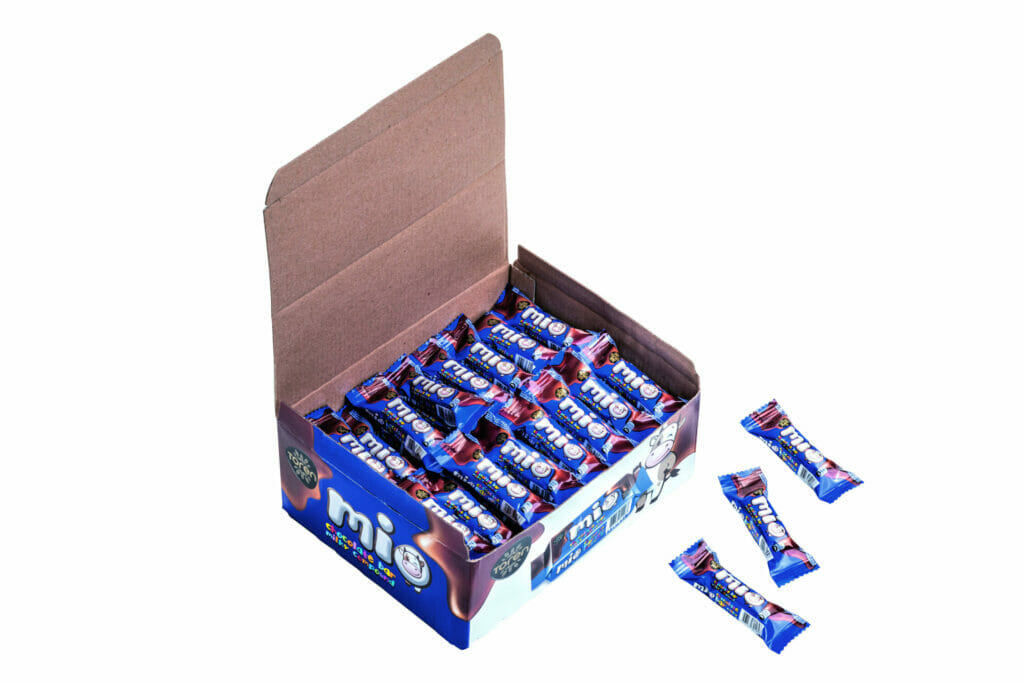
A machine manufacturer from Crailsheim also offers packaging design as a service. Sustainability is taken into account as well as product safety and efficient handling. „We do not see design for recycling as an obstacle, but as an integral part of the development process. After all, thinner wall thicknesses or cartons with smaller dimensions not only have a positive effect ecologically, but also economically,“ says Valentin Köhler, who has been a packaging developer at Schubert. With an intelligent solution, the packaging system manufacturer from Crailsheim recently helped a confectionery manufacturer from Turkey to achieve material savings of up to 25 per cent, for example.

Clever cuts: they led to significant material savings in the boxes of the Turkish confectionery manufacturer Tören. (Image: Gerhard Schubert GmbH)

„This pays off quickly and in the long term - especially in times of rising raw material costs,“ he emphasises. The savings were made by completely redesigning the boxes: The previous solution with pre-glued boxes was replaced by a new box concept as part of the packaging automation. As the case packer works very precisely and only requires low tolerances for the packaging, This made it possible to cut the blanks to a smaller size and reduce the amount of packaging material.

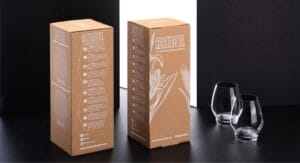
At herbal liqueur manufacturer Jägermeister, for example, the bottles were inserted into cardboard trays by hand outside of production and then wrapped in shrink film. In close collaboration with Schubert, Mast-Jägermeister SE designed new outer packaging that does not require plastic. It was important to remain true to the appearance of the traditional Jägermeister brand and not only with state-of-the-art robot technology, but also with material and format a safe step into the future of packaging design. To this end, both the sales and shipping packaging were completely redeveloped for machine processing and optimised for automated packaging processes.

Harmonising sustainability with other requirements

Standardised material, and as little of it as possible - is that the whole secret to developing sustainable packaging? „Of course, you always have to be realistic: For food producers, sustainability is one aspect among many„, Köhler points out. „Competition is extremely fierce in the food industry in particular. Issues such as visibility at the PoS, reliable procurement and compatibility with common transport systems also play a comparable role there.“ The trick is therefore to consider all requirements equally in order to ultimately find the optimum solution that requires as few compromises as possible.

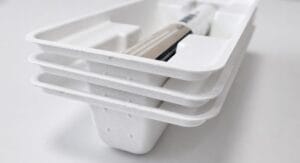
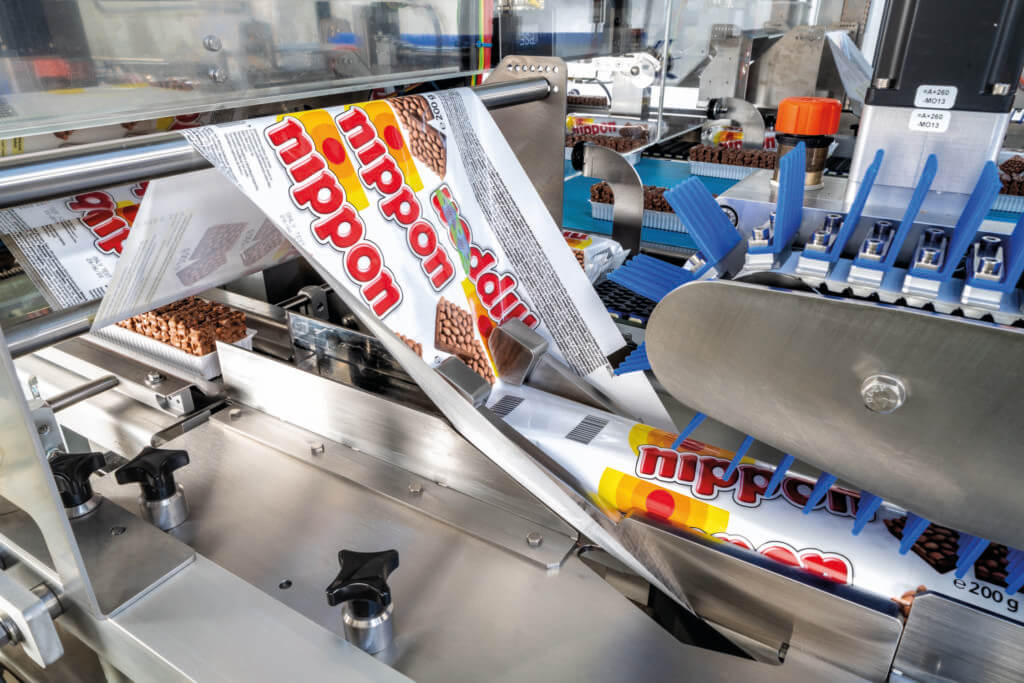
Small savings, big effect: shortened plastic trays require less film for the tubular bags. (Pictures: Gerhard Schubert GmbH)

The development for Hosta is an impressive example of how sustainability and profitability can be combined. The long-established Franconian company is best known for its Nippon puffed rice product. Schubert was brought in as a partner at a very early stage of the project to design a new packaging approach. The aim was to optimise the packaging design with regard to Sustainability and Economic efficiency to optimise.

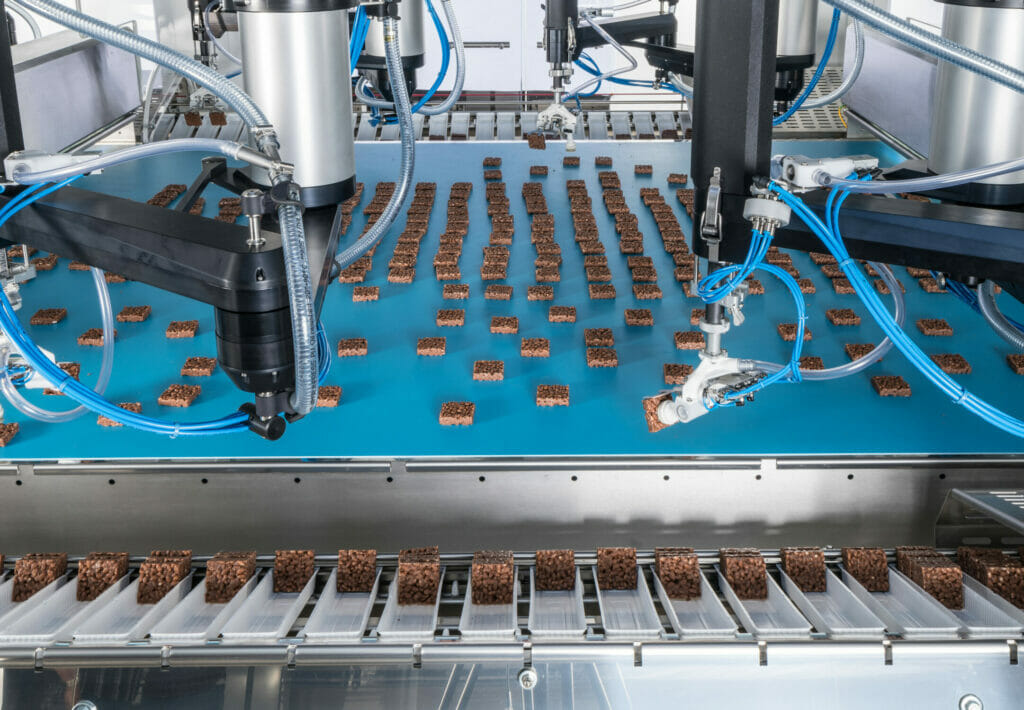
Precision work: Thanks to precise pick-and-place robots, the plastic trays at Hosta could be shortened by ten millimetres. (Image: Gerhard Schubert GmbH)

Thanks to precise pick-and-place robots, the developers were able to shorten the plastic trays by ten millimetres. Thanks to this optimisation, the film repeat of the tubular bags could also be shortened once again. by six millimetres reduce packaging material. This saves packaging material and therefore costs in the long term.

The packaging professionals have even redesigned the box: It now consists of a single flat blank with a lid, rather than three different parts. Taken together, the improved packaging offers so much savings potential that the footprint of the outer packaging could be significantly reduced: There is now space for nine boxes per layer on a shipping pallet instead of the previous eight.

Utilising many years of expertise for today's challenges

As a packaging machine manufacturer that already worked mainly with cardboard 50 years ago, Schubert has a high level of expertise in this material. This is paying off again today, In Europe in particular, the trend towards paper, cardboard and paperboard has increased due to stricter legal requirements. „Cardboard is now in even greater demand from manufacturers,“ confirms packaging developer Köhler.

However, the compatibility of sustainability and cost-effectiveness also takes centre stage for all other materials. „With a view to sustainability, there is an increasing demand for technological openness in many areas of industry,“ explains Köhler. „We have been offering this with our flexible systems since the mid-1980s: Today, for example, most of them can be used to process both plastic and cardboard packaging.“ The handling of composite materials is also possible without any problems.

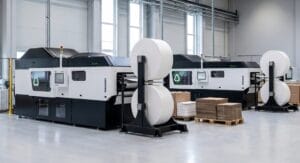
(Image: Gerhard Schubert GmbH)

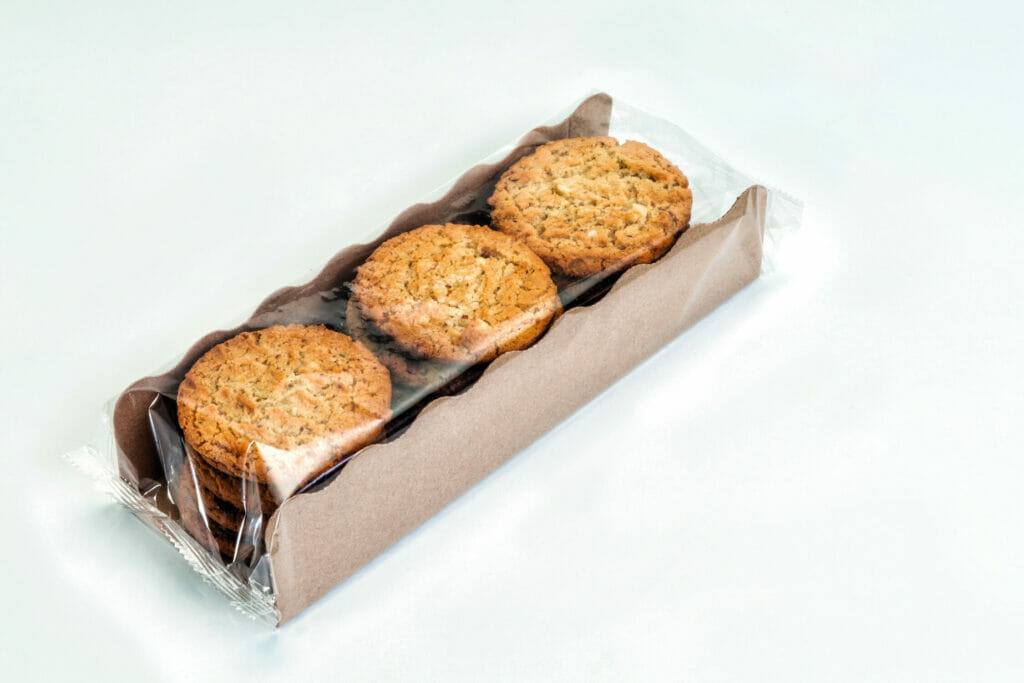
A baked goods manufacturer from Alsace, for example, has recently been benefiting from this flexibility: a modern flow-wrapping machine packs biscuits and wafers in flow-wraps, a cardboard tray or a cardboard U-tray, each of which is then wrapped in a flow-wrap. The machine can process composite and mono films and is also suitable for paper-based materials.

„Consumers are Packaging with fibre content very popular, because paper is more environmentally friendly and feels better than plastic,“ says Köhler. However, because sorting and material recycling have so far been Still some challenges however, recyclers remain sceptical for the time being.

Do not disregard the quality and safety of the product

However, as great as the desire for sustainability may be, the most important task of packaging, especially in the food industry, remains Barrier function between product and environment. „The most ecological packaging is useless if it can no longer guarantee its protective function - even during transport and storage,“ confirms Valentin Köhler. All aspects must therefore always be carefully weighed up when developing packaging. „If the barrier function cannot be guaranteed in any other way, If in doubt, we recommend a pure plastic film„, he explains. After all, this can also be recycled in many cases if disposed of properly.

In Schubert flow-wrapping machines, a variable sealing system ensures future-proof processing. For product protection, the technology combines the ultrasonic process or optionally a sealing technology with ceramic heating elements for longitudinal sealing with a transverse sealing process whose sealing time can be precisely set to a constant value thanks to the flying transverse sealing unit. The advantage: Both methods for longitudinal sealing work very gently and are not only suitable for heat-sensitive products, but also for sustainable films.

„Our aim is always to fulfil ecological and economic requirements in equal measure,“ says Valentin Köhler. „Because If both are in harmony, this is the most sustainable solution."

http://www.schubert.group/de

More news from the cardboard and cartonboard sector