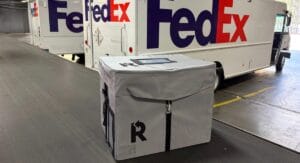
Study: How sustainable is online retail?

A recent study summarises research findings on sustainability in online retail and offers new insights into customer expectations and best practices in seven European countries.

A recent study summarises research findings on sustainability in online retail and offers new insights into customer expectations and best practices in seven European countries.

Around 60 per cent of Germans and as many as 64.2 per cent of French people consider e-commerce to be an environmental sin. They are wrong, as scientific studies show. This is the result of a recently presented Study by Seven Senders on sustainability in online retail. It summarises the most important research findings on the topic, supplemented by a recent survey of consumers in seven European countries and bundles them into a wealth of valuable practical tips and best practices for e-tailers.

In Generation Z, which includes young people between 18 and 24, nine out of ten believe that every company should assume environmental responsibility. At the same time, 85 per cent of European companies are already interested in reducing their emissions. This also applies to the e-commerce sector, although it is in a much better position in terms of environmental impact compared to bricks-and-mortar retail: On average, the calculated CO2-emissions per product sold on the Internet are 2.3 times lower.

Nevertheless, there is still room for improvement when it comes to climate protection: The lion's share of the emissions generated in e-commerce are attributable to transport - First and last mile taken together. It accounts for between 35 and 65 per cent of the total environmental impact and therefore offers the greatest leverage for improvement, alongside packaging and returns management. 

Display

Sustainability is (not) a topic for the future

The study shows: With the growing environmental awareness of online shoppers in Germany, Austria, Switzerland, France, Italy, Spain and the Netherlands, the willingness to shop online has also risen sharply recently, spend more money on sustainable delivery options, from 54 per cent in 2021 to 70 per cent this year.

This does not automatically mean that the option is actually used at checkout. However, best practices in the Seven Senders study show that good user guidance and information about the environmental impact of different shipping solutions contribute to this, that sustainable options are accepted up to four times more frequently.

In general, the study makes clear, online retail is dependent on the cooperation of its customers to achieve its climate targets: A reduction in the returns rate, which causes avoidable environmental pollution, or greater acceptance of delivery to out-of-home collection points create quick wins for the climate that every e-tailer can only achieve together with its customers - and thus save tonnes of CO2 can save.

Seven Senders even quantifies exactly how much in a DEKRA-certified calculation model. delivery to an out-of-home collection point 300 g less CO2 per package.

Nevertheless, the path to a Online trading, which no longer produces emissions, still has a long way to go - and the realisation of CO2-neutral logistics solutions, such as the use of e-trucks, will still take years. However, climate protection needs effective solutions quickly, and offsetting unavoidable CO2emissions as a „golden bridge“ to a low-emission or even emission-free future in which appropriate measures can be implemented and take effect.

The study also shows that such a strategy can also be a competitive advantage and growth driver for responsible e-tailers. the economies of scale of e-commerce logistics and differing consumer habits in the various European markets even expansion can have a positive effect on the carbon footprint.

„Hardly any other industry is developing as dynamically as online retail, which knows more about disruption than almost any other. One of its strengths is responding to consumer wishes at an early stage and implementing them quickly and efficiently. E-tailers can once again capitalise on the intense debate surrounding environmental and climate protection and more sustainable consumption to grow and gain strength.“

Thomas Hagemann, founder and co-CEO of Seven Senders

Source: Seven Senders

E-Commerce - More news