Optima's German sites are climate-neutral

Optima has now become the first private-sector company in Baden-Württemberg to be awarded the „CO2-neutral company“ label by the Baden-Württemberg Climate Protection Foundation.

Optima has now become the first private-sector company in Baden-Württemberg to be awarded the „CO2-neutral company“ label by the Baden-Württemberg Climate Protection Foundation.

The Optima Group presents its environmental and climate strategy as part of the company's 100th anniversary, thereby expanding its sustainability strategy „We care for tomorrow“. Through the consistent use of renewable energies, Optima already reduce greenhouse gas emissions by 40 per cent. The climate footprint is to be reduced by a further 25 per cent by 2030 with a comprehensive package of measures.

In addition all German locations have been net climate neutral since 2022. This means that Optima Optima is already taking responsibility for currently irreducible and avoidable greenhouse gas emissions. From 2023, Optima will be able to determine the individual carbon footprint of customer projects, implement reduction measures together with customers and deliver machines and systems in a net climate-neutral manner by offsetting the remainder. Other environmental issues will also be taken into account in the long term.

Both existing and numerous additional activities now flow together in the existing sustainability strategy, which will be labelled „We care for tomorrow“.

Display

Optima's customers are also increasingly interested in CO2-footprint, reduction targets and measures. In addition, the Implementation of a holistic ESG profile (ESG: Environmental, Social and Governance) are increasingly being pursued to achieve the objectives.
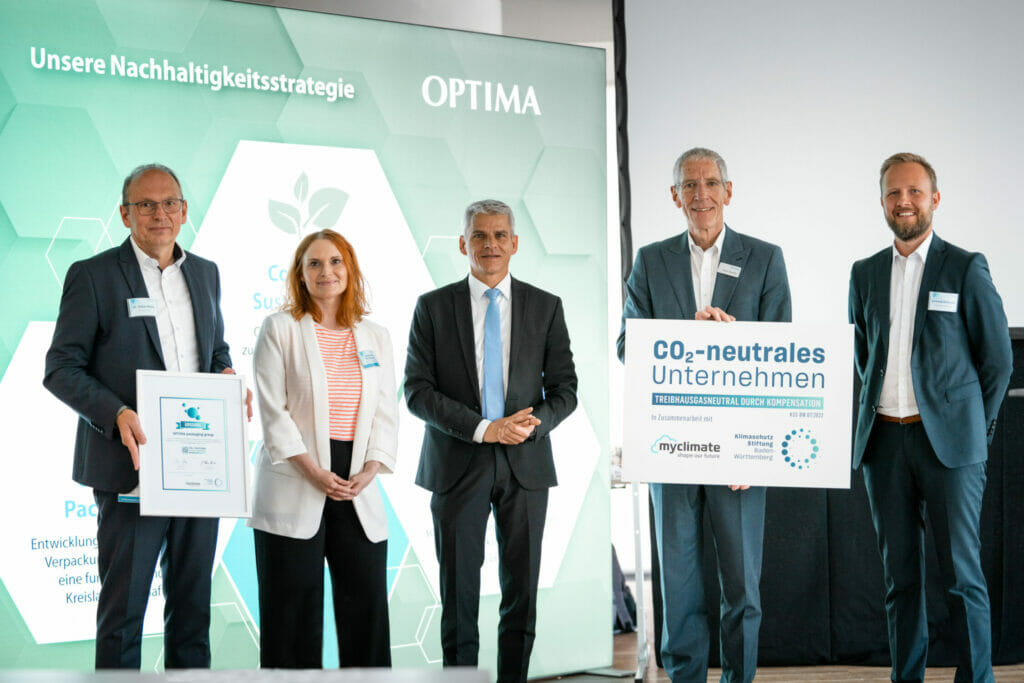
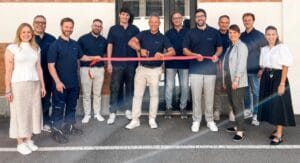
Optima awarded CO2 label
From left to right: Dr Stefan König - Managing Director, Julia Kovar-Mühlhausen - Head of the Baden-Württemberg Climate Protection Foundation, Dr Patrick Rapp - State Secretary in the Ministry of Economics, Labour and Tourism in Baden-Wuerttemberg, Hans Bühler - Chief Executive Officer, Dominik Bröllochs - Group Sustainability Manager (Image: Optima)

Central sustainability strategy with 3 pillars

Optima's „We care for tomorrow“ sustainability strategy consists of three pillars:

Circular Packaging: Development of sustainable packaging solutions for a functioning circular economy. Current examples include the conversion of packaging for hygiene products to 100 per cent recyclable solutions and the conversion of food packaging to mono-materials and paper. The aim is to ensure that packaging materials can be reused again and again for the same packaging without any loss of quality (cradle-to-cradle principle).

Sustainable Technology: Development of resource-saving machine solutions that take the entire life cycle into account. For the first time, it is possible to calculate the climate footprint of machines, the so-called Product Carbon Footprint (PCF). The PCF is continuously improved for the manufacturing and utilisation phase of the machines. The utilisation phase in particular is highly relevant for customers and offers the greatest potential for savings.

Corporate Sustainability: Optima is committed to ecological, fair and successful long-term business practices. The company is already aligned with the UN Global Compact, the world's largest and most important initiative for sustainable and responsible corporate governance, and external assessment systems such as Ecovadis. Since the beginning of 2022, Optima has also been certified in accordance with ISO 14001 through the application of an environmental management system.

Climate-neutral delivery of machines and systems from 2023

The starting point for climate protection measures is the calculation of the Corporate Carbon Footprint (CCF). The correct balancing of greenhouse gases and the compensation of remaining emissions have been verified by TÜV Süd in accordance with the internationally recognised ISO 14064 standard and the GHG Protocol model.

Optima has also been using green electricity since 2009 and has already reduced the company's operational carbon footprint by 40 per cent through further measures. A further package of measures will reduce this by a further 25 per cent by 2030. Increasing energy and resource efficiency at selected locations and expanding sustainable mobility are important cornerstones for this. Optima invests exclusively in climate protection projects with the highest quality standards to offset remaining emissions (Gold Standard CER) and is therefore working with the Baden-Württemberg Climate Protection Foundation with immediate effect. The certificates were obtained through this organisation in cooperation with myclimate.

Optima will be the first supplier in the mechanical engineering sector to offer its customers this service from 2023, Deliver machines and systems in a net climate-neutral manner on the basis of an initially reduced and then compensated, project-specific climate footprint. The product carbon footprint (PCF) of the project is determined for this purpose.

„The greenhouse gas emissions for individual machine projects will be an additional criterion in the future when making purchasing decisions of our customers. We will be able to recognise which measures - for example in design and procurement - we can use to further reduce our product-related carbon footprint. And thus have a direct and positive influence on our customers“ carbon footprint."

Dominik Bröllochs, Group Sustainability Manager at Optima

Source: Optima

Optima - More news