In this year's industry survey, the IPV Industrieverband Papier- und Folienverpackung (Industrial Association for Paper and Film Packaging) found a fundamentally positive mood among companies looking ahead to 2022. The companies are in a stable position to fulfil their tasks and the year will bring changes for the industry.
The war in Ukraine, difficulties with the supply of raw materials, exploding energy costs, a shortage of skilled labour and the conversion of products to both renewable raw materials and better recyclability - the list of defining buzzwords in this year's industry survey is long. Although the Large and varied construction sites for companies and, for example, more than 87 per cent of companies fear further high prices and rising costs on the raw materials markets for paper and plastics - at least 60 per cent of member companies believe that business in 2022 will be the same or (even) better than in the previous year.
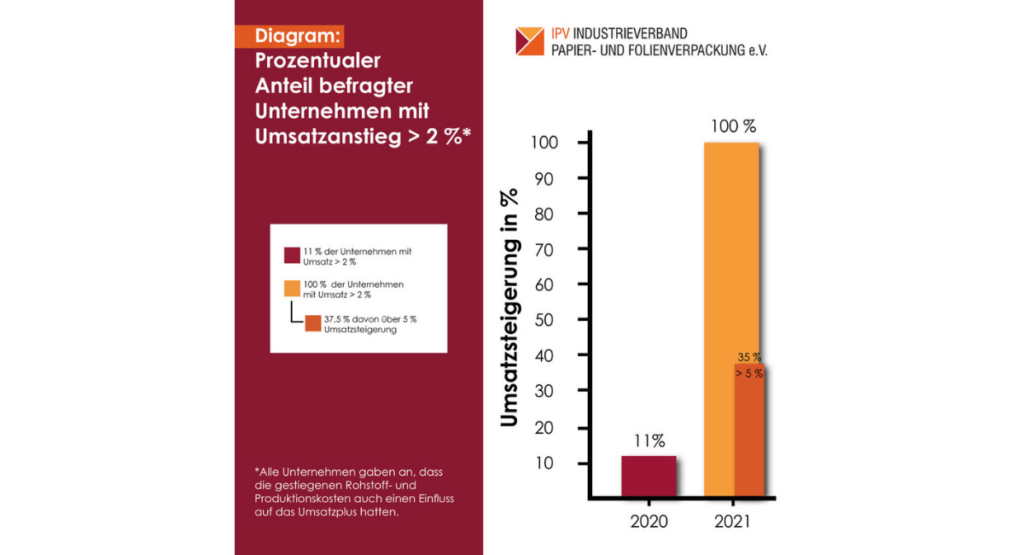
For the IPV it is already the second survey this year. Following an unscheduled Ukraine flash survey in April, the focus was now on the overall view of the 2022 financial year and the assessment of the past year. What stands out is the fact that more than 75 per cent of companies report growing sales. The obvious and at the same time sobering answer behind this is quite simply that raw material and production costs have risen significantly, making the Have artificially increased sales. However, 75 per cent also generated a better return in the past year than in the previous year (greater than two per cent). This is 20 per cent more than in the previous year. The Companies are currently working at full capacity.

Shortage of skilled labour continues
Not a single company reported a significant decrease in the number of employees to the IPV. However, 75 per cent of companies are working with the same number of employees as in 2021. 25 per cent reported an increase in the number of employees. A look at investment performance provides an unclear picture. After all Almost 40 per cent have increased their own investment activities for 2022, that is almost 15 per cent more than in the previous year. However, the same number of companies also reduced their investments. However, it is also true that a number of companies had already invested extensively in previous years.
„You can see that our sectors are exactly at the crossroads between spending for the future and spending for the present. The development of the markets provides arguments in favour of both stances. We have a future-proof industry with a very good order situation, but every second company is now complaining about a lack of employees to operate its machines professionally in order to produce successfully.“
Klaus Jahn, IPV Chairman of the Board
Demand for fibre-based packaging solutions
The conversion of products has already begun several years ago with research into better recyclability and the switch to renewable raw materials. Almost 70 percent feel the demand or pressure from customers for fibre-based products as a substitute for plastic-based packaging. Three out of four companies continue to complain about the negative public image of plastics. The number of companies that are critical of littering is even higher. Manufacturers are repeatedly held responsible when consumers improperly dispose of packaging in the environment instead of recycling it. Yet Germany has a comprehensive and very well-functioning Recyclable material cycle that is recognised worldwide.
A critical look at politics
In the political section of the industry survey, companies provide an outlook on the politics of the day. They are sceptical about the ruling "traffic light" coalition. The majority of companies fear that it will make their work more difficult. Among other things, they fear Interference in collective bargaining autonomy and the threat of environmental protection measures, which will have a direct and one-sided impact on the packaging industry.
„Our members are also demanding as a political agenda that we continue to campaign for the abolition of EU subsidies for Eastern European competitors, as this distorts competition. The framework conditions in the EU must be equal. In addition, we are also fighting on a broad national front to maintain the competitiveness of our regionally strongly anchored industry. And if I may add: the long-requested reduction in bureaucracy must finally become tangible. The statistical and regulatory burden that companies in the packaging industry have to deal with has increased rather than decreased.“
Karsten Hunger, Managing Director of the Industrial Association for Paper and Film Packaging
Source: IPV
More news on packaging and packaging materials


Confectionery: Flavour alone is no longer enough

Croxsons launches first British sparkling wine bottle on the market

adapa completes refinancing

Interaction of machine, adhesive and application technology