
Everything is fine!

The cord labelling system from Logopak fulfils Rothaus' ecological catalogue of requirements with the use of linerless labels.

The cord labelling system from Logopak in conjunction with the use of linerless labels, which do not require silicone-coated label backing paper, optimally fulfils the ecological requirements catalogue of Badische Staatsbrauerei Rothaus. In addition, the system solution realises transport security and labelling of loaded pallets in a single operation.

Beer has been brewed in Rothaus, located at an altitude of around 1,000 metres in a district of Grafenhausen in the Upper Black Forest, since 1791. Situated in a beautiful landscape, a environment and was aware of the importance of pure brewing water for the quality of the beers The company was already committed to sustainable business practices at a time when the concept of environmental protection was far from being a common good and social value. The company demonstrates its high level of personal responsibility in terms of sustainability through the Use of 100 per cent regional green electricity from hydropower plants, through the generation of solar thermal energy on the roofs of its buildings, The company's environmental and energy management systems and the strong focus on energy efficiency and sustainability criteria when investing in production facilities and processes.

Pallet labelling according to the „purity law“

According to the German Purity Law, only hops, malt, yeast and water should be used to brew beer in Germany, without any other ingredients. Applied to the labelling technology of beer pallets, this means that only waste-preventing and environmentally friendly technologies and materials should be used wherever possible, even without „ingredients“ such as disposable plastic films, silicone-coated backing paper waste or unnecessary CO2-Pollution of the environment. For Badische Staatsbrauerei Rothaus, it was therefore only logical and logical to opt for a consistently sustainable eco-labelling solution in line with the „Purity Law“ with the Logomatic 920 PSCK cord labelling system and the use of liner-free labels. It fulfils these ecological aspects as well as the economic requirements for an efficient labelling system that meets the GS1 standard-compliant pallet labelling.

Cord labelling can have environmental benefits
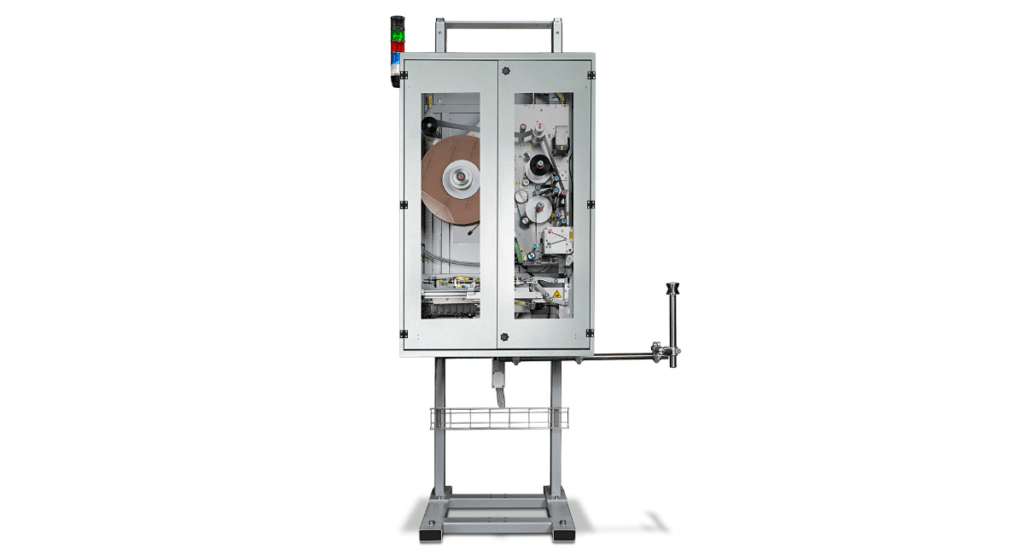
The Logomatic 920 PSCK cord labelling system secures beer pallets and applies labels in the same operation so that they do not adhere to the crates themselves, but to the securing cord. (Image: Logopak Systeme)

Focus on sustainable management

With the Logomatic 920 PSCK cord labelling system, Badische Staatsbrauerei Rothaus has opted for a labelling solution that combines two process steps in one. It secures the pallets loaded with crates of beer with a reusable safety cord made from recycled textile fibres. At the same time, it generates two labels per pallet in real time with all the important information from Rothaus' IT system, for example the shipping unit number (SSCU), the article number, the batch ID and the best-before date (BBD), and attaches them to the securing cord.

Display

The Label folded over the cord so that the adhesive sides stick together. In the end-of-line area of the Rothaus palletising system, up to 85 pallets per hour are labelled on both sides. It takes less than ten seconds to print and apply a GS1 label. The integrated height adjustment of the labelling system with a travel distance of 300 millimetres enables the cord and labels to be attached to the pallet at the desired height.

To ensure consistent identification reliability along the supply chain from the brewery to the retailer, the codes and plain text are verified for legibility immediately after printing and, in the event of a „bad read“, a replacement label is generated immediately. Every error-free read cycle is reported back to the IT system via the LogoSoft software with the application or industry-relevant data. Rothaus uses the residual pallet handling mode of the Logomatic 920 PSCK for pallets that are not fully loaded. The system operator records the quantity of beer crates on the pallet via the touch display, removes the dispensed labels and attaches them to the safety cord.

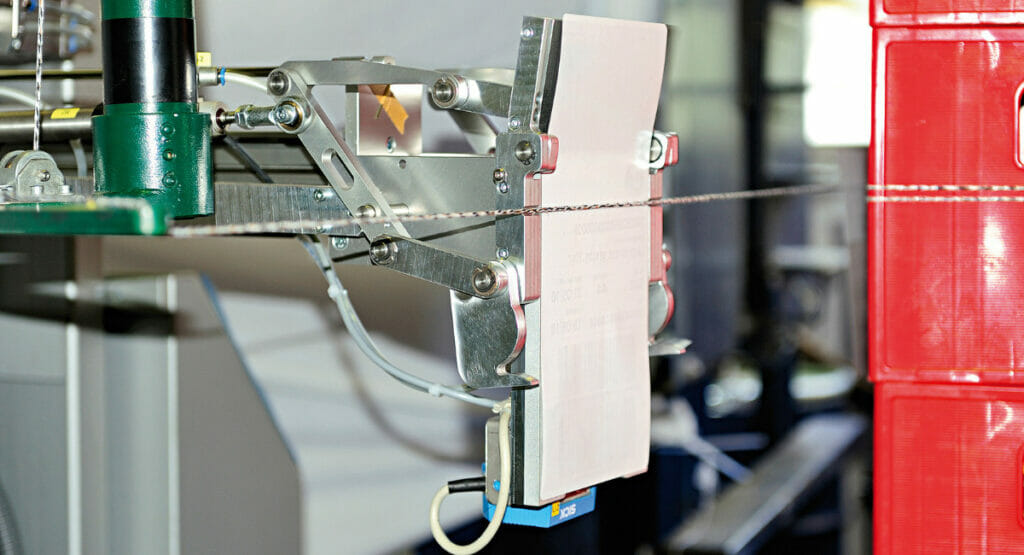
An integrated height adjustment allows the labels and cord to be applied at different heights.
The label is folded over on the cord so that the adhesive sides adhere to each other. The system's integrated height adjustment allows the cord and labels to be applied at the appropriate height. (Image: Logopak Systems)

Linerless labels improve eco-balance

The Logomatic 920 PSCK cord labelling system meets the demand for environmentally friendly pallet labelling in a variety of ways. So the securing cord made from recycled textile fibres replaces the stretch film often used for load securing. The use of plastic is completely eliminated and the cord also performs significantly better than film in terms of cost per pallet. In addition, the immediate reusability of the beer crates is simplified: while the removal of labels applied directly to the load carrier often leaves behind unsightly and unhygienic material and adhesive residues that have to be laboriously removed, the Cord labelling system leaves no residue whatsoever.

Further benefits result from operating the labelling system with linerless labels, whose paper itself is FSC-certified. Due to their special cold seal coating, these labels do not require a silicone-coated backing material. This means there is no backing paper waste, which is expensive and time-consuming to dispose of. Without the backing material, the running length per label roll is 50 to 60 per cent longer, giving it a better usable capacity compared to conventional thermal transfer rolls. Accordingly, the rolls in the labelling system at Rothaus need to be changed less frequently. This improves the system and process availability of the end-of-line palletising system. Rothaus also has to procure fewer label rolls for the required labelling volume. This saves a considerable amount of effort and CO2-emissions in procurement and replenishment logistics and improves the CO2-Footprint.

http://www.logopak.de

More news from the magazine

One hundred years blue tin

Since 1925, the Nivea cream can has borne its deep blue colour, white lettering and round shape - a design that has remained stable over generations, markets and crises and is now celebrating its 100th birthday.
Read more "