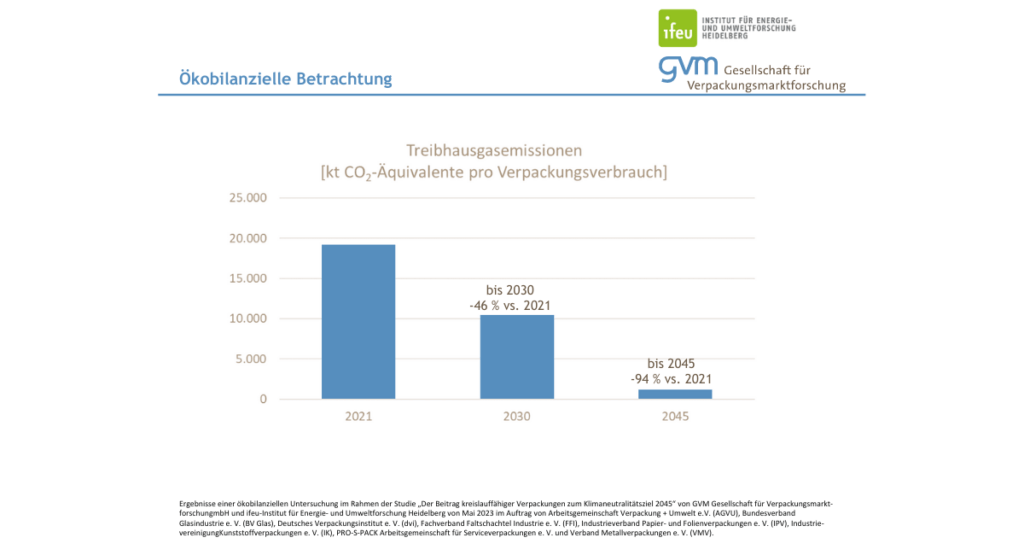
What contribution can packaging make to reducing Germany's greenhouse gas emissions? Eight industry associations asked themselves this question and commissioned a study. One result: the emissions associated with German packaging could be reduced by 94 per cent by 2045.
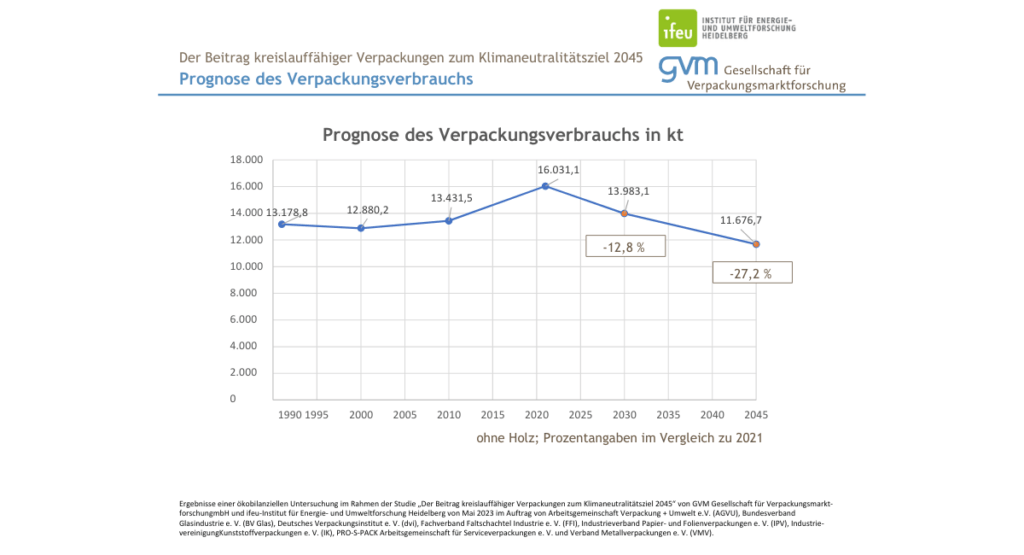
A recent study by the GVM Society for Packaging Market Research and the ifeu Institute for Energy and Environmental Research Heidelberg gGmbH, commissioned by eight industry associations, predicts that the packaging consumption in Germany has reached its peak in 2021 and will decline continuously in the future. will increase. In contrast, the use of recyclate and recycling rates will increase.
The study with the title "The contribution of recyclable packaging to the 2045 climate neutrality target" was created in May 2023 and presented on the occasion of the 9th Packaging Day on 15 June 2023. It analyses which Contribution of recyclable packaging with a view to the German climate neutrality target for 2045 across all materials and forecasts the development of relevant factors such as recycling rates, use of recyclates, packaging optimisation and packaging volumes. The life cycle stages of raw material production, packaging production, distribution, disposal and recycling were analysed for average German conditions.
The reference point for the study is the year 2021, with modelling carried out for the years 2030 and 2045. The study takes into account state or European steering interventions that have already been adopted. Planned or expected specific regulations such as the new European Packaging and Packaging Waste Regulation (PPWR), on the other hand, were not included in the forecasts. However, according to the study, the direction of impact is similar due to fundamental endeavours that can also be found in the PPWR's catalogue of measures. The results of the study were announced by GVM and ifeu at a press conference in Berlin.
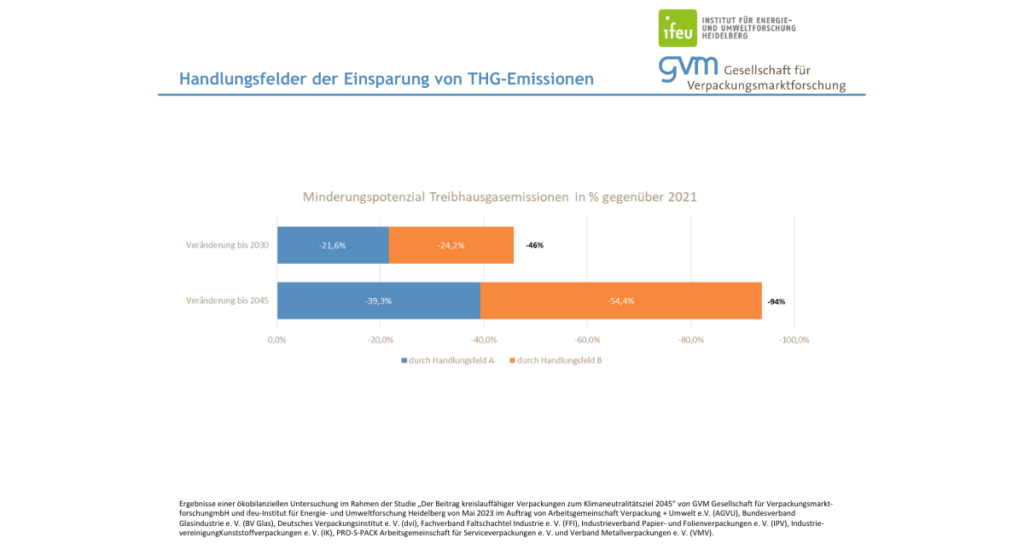
"The results of the life cycle assessment show that the greenhouse gas emissions associated with the packaging volume are continuously decreasing and that a reduction of 94 per cent is possible by 2045. This corresponds to a saving of 18,025 tonnes of CO2 equivalents."
Benedikt Kauertz, Head of Industry and Products at ifeu
Savings potential
39.3 percentage points of the savings are attributable to factors from the "Packaging market and circular economy" field of action. These include, for example lighter packaging, reusable packaging, packaging-saving consumer behaviour, increasing use of recyclates and, last but not least, the greatly improved recycling of packaging. The remaining 54.4 percentage points come from the "Climate and energy transition and process optimisation" field of action. "Keywords here include, for example Decarbonisation of industrial production processes, green energy sources and energy savings in production and transport, says Kurt Schüler, Managing Partner of GVM.
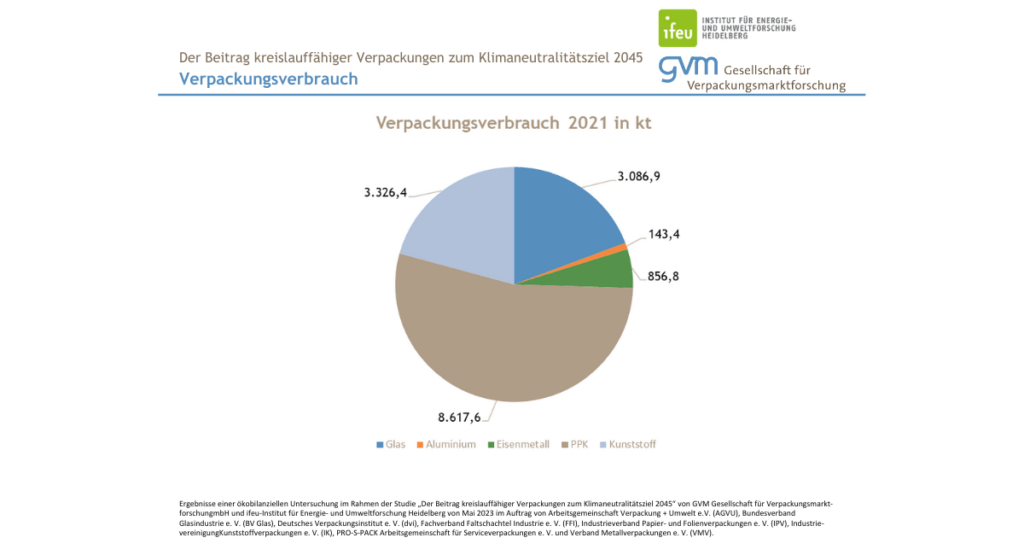
The study predicts that the packaging consumption has already peaked in 2021 and will continue to decline in the coming years. will be. While packaging consumption (excluding wood) was still at 16 million tonnes in 2021, the study calculates that it will fall to 14 million tonnes by 2030 and to 11.7 million tonnes by 2045. "This corresponds to a reduction of 13 per cent by 2030 and 27 per cent by 2045," says Kurt Schüler.
The reason for the study was the 9th Packaging Day on 15 June 2023. Packaging Day was launched by the German Packaging Institute in 2015 and takes place annually in mid-June.
"With Packaging Day, we want to draw everyone's attention to the importance of packaging once a year. Packaging performance and the people who make it possible. Packaging is indispensable if we want to ensure the daily supply of the population and companies with all the products and raw materials they need. This applies to everything from food and medicines to industrial components, building materials, electronics and textiles. Without packaging, there is no protection of products against damage and spoilage and no option for storage or transport. This applies regardless of what material the packaging is made of or whether it is used as a disposable or reusable solution. But precisely because we can only do without packaging to a very limited extent, we need to be all the more aware of how we use it. Packaging is also valuable after use. As an important secondary raw material, it is a sustainable fuel for the circular economy. The circular economy is a technology of freedom because it makes us less dependent on raw materials."
Kim Cheng, dvi Managing Director
The study was commissioned by the Arbeitsgemeinschaft Verpackung + Umwelt e.V. (AGVU), the Bundesverband Glasindustrie e. V. (BV Glas), the German Packaging Institute e. V. (dvi), the Fachverband Faltschachtel Industrie e. V. (FFI), the Industrievereinigung Kunststoffverpackungen e. V. (IK), the Industrieverband Papier- und Folienverpackungen e. V. (IPV), the PRO-S-PACK Working Group for Service Packaging e.V. and the Metal Packaging Association e. V. (VMV).
Source: dvi
More news on packaging and packaging materials


Confectionery: Flavour alone is no longer enough

Croxsons launches first British sparkling wine bottle on the market

adapa completes refinancing

Interaction of machine, adhesive and application technology