Carboliq turns plastic waste into oil

Carboliq is an industrial-scale process that converts mixed and contaminated plastic waste, for which incineration was previously the only disposal method, back into oil. The company of the same name operates a pilot plant in Ennigerloh and co-operates with Südpack.

Mixed and contaminated plastic waste is the biggest challenge for recycling. Carboliq is an industrial-scale process that converts plastic waste, for which incineration was previously the only disposal method, back into oil. The company of the same name operates a pilot plant in Ennigerloh and co-operates with Südpack.

Chemical recycling can be an important building block for the circular economy and should always be used when can be used when mechanical recycling reaches its limits. Südpack, the Swabian manufacturer of high-performance films for packaging food and medical products, agrees.

„My father, company founder Alfred Remmele, already had the vision 20 years ago that chemical recycling could be a future technology for the utilisation of plastics that cannot be mechanically separated and recycled. As the technology was not yet fully developed at the time, this vision remained for the time being.“ 

Johannes Remmele, Südpack owner

Display

At that time, the company's portfolio consisted of far more composite films. In recent years, Südpack has Although the proportion of recyclable monostructures has been greatly expanded, Nevertheless, composite films are still indispensable for many applications. „The much-discussed ‚waste problem‘ that is commonly generated by the production of this packaging is only one aspect - and does not go far enough,“ says Johannes Remmele. „Südpack does not produce waste, but high-quality functional films that make a significant contribution to the protection of food and pharmaceuticals. Films only become waste if suitable systems cannot be set up, with which these materials can be recycled. And precisely for this is chemical recycling as a complementary technology an essential building block.“

Sustainable technology

Südpack has therefore entered into a strategic cooperation with Carboliq, the chemical recycling division of the Remscheid-based company Recenso. The aim: to optimise the recycling plant operated in cooperation with the waste disposal company Ecowest in Ennigerloh, Münsterland. Pilot plant for the oiling of plastic waste to recycle its own streams of recyclable materials generated during the production of packaging film. The cooperation project has already shown how a plant needs to be designed in order to process the different fractions so that they do not have to be sent for thermal utilisation.

„From today's perspective, Carboliq is a unique and, above all, sustainable technology - not only in terms of recycling options, but also in terms of energy efficiency and low emissions. This makes us the only manufacturer of flexible films that has direct access to capacities for chemical recycling. What's more, in combination with our site in Schwendi, which has capacities for mechanical processing, we are always able to use the technology that is better in terms of environmental impact and cost-effectiveness.“

Johannes Remmele

Dirk Hardow, Head of Business Unit Functional Films & Compounds at Südpack, is also convinced: „In the future, there will be only with mechanical and chemical recycling to close the loops for food packaging.“ In the course of the cooperation with Carboliq, it has already been possible to prove that the process can be used to successfully recycle multi-layer films. „The technology is robust and ready for the market."

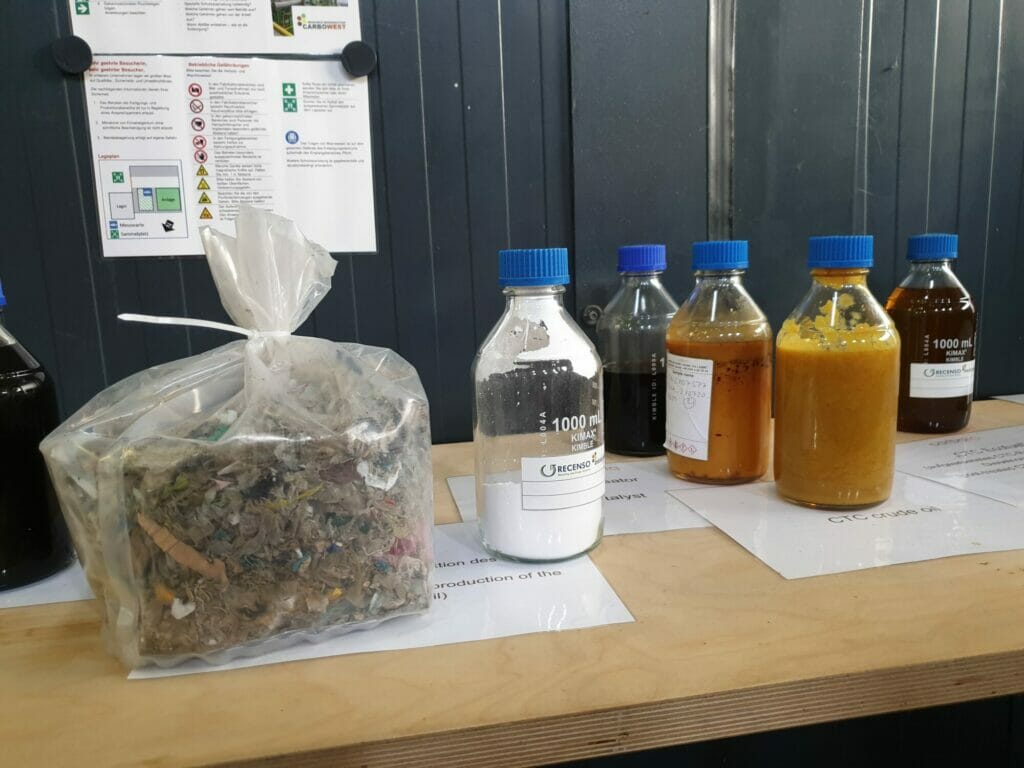
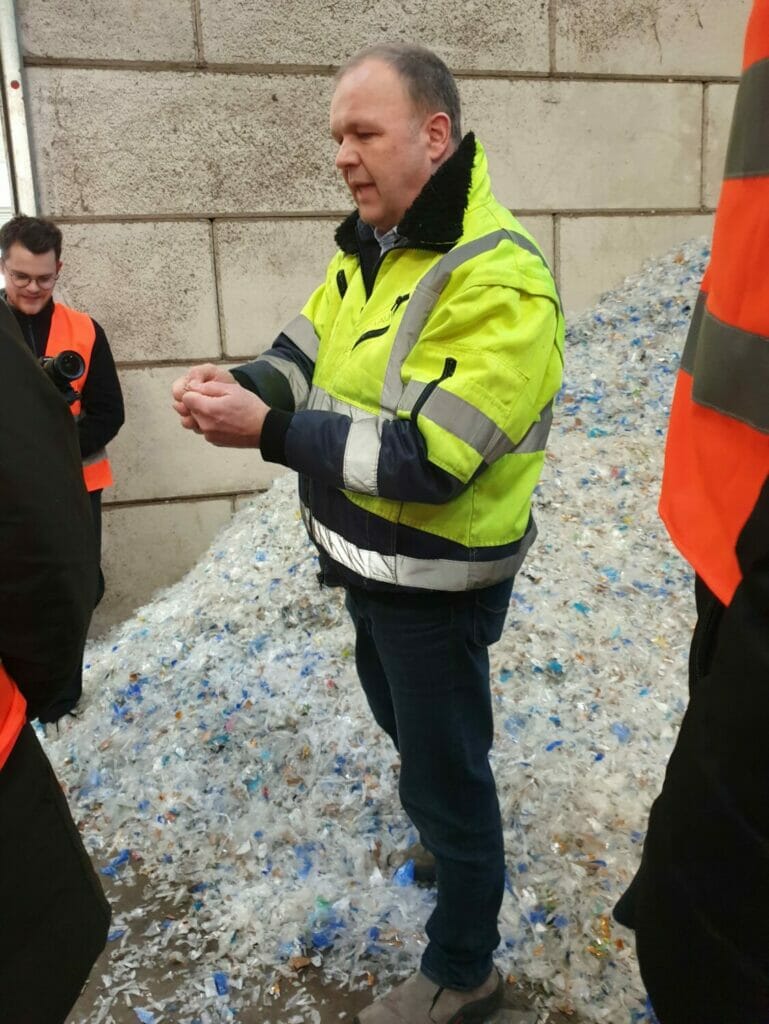
Carboliq Managing Director Christian Haupts shows the starting material for the recycling process. (Image: packaging journal)

New plant planned near Cologne

In the material recycling process of direct oiling, the waste material is liquefied in a single-stage process At process temperatures below 400 °C, the process achieves a high oil yield. The Carboliq process is operated by means of friction, i.e. frictional heat. Special rotating units were developed for this purpose, which transfer the required energy directly into the material. This circulates in the reactor until the chain lengths are so short that the material is vaporised. The vapours are condensed and the condensate is fed into an oil-water separator for phase separation. Carboliq then markets the liquid product under the name CLR (Circular Liquid Resource).

The pilot plant in Ennigerloh has been approved as a recycling plant for fully continuous operation and has been certified in accordance with the ISCC-Plus sustainability criteria since March 2021. And Carboliq already has further plans.

„An investment decision for the construction of a new plant south of Cologne is expected to be made soon. It will be designed for a capacity of 10,000 tonnes of output per year and the first products will be launched on the market in 2025.“

Christian Haupts, CEO Carboliq

The Carboliq Managing Director calculates: „In Germany alone, more than six million tonnes of plastic waste are generated and treated every year. Statistically, around half of this is utilised for energy and materials. Even if only half of the plastics destined for incineration are recycled using the Carboliq process, the recycling rate for plastics increases by more than 50 per cent, the CO2-emissions from combustion are reduced by more than 40 per cent and there is a revenue potential of more than two billion euros from the sale of CLR.“

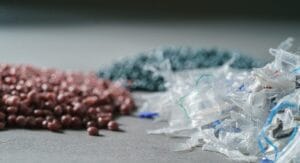
At the end of the process is oil that can be processed in petrochemical plants. (Image: packaging journal)

Chemical recycling offers many possibilities

The technology is highly tolerant of impurities and mixtures of varieties. The Carboliq process is therefore suitable for a wide range of applications, also contaminated, mixed or other plastics. The same applies to flexible packaging and the recycling of highly complex multi-layer films made from several types of plastic, which are commonly used in the food industry in particular. „Compared to mechanical recycling chemical recycling therefore offers significantly more opportunities, as it aims to recover the valuable components through thermal decomposition. However, we need to know the composition of the feed in order to optimise the operation of a plant and ultimately obtain material that can be processed in large-scale chemical industrial plants such as a cracker,“ says Christian Haupts.

Recycling - More news