Chep is working with Nestlé Germany to test new ways of creating more sustainable promotions in the retail sector: in order to reduce packaging waste on the sales floor, a promotion for the product Thomy mustard is being launched on the Q+ Reusable Display. The mustard classic is on sale in around 30 stores on four display shelves per promotional display.
The promotion was preceded by a test of Nesquik cocoa in various markets. The aim of Chep and Nestlé Germany is to use different test runs Gain insights into various product categories. The closed, standardised and scalable Chep pooling system enables manufacturers to significantly reduce the ecological footprint of their promotions.
„Our aim with this test series is to combine attractive promotions with our commitment to sustainability in the long term. A consistent focus on the circular economy, product innovations and a high level of expertise in implementation make Chep an ideal partner for testing new ways to reduce waste.“
Reinhard Dittmar, Team Leader Display and Co-Man at Nestlé Germany
More sustainability and circularity for promotions
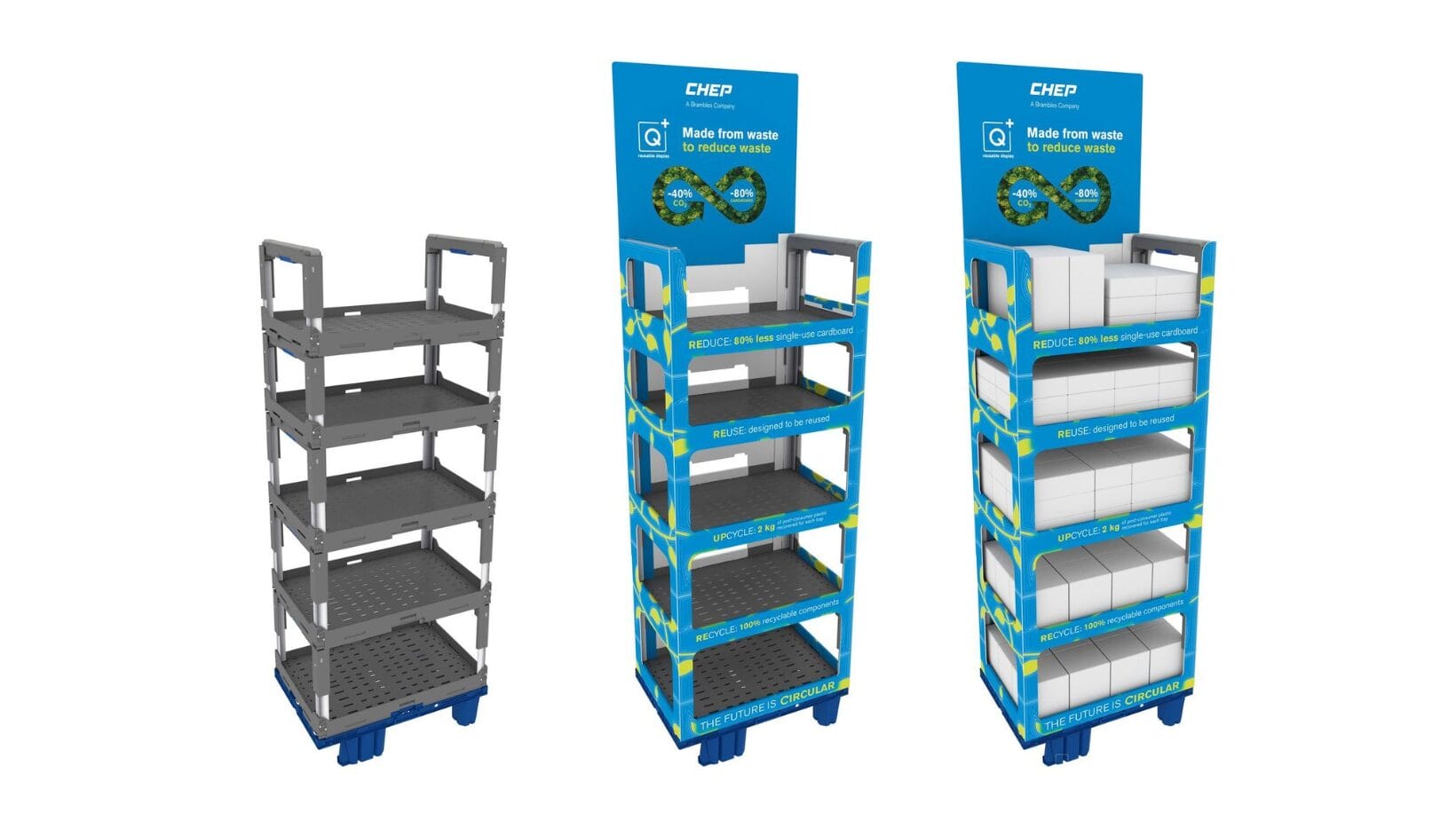
The waste that accumulates from single-use packaging, particularly in supermarkets, is often underestimated. Chep is taking an important step with its Q+ Reusable Display, Reduce large quantities of cardboard waste on the sales floor. The reusable display is EUCertPlast certified and is made in Germany from 82 per cent recycled post-consumer waste; Chep uses 2.3 kilograms of post-consumer plastic waste for each base. All components are fully recyclable at the end of their product life cycle and are further processed into new reusable packaging solutions, which ensures Chep's strictly controlled chain of custody.

For manufacturers, the display is also a smart and uncomplicated solution to make their promotions more environmentally friendly: In total, up to 57 per cent of disposable cardboard packaging and 34 per cent of CO2 emissions can be saved per display. Calculated per individual display, this means up to 3.6 kilograms less cardboard packaging.
Share & Reuse principle
By offering its display according to the principles of sharing and reuse, Chep is also promoting the circular economy. Regular inspection and repair after each cycle ensure the long service life of the reusable display and consistently high quality. Handling is simple and intuitive: thanks to a small number of components, the display can be set up quickly in co-packing; when dismantling at the point of sale, the casing is easy to remove.
At 60×40 cm, the Q+ display shelves offer a large sales area; Up to six shelves can be configured in total. As the goods are accessible from all four sides, the display offers maximum product visibility. If required, the upper compartment can be completely free-standing so that shoppers can access the products without any obstacles. In addition to its high sustainability value and ease of use, an attractive appearance is not neglected.
„We are delighted to have Nestlé Germany not only as a strong company, but also as a partner with extensive experience in global reusable pilots for the test series of our Q+ Reusable Display. Together with Nestlé Germany, we want to put reusable packaging on a broader footing and promote sustainable promotions in the retail sector.“
Katrin Zeiler, Senior Director Zero Waste World, Customer Innovation & Solutions Europe at Chep.
The Q+ Reusable Display is currently being tested in practice with various brands. The aim is to gain insights into the best possible application in test runs with different test set-ups. In the long term, this should create the conditions for a broad market launch.
Source: Chep