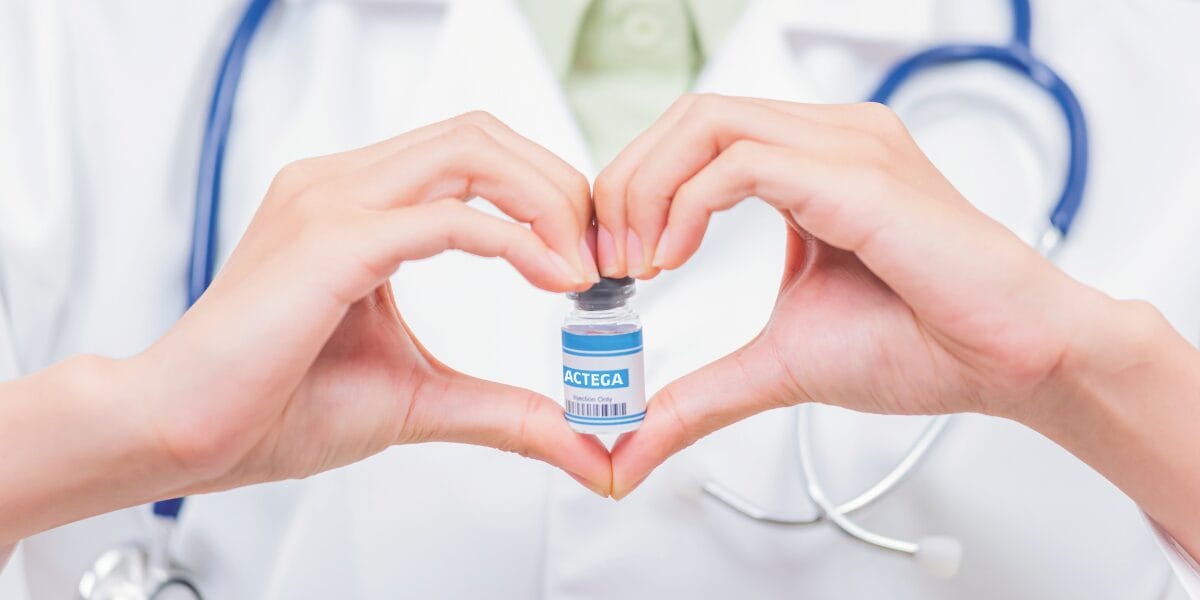
When working with vials in the pharmaceutical industry, pharmaceutical stoppers provide the necessary sealing protection against contamination. As you would expect, the materials used for the stoppers are subject to stringent regulatory requirements. With ProvaMed TPE, Actega offers a sustainable alternative to the frequently used butyl rubber.
In the pharmaceutical industry, butyl rubber is often used for closures as it has excellent mechanical properties in terms of sealing and flexibility. In addition, its production requires hardly any cross-linking agents and contains only a few secondary components, which makes it ideal for medical applications. However, the Production of butyl rubber is very energy-intensive, expensive and often harmful to the environment.
According to a report in the Tagesspiegel newspaper, around four million hectares of rainforest were destroyed in 2023 to make room for rubber plantations. The numerous energy-intensive processing steps as well as the subsequent onward transport, 90 per cent of which comes from South East Asia, also cast a poor light on the environmental footprint of rubber. The often opaque supply chain also poses new challenges for rubber producers, as the Supply Chain Act for Deforestation-Free Products, which was introduced in 2024, requires all manufacturers to prove that their raw materials have been produced without deforestation. This is almost impossible with rubber.

Tight, efficient and safe
A legally compliant alternative to butyl rubber can be achieved with TPE such as ProvaMed from Actega can be created. The TPE specially developed for pharmaceutical stoppers and medical closures has the required Soft-elastic and sealing properties, to be used as pharmaceutical stoppers. TPE is processed using the widely used injection moulding process, which enables faster and more energy-efficient production. TPE compounds offer a decisive advantage, particularly in the production of pharmaceutical stoppers and other medical closures: they contain No harmful additives such as phthalates, plasticisers, latex or heavy metals.
Materials used in the sensitive medical and pharmaceutical sector are subject to strict regulations. Materials used for injection and pharmaceutical stoppers must undergo extensive testing and meet the requirements of the European Pharmacopoeia and the United States Pharmacopoeia (USP) in terms of protection, safety, compatibility and functionality. This includes testing numerous physical and mechanical properties as well as processability and sterilisability. In addition, verification in accordance with USP 381 is required. These tests monitor possible changes, influences as well as pierceability, fragmentation and reclosability (self-sealing).
Comprehensive tests
In the case of injection stoppers for drug ampoules (vials) with multiple uses, it is important to ensure pierceability, fragmentation and resealability (self-sealing) in order to protect the liquid remaining in the vial from contamination and leakage.
The pierceability test in accordance with USP 381 ensures that the force required for piercing does not exceed 10 N per closure. In the fragmentation test, the pharmaceutical stopper is pierced several times with a needle and the liquid in the vial is examined for particle residues to ensure that no particles get into the liquid. In the self-sealing test, the stopper of a filled injection vial is pierced several times, immersed in a solution and pressurised. After 30 minutes under normal pressure, it is checked whether methylene blue has penetrated the bottle and whether the liquid is discoloured.
In addition to the standard tests carried out by independent suppliers, some manufacturers such as Actega subject their materials to further tests, such as testing for oxygen permeability, the presence of NIAS or allergens and compatibility with all common sterilisation processes (EtO, gamma, autoclaving).
Continuous further development in the TPE sector
New developments and improvements are constantly being worked on, making TPEs ever more efficient. One example is the ProvaMed 6345 NC HF for pharmaceutical and medical closures from Actega, which is characterised by Extended flowability and sustainable processing characterised. In the long term, TPEs generally offer considerable cost savings, higher quality and safety of the end products as well as a significant contribution to environmental protection. With the increasing demand for environmentally friendly solutions in the pharmaceutical industry, TPEs are becoming a promising alternative to conventional materials. Alternative to conventional materials.