Researchers at the Fraunhofer Institute for Applied Polymer Research IAP have developed a film that foams up into a polyurethane foam (PU foam) using heat - without any health risks.
The film enables isocyanate-free foaming and thus improves occupational safety. It also offers Logistical advantages for storage and transport. The material can be customised for various applications ranging from the automotive and construction industries to the packaging industry.
„A frequently discussed aspect in the production of PU foam is the health risk in the workplace from isocyanates, one of the main components in the chemical reaction to form polyurethane. Our film enables isocyanate-free foaming. It minimises health risks in the workplace and improves occupational safety, especially in on-site applications, such as in the construction industry.“
Dr Thorsten Pretsch, Head of the Synthesis and Polymer Technology Research Division at the Fraunhofer IAP
Strict regulations and protective measures apply to the handling of isocyanates. They are toxic and have a sensitising effect on the respiratory tract and skin; some isocyanates are suspected of causing cancer. The newly developed film moulds itself into a PU foam simply by applying heat, without reacting chemically. The research team's innovative approach also means a new technology for foam production itselfthermal foaming. The product bears the name FOIM - a combination of the English words foil and foam.

Flexible: polyurethane foam with shape memory
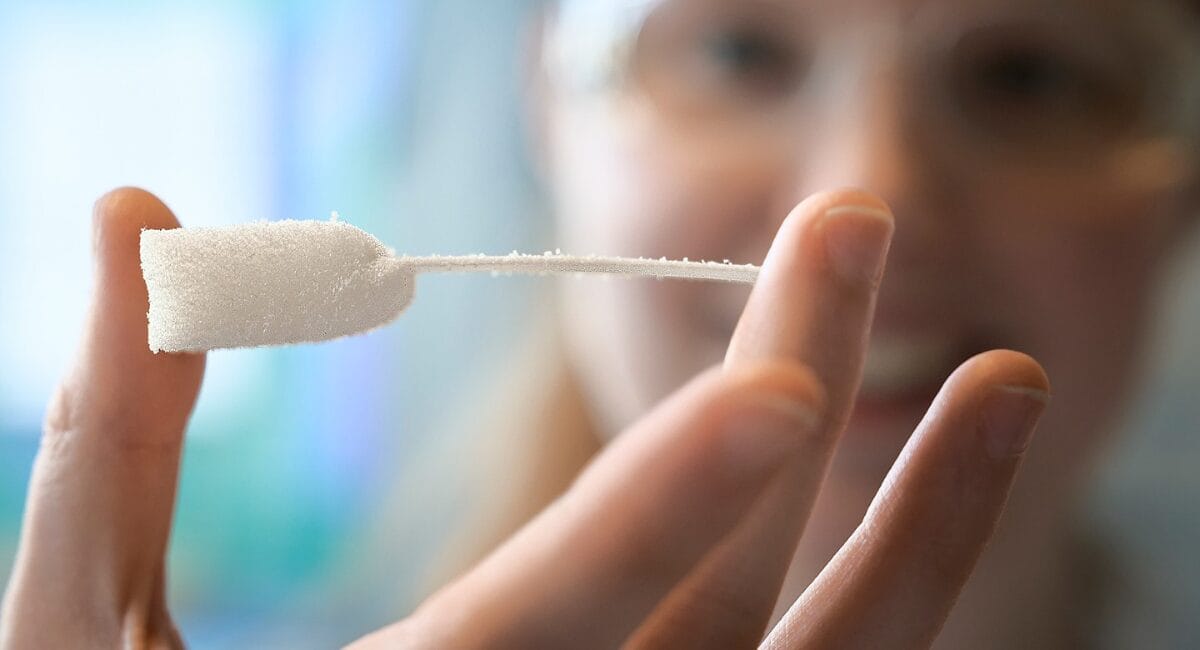
The new material is a shape memory polymer. It is capable of this, to return to its original shape after it has been deformed. An external stimulus such as heat triggers the shape memory effect. The researchers synthesised a polyurethane foam for the film and then compressed it. At a temperature of 60 degrees Celsius, the film expands from a thickness of 2.5 millimetres to a foam with a height of 40 millimetres - an expansion by a factor of 16. The result is a soft and elastic PU foam with a density of 80 kilograms per cubic metre. According to the DIN EN ISO 33861 standard, this is a low-density foam, which is suitable as packaging material, among other things.
Space-saving: semi-finished product made from shape memory foam
Industrial production often uses polyurethane foams as a standardised, prefabricated intermediate product in cut-to-size form. In the production process, these so-called semi-finished products are further processed or directly integrated into end products. They enable mass production with consistent quality. Their drawback: polyurethane foams take up a lot of volume. „Our film saves space during transport and storage,“ emphasises Thorsten Pretsch. The film only foams up when it is heated to sixty degrees Celsius. „This benefits both Industries that want to reduce their logistics costs, as well as industries in which a low transport volume is desirable, such as aerospace,“ says the scientist.
Low-density PU foams are suitable for a wide range of applications and industries: Furniture manufacturers use them for upholstery, in the packaging industry they protect fragile goods during transport, in the construction industry PU foams backfill joints, in vehicle interiors they are used for insulation or panelling. The properties of the innovative material are variable: the scientists can customise how flexible or transparent the film is before foaming. The density, thermal conductivity, elasticity or compression properties of the foam can also be customised. „We adapt the properties of the film foam to the technical requirements of different applications“, says Thorsten Pretsch.
Source: Fraunhofer IAP