Adapa relies on the shrink bag

Although shrink bags are not a new development, they are currently experiencing a boost as a resource-saving packaging solution in the food sector. The adapa Group is also focussing on this trend.

Although shrink bags are not a new development, they are currently experiencing a boost as a resource-saving packaging solution in the food sector. The adapa Group is also focussing on this trend.

Shrink bags have been a tried and tested packaging solution for decades and are also a real high-tech product: Modern shrink materials are extremely thin and consist of several different layers that give the respective packaging its special properties. Shrink packaging is efficient and offers the packaged goods protection and quality retention throughout their entire life cycle. Shrink bags are used as maturing packaging for certain products, e.g. cheese or meat. With their barrier properties tailored to the respective packaged goods, they ensure high product quality. In terms of look and feel Shrink-wrap is „honest packaging“It presents its contents clearly visible and tangible from all sides. In addition, the good printability offers many possibilities for an eye-catching brand presentation, whether in the service counter or on the self-service shelf in food retail.

In the interests of conserving resources and protecting the climate adapa With its entire portfolio of flexible packaging solutions, the company endeavours to combine the best packaging performance and use of materials. In the shrink bag segment, this has been achieved through many years of development work, which has resulted in ever thinner films. has made this packaging variant an extremely sustainable solution. Shrink bags combine reliable product protection - which simultaneously counteracts food waste - with minimised material usage.

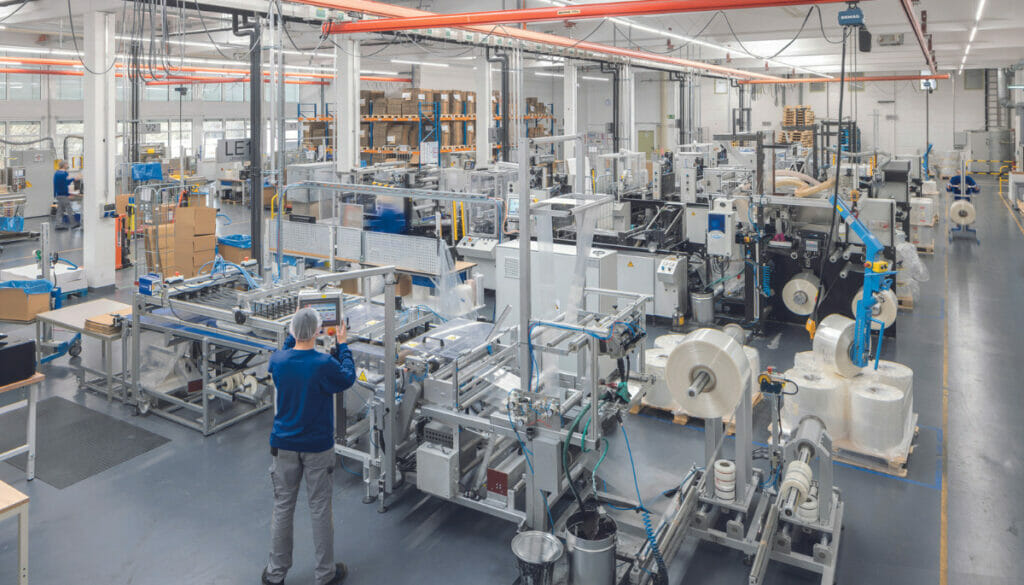
The bagging system in Kempten supplies shrink bags customised to customer requirements. (Image: adapa Group)

The process sequences in shrink bag packaging are now largely automated. The bags are opened in the systems, filled with the product, vacuum-packed, sealed and then shrink-wrapped. Robot technology is increasingly being used to fill the pouches. This high degree of automation has massively increased the cycle output (packs/minute) and has led to a doubling of the packaging speed in recent years. The high speed, combined with shorter cycle times, leaves less time for sealing, so that the sealing media have been adapted to ever smaller processing windows. In addition, shrink bags for these highly automated packaging processes require appropriate mechanical strength and particularly reliable sealing seams, as they are exposed to high loads during the filling process. Overall, the degree of automation and therefore the packaging speed depend heavily on the filling product: while uniform and firm products, e.g. pieces or loaves of cheese, can be packaged relatively well automatically, this is not always possible to the same extent for soft products with varying sizes, such as fresh meat.

Display

Multiple awards

The packaging industry's commitment to more sustainable solutions means that the classic shrink bag can fully utilise its properties. As part of its company-wide rethink initiative, the adapa Group is working with its customers to replace conventional packaging with more sustainable alternatives. A prime example of this is the VACUshrink(re) MEX 55: the shrink bag with a high barrier, which is suitable for packaging meat or cheese, does not require the usual cross-linking. The PE-based, recyclable pouch is free from PA layers or PVDC barriers and can be processed on conventional systems, according to the company. The VACUshrink(re) MEX 55 was honoured with the WorldStar Award 2023 in the packaging materials and components category. It also won the German Packaging Award 2022 in the Sustainability category and the PackTheFuture Award 2023 in the Design for Recycling category and was recently shortlisted for the Environmental Packaging Award.

The adapa Group's shrink materials are available both as prefabricated bags and as flat films. The shrink bags are available with different seam shapes, such as bottom and side seams in various designs, as well as special trapezoidal bags. The shrink bags, which are supplied loose, stacked, on a chain or as tear-off bags on a roll, can be processed on all standard packaging systems. The packaging solution has great future potential thanks to its good compatibility of product protection and resource conservation. This fact has motivated the adapa Group to invest in two locations at once. In Kempten in southern Germany, the company has invested in an upgrade to increase capacity at adapa's Centre of Excellence for shrink materials. In addition, the site in St Helens Limited in the north of England is currently being expanded with two shrink bag systems, which will offer British customers in particular even faster availability and the best local service.

Source: adapa

More news from the packaging and packaging materials sector