
Potential of AI in packaging design

From packaging to purchase - what happens in the brain? Neuroscientific findings make the relevant success factors for customised package design comprehensible. Artificial intelligence (AI) becomes an assistant in the design process and saves time and resources.

From packaging to purchase - what happens in the brain? Neuroscientific findings make the relevant success factors for customised package design comprehensible. Artificial intelligence (AI) becomes an assistant in the design process and saves time and resources.

Whether it's crisps, oat biscuits or wine gums - packaging plays a decisive role in the marketing of food and confectionery. It is the touchpoint with the highest frequency of contact. Consumers often plan which categories they want to buy, but The decision on which product to buy is usually made at the PoS. This purchasing decision is significantly influenced by the packaging design. But it also influences the product experience during use. It has a significant influence on the perception of odour, taste and even product performance. Neuroscience offers a systematic approach to the effect and success factors of packaging. AI solutions are now able to evaluate precisely these success drivers automatically and therefore quickly and cost-effectively.

(Image: aimpower)

What are the drivers of success and how can AI help to verify them? Dr Dirk Held from aimpower supported us with his expertise during the analysis. He is one of the leading experts in the transfer of scientific findings into concrete marketing measures. He is also the author of several bestsellers on the subject of neuromarketing and advises international brands on optimising their marketing activities worldwide.

„AI can now be used in a targeted manner to assess brand consistency.“

Display

Dr Dirk Held from aimpower is an expert in the field of behavioural economics, in particular the influence of brands on purchasing decisions.

Immediate attention

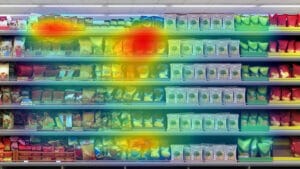
Packaging that stands out from the crowd and manages to attract attention is more likely to be purchased. The design, but also the placement in the environment, plays a decisive role here. The stronger the visual contrast, the more the packaging stands out. In addition, the important information about the product on the packaging must be eye-catching. AI solutions that have been trained with human attention data are able to do this, predict the corresponding attention without cost-intensive eye-tracking. This allows the manufacturer to optimise the placement and design of its packaging in terms of attention.

Easy to record

Visual elements and texts are then recognised. Visual simplicity is particularly helpful here. Complicated packaging generates cognitive effort, and this is coded by the brain as pain or punishment. At the other end of this scale is coding as a reward: the brain is basically made for quick decisions, not for thinking. Therefore information must be easy and quick to grasp. These criteria can be easily measured using algorithms. For example, it is known from research that people can read an average of four words per second. AI can extract the words on the packaging and then predict them, how many seconds a human brain needs, to read the text on the packaging. This allows you to check whether the information is easy to perceive.

aimpower artificial intelligence
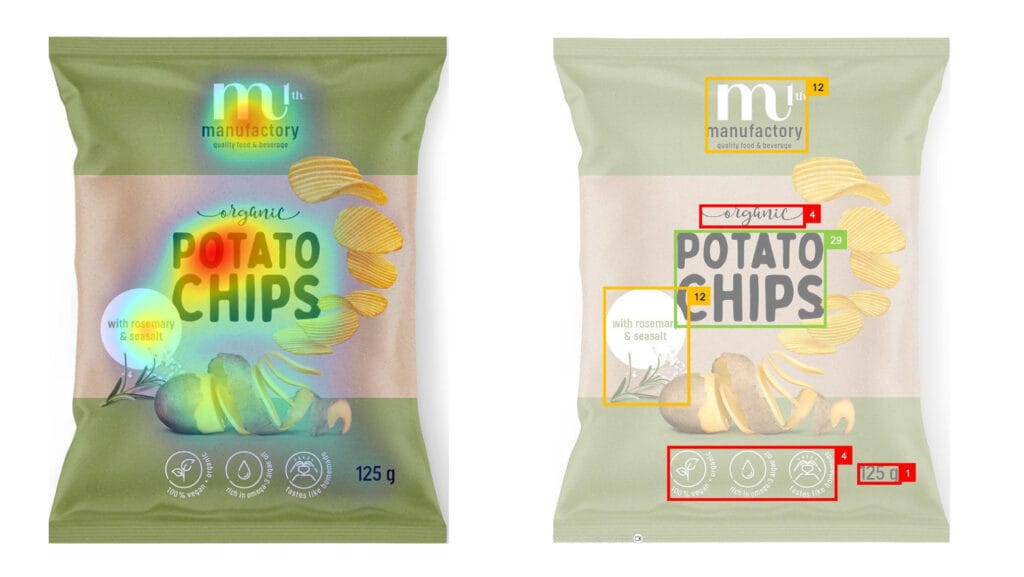
AI-based attention analysis of a packaging design. Which details stand out? Do the important elements get enough attention? (Image: aimpower)

The packaging must also be consistent at brand level. To be recognisable in the brand block, the product variant must also be Express the specific benefits via visual and textual elements. This is the only way buyers can quickly find their way around the product range. So how does the brain recognise which brand it is? The brain recognises brands based on iconic cues: elements that are strongly associated with the brand - such as Haribo's Gold Bear. If these elements are present in an eye-catching way, the brand is recognised.

„Neural networks are trained to recognise the specific brand and its competitors,“ explains Dirk Held from aimpower. Using the human brain as a model, the neural networks learn the patterns and iconic features of a brand. If the system is confronted with a new design proposal, the AI can make statements about it, whether the iconic features such as brand name, logo, colours are present, how distinctive the design is and how high the risk of evoking associations with competitor products is. The right balance between originality and consistency can be continuously optimised in the design draft based on the findings from such tests.

Visible value proposition

Within the brand range, the consumer must then recognise which of the products is the right one for their needs. For example, if they are looking for a product from organic farming, the colour green is „iconic“ for this benefit. The colour green is intuitively associated with „nature“/„organic“. By using this iconic cue, the packaging signals that this product is „organic“.

Using the right benefit cues also has another advantage: in addition to the visual contrast attention is also influenced by our needs. So when we feel the need for an organic product, our brain scans the environment for signals that symbolise organically grown products. So if there is green packaging on the shelf, our attention is drawn to it.

The final choice of product then depends on the relative value of the product. The brain calculates this in terms of the expected reward or the expected pain. Reward is the expected fulfilment of the need. And This expectation is created by the packaging design. The colour green is associated with organically grown food, and if this is the need, then the reward value is high. In addition to the complexity of gathering information, the price of the product and the expected effort involved in transport or storage may also cause pain. The formula is as follows: Value equals reward minus pain. The product with the highest value is purchased.

Companies are naturally aware of the importance of effective packaging and usually spend a lot of money and time developing the right design for their products and brands. Usually, a creative team proposes a series of packaging designs based on a briefing. After a subjective assessment by the client, selected versions are further refined until two or three of them are finally tested. The consumer tests are designed to determine whether they like the product, understand it and whether they would buy it. Eye-tracking studies are sometimes used, which provide information about the assertiveness of the design in the shelf environment. „However, these consumer tests tend to be time-consuming and cost-intensive and are therefore usually only carried out at the end of the process,“ Dirk Held knows from experience. „Here, AI offers the opportunity to iteratively evaluate and optimise designs from the very beginning of the design process."

Shelf set-ups also vary from retailer to retailer. In addition, there are product environments in e-commerce that also differ greatly from one another due to their dynamic display. Thanks to automation and significantly lower costs, packaging can be tested by AI in many environments.

Evidence-based decision-making

Developing the right packaging design is a complex challenge. Today, AI offers the opportunity, to streamline the lengthy and costly design process. „AI solutions such as brainsuite of aimpower are able to evaluate the relevant success factors quickly and cost-effectively and find optimisation approaches,“ emphasises Dirk Held. As the use of such tools hardly incurs any incremental costs, it enables brand and design teams to do more than just optimise, test several packaging variants in the early stages of development, but at the same time in a large number of environments.

Important decisions can thus be initiated at an early stage and expensive undesirable developments avoided become. As a positive side effect, the results also help in discussions with retailers when it comes to placing a brand appropriately on the shelf.

from the magazine - More news

In the Battpack folding box with the mobile partition, full and empty batteries no longer get mixed up.

Battpack: No more battery chaos

Leonie Theurer has developed a simple and innovative solution that allows empty and full AA batteries to be stored separately in a single pack. This won her a German Packaging Award in the Young Talent category and one of the coveted Gold Awards.
Read more "
aimpower artificial intelligence

Potential of AI in packaging design

From packaging to purchase - what happens in the brain? Neuroscientific findings make the relevant success factors for customised package design comprehensible. Artificial intelligence (AI) becomes an assistant in the design process and saves time and resources.
Read more "