To further improve the conditions of the sterilisation process during pudding filling at the Danone GmbH plant, active ingredient mists from AirSolution GmbH with natural ingredients are used.
5. July 2018
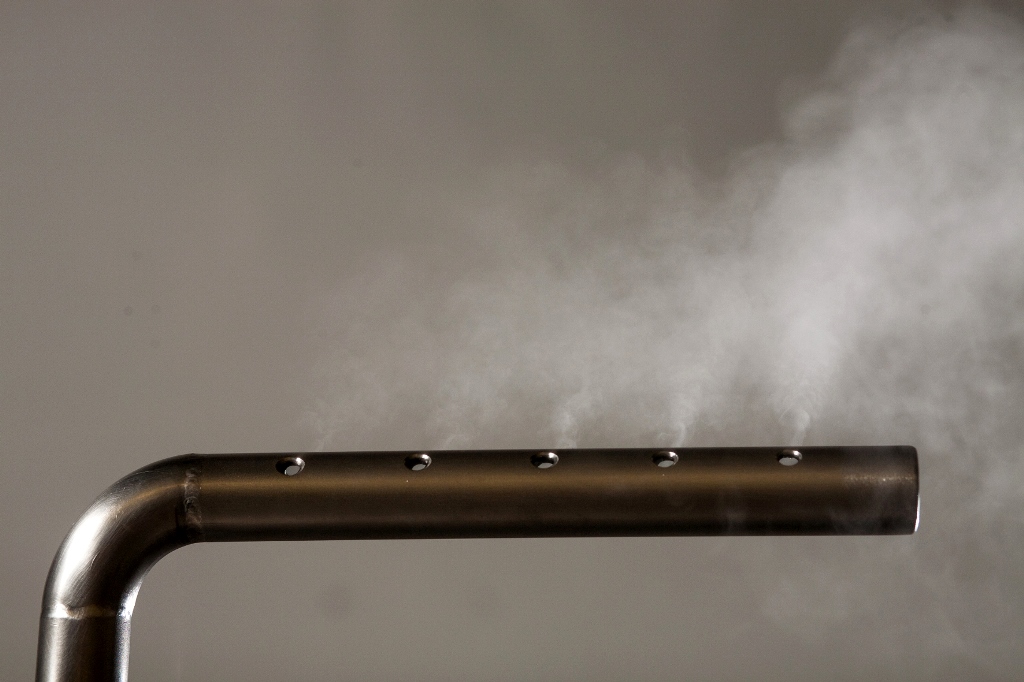
At the critical points in the pudding filling process, a harmless, micro-fine mist of active ingredient is introduced, which measurably reduces the number of germs in the ambient air and on the surfaces. (Image: Danone GmbH)
Previous sterilisation processes for packaging dairy products often use chemicals to combat unwanted microorganisms. To further improve the conditions for pudding filling at the Danone GmbH plant in Ochsenfurt, active ingredient mists from AirSolution GmbH, Bremen, with natural ingredients are used.
Dairy products are produced under constant monitoring and are subject to strict hygiene regulations. Traditional sterilisation processes can usually only be used with considerable safety precautions for employees. At Danone, an innovative and proven method is used to sanitise the plant that also protects the environment. Nebuliser modules is used at the most important points in the filling process. Microfine active ingredient mist which is based on natural ingredients and measurably reduces the number of germs in the ambient air and on surfaces.
The nebuliser modules are used to introduce micro-fine mists of active ingredients. (Image: Danone GmbH)
The active ingredient „L.O.G. four“ poses no risk to food safety, employee health or the environment. The active ingredient, the process and the nebulisation devices were developed by AirSolution.
Extensive measures
The Danone food group uses several measures to optimise hygiene standards in production: Cup and lid film are sterilised with UVC lamps. The plant in Ochsenfurt also carries out regular air measurements in the production area as well as sterilisation and uses a laminar flow bonnet over the cup film unwinding system to keep the air free of unwanted particles. In addition, the sterile chamber is disinfected manually every time the product is changed. As regular monitoring in the pudding filling area had nevertheless revealed yeast and mould from time to time, the company decided to use the further optimise the disinfection process. „The aim was to reduce the percentage of mould in the finished product to almost zero, even after 14 days at a continuous temperature of 25 °C,“ explains Paolo Paparella, hygiene officer at Danone in Ochsenfurt. „The process should also be improved to such an extent that all empty cups, including the lid and cup foil, are completely germ-free.“
Display
Paolo Paparella
„Our aim was for the finished product to have a percentage mould content of almost zero even after 14 days at a continuous temperature of 25 °C. In addition, all empty cups, including the lid and cup foil, had to be completely mould-free,“ explains Paolo Paparella, hygiene officer at Danone in Ochsenfurt.
Additional sterilisation system
With this in mind, Danone commissioned AirSolution GmbH to connect an additional sterilisation system at the beginning of 2016. The system is used Active ingredient L.O.G. four, which consists exclusively of natural ingredients and can be legally used throughout the EU as a food processing aid. The company's development was inspired by nature, which has developed efficient mechanisms to defend itself against pests and germs. The active disinfectant eliminates bacteria, yeast, mould and even noroviruses in an environmentally friendly way. In addition, its effectiveness against pathogens, including salmonella, listeria and Escherichia coli, has been confirmed by DIN EN-certified reports.
Leif Tober
„For monitoring purposes, we determined the influence of mould in empty and filled cups. We then compared these values with the figures that were obtained without the new sterilisation system,“ explains Leif Tober, responsible for engineering and application technology at AirSolution GmbH.
For the plant in Ochsenfurt, the hygiene expert installed (within three days) three Nebuliser modules at the neuralgic points of the pudding filling machine. The active ingredient is distributed via the nebulisers in droplet sizes between 0.1 and 100 μm. „We usually place the modules in two places: firstly to sterilise the packaging material in the empty cups, and secondly to sterilise the packaging head space as well as the blanks and lids,“ explains Leif Tober, responsible for engineering and application technology at AirSolution GmbH.
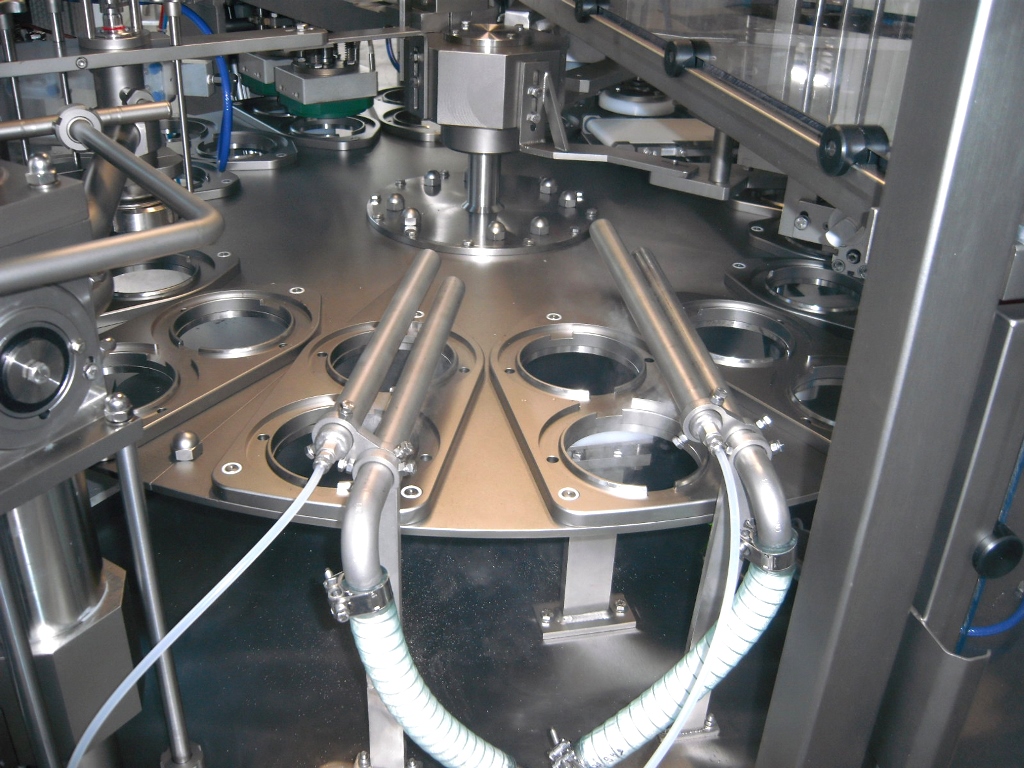
Special nebuliser modules are used to sterilise the empty cups and for the packaging head space as well as the blanks and lids. (Image: AirSolution GmbH)
At Danone, however more complex machines which require more nebuliser modules. Both cups and lids are made from film webs, the lids are threaded into the system and then placed over the filled cups. Finally, the lidding film is sealed onto the cups, which are then punched out in a special mould. The first two lances were fitted in the usual places, i.e. at the empty cup and head space. As the filling consists of two separate layers, one of custard and one of cream, a further lance was fitted directly after the custard filling station to provide additional protection for the interior of the machine. The installation of a fourth lance on the top film was planned and implemented in order to further optimise the hygienic protection of the entire process.
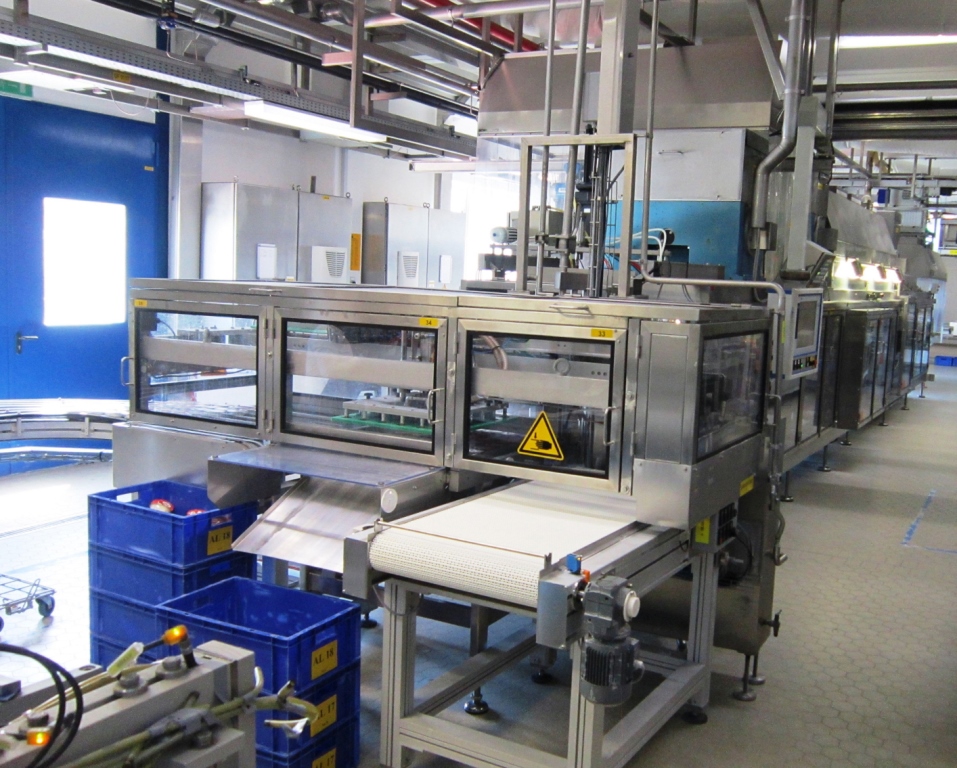
As the filling consists of a pudding and a cream layer, another lance was installed directly after the pudding filling station to provide additional protection for the interior of the system. (Image: Danone GmbH)
Fully automatic process
The nebuliser modules were integrated into the filling process in such a way that the previous production speed could be maintained unchanged. This means that the system now covers the entire inner area of the machine, from the empty cup to the finished product. In addition, sterilisation and filling are linked via a release and function fully automatically. To achieve this, AirSolution installed a control cabinet with Microprocessor control. „If a fault occurs or production is stopped, for example during a product change, the nebulisation is also switched off automatically and a changeover valve is activated on each module,“ explains Paolo Paparella. This mechanism ensures physical separation between the sterilisation system and the products so that the active ingredient cannot get into the cups. The two systems are linked in such a way that there is no need to operate the AirSolution system separately, which means no additional work for the operator.
Efficiency of the system confirmed
After commissioning, AirSolution and Danone extensively tested the effectiveness of the sterilisation system. Despite the already very good hygiene standards and limit values in the existing production, the Sterilisation through the use of the AirSolution system significantly improved once again are used. Danone uses this process in addition to the hygiene measures already in place. „We want to continuously optimise the process of keeping our food clean. To this end, we are currently calculating the most effective use of L.O.G. four in order to achieve an ideal balance between dosage quantity and operating costs,“ explains Paolo Paparella. Based on the good results, the hygiene officer can also imagine equipping a second dessert line with the AirSolution system. [infotext]
About AirSolution GmbH
Founded in 2000, AirSolution GmbH specialises in the sanitisation and disinfection of air, water and surfaces using natural, sustainable and compatible active ingredients. The basis for this are groups of substances that are also contained in conventional foods, which is why they are harmless to the health of both the user and the consumer. It is also possible to sterilise during operation in the presence of staff. The interaction of the components results in a strong germ-reducing effect of up to log 7 and more, which has been proven by experts and in practice. Well-known customers from various sectors, in particular the food and beverage industry, are now using the company's solutions[/infotext].
About Danone GmbH
The foundation stone for Danone GmbH was laid back in 1850 by the Frenchman Charles Gervais, who produced cream cheese in his company of the same name. Independently of this, Isaac Carasso, the founder of Danone, worked in Barcelona on the development of a recipe for healthy yoghurt. In 1967, the two companies merged on an international level. Two years later, the German Gervais Danone AG was founded, which has been trading as Danone GmbH since 1996. Today, the company operates two large research facilities with 1,200 employees. The food group also regularly co-operates with renowned institutes.