Dogs and cats are increasingly regarded as members of the family. As a result, pet owners are becoming more demanding when it comes to their pet's diet. The pet food industry is responding and promoting healthy products with functional ingredients and new dosage forms. The use of insect proteins could become a trend. Many pet food manufacturers are also switching to more sustainable, recyclable packaging.
Market researchers estimate that the German animal feed market to over 6.5 billion euros in 2024 - And the trend is rising. However, the trend towards the humanisation of pets is also leading to a dynamic change in their diet. Raw meat, grain-free products or food with insect proteins are in demand, as are functional ingredients and new dosage forms. Many products are processed and packaged according to food standards - on food processing machines from well-known manufacturers. And, as in the food sector, conventional packaging is becoming increasingly obsolete in the pet food sector. switched to resource-saving, recyclable alternatives.
Great Britain, France, Germany and Italy are the four top markets for pet food in Europe, followed by Spain, the Netherlands and Bulgaria. „We are currently seeing the highest annual growth rate for products with sustainability attributes in these markets,“ says Javier Muñoz, Senior Analyst at Euromonitor. „Pet owners here are prepared to pay more for sustainability promises from manufacturers.“

Market for insect-based animal feed is growing
The use of insects in pet food could become a trend in the future. According to the French biotech company Agronutris, the proportion of insect proteins could rise to 40 per cent of the sales volume in the pet food market by 2030. Already today there are over 100 brands and more than 500 insect-based products for pets. Agronutris specialises in the rearing and processing of black soldier fly larvae and produces proteins and lipids. Novel foods such as these (also known as novel foods) require authorisation, which in Europe is governed by a separate EU regulation. „We were the first European company to receive novel food authorisation for insect food,“ says Chloé Champion, animal feed developer at Agronutris.
Last year, the company commissioned a 16,000 square metre plant in eastern France, which is expected to process up to 70,000 tonnes of organic waste per year at full capacity. The complete process technology for the industrial insect plant was supplied by the Swiss machine manufacturer Bühler. Its solutions cover the entire production chain, from the preparation of the raw material to a fully automated larvae rearing system with sophisticated climate control through to the processing line for converting the reared larvae into protein meal and lipids of consistent quality. Bühler was also responsible for the entire automation and on-time project realisation.
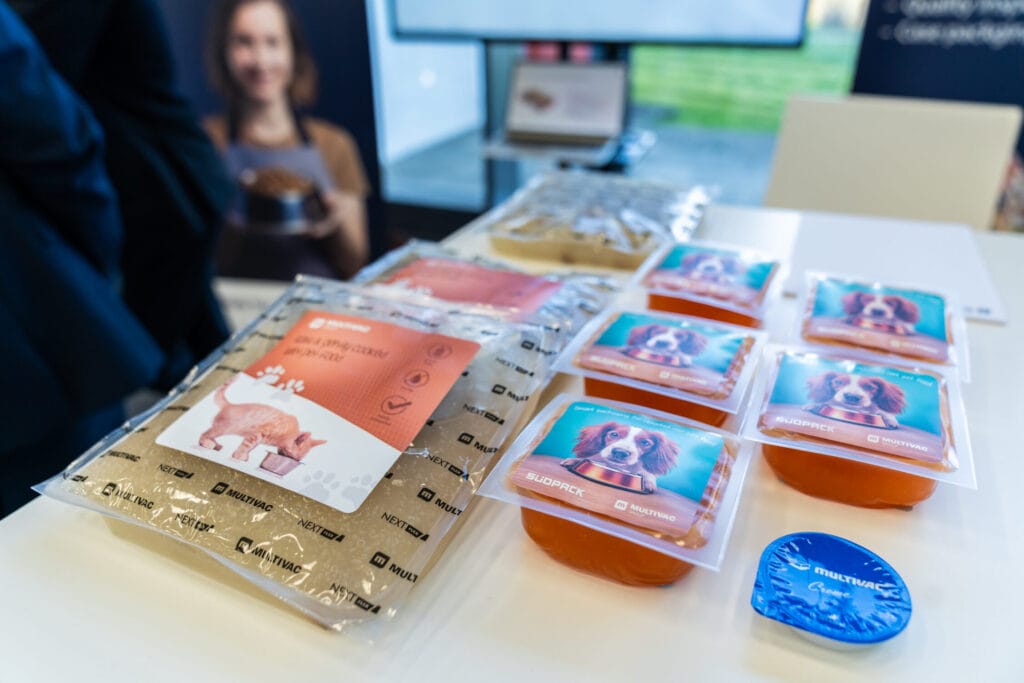
Recyclable thermoformed packaging for wet food
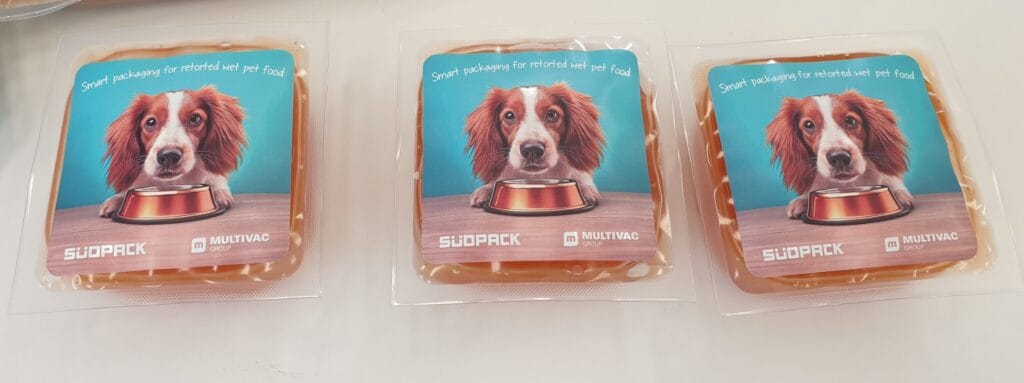
Sustainable pet food packaging should guarantee a long shelf life for the packaged food, be recyclable and cost-effective. Machine manufacturer Multivac and film specialist Südpack have therefore joined forces and are working together on the Development of a flexible packaging solution for wet food, which is intended to fulfil these requirements. They recently presented the first results. Multivac already has machine solutions in its portfolio for packaging raw and gently cooked pet food as well as snacks and treats. Now Sterilised wet food in flexible thermoformed packaging and thus close a gap. The new development should use less material, be recyclable and guarantee that the product can be stored at room temperature for twelve months.
The new deep drawing solution for example, saves around 50 per cent material compared to conventional pet food tins. The flexible packaging is also easier to open, has no sharp edges and produces less packaging waste. The pack geometry and size can be varied, as can the film type and thickness. Opening aids and perforations can also be integrated, and embossing or customised printing is also possible. However, further tests are required before the recyclable wet food packaging reaches the shelves of pet shops. The necessary certifications for recyclability are also still pending.
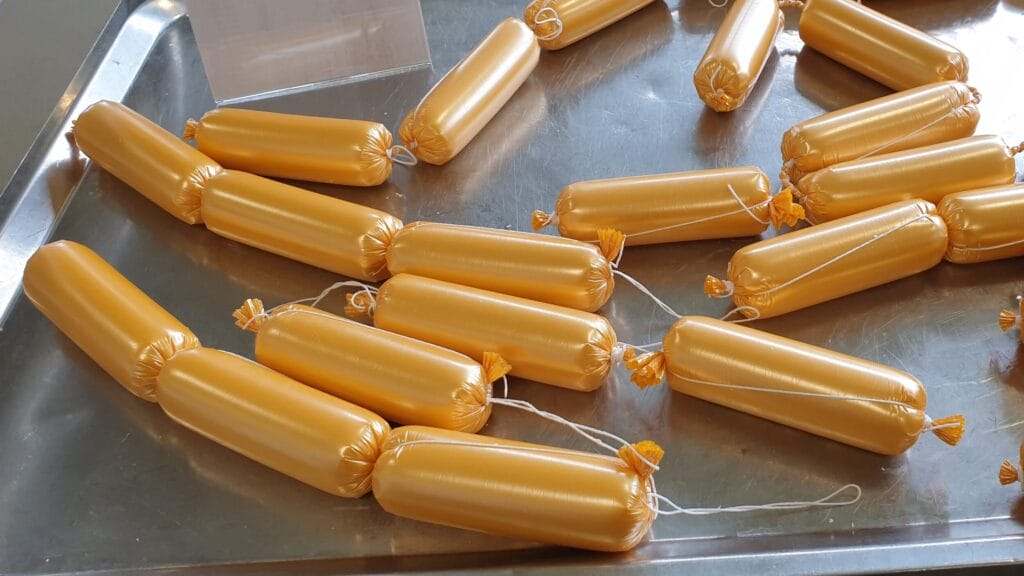
Like handmade
Dog food in flexible plastic casings is becoming increasingly popular, partly because little packaging waste remains after use. The dog sausages are usually sealed with a metal clip and cannot be resealed once opened. Handtmann has now developed a new concept in which tie the sausages together with a thread without a metal clip be used. This also serves animal safety, they say. The tied thread is also intended for a handcrafted premium look and ensure reclosability. Handtmann produces the new dog sausages on its Inotec VarioMix mixing system, which is equipped with interlocking, independently controllable spiral shafts and can therefore be optimally adapted to a wide variety of products. The sausages are then tied with the Inotec IG5-iT tying machine at high output with freely definable distances, with or without a loop and with precise weight. They can then be separated directly. A special thread specially developed by Handtmann is also used.