The Anuga FoodTec planned for next March has been cancelled in 2021. The supplier fair for the food and beverage industry will not take place again until April 2022 as a hybrid event.
11 December 2020
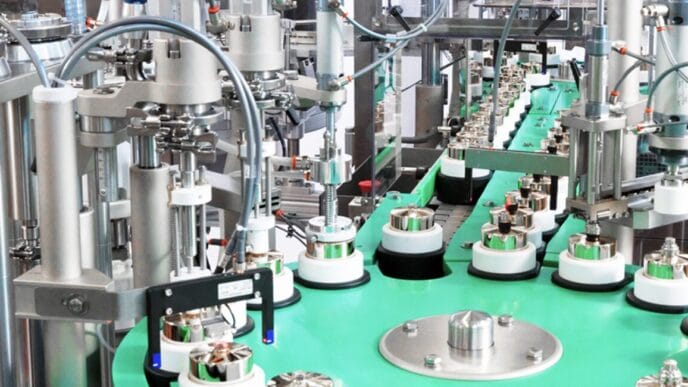
Process technology at Anuga FoodTec (Image: KoelnMesse)
The Anuga FoodTec planned for next March has been cancelled in 2021. The supplier fair for the food and beverage industry will not take place again until April 2022 as a hybrid event.
According to trade fair organiser Koelnmesse, the cancellation follows intensive discussions with industry participants and the DLG Deutsche Landwirtschafts-Gesellschaft e. V. (German Agricultural Society), the trade fair's technical and conceptual sponsor. The new date for Anuga FoodTec is 26 to 29 April 2022.
(Image: Koelnmesse)
„We very much regret that we have to postpone Anuga FoodTec until 2022 despite good preparations and encouragement from the industry. However, there have been signs of increasing scepticism and concern among all those involved in recent weeks. As a result, many companies withdrew in view of the infection situation and the current uncertainties. However, Anuga FoodTec cannot be realised without the important key factors of internationality and cross-industry participation. The What the industry wants, We have therefore taken into account the need to postpone the trade fair with the new date.“ Oliver Frese, Chief Operating Officer, Koelnmesse
Maintaining internationality
With an event date in 2022, Koelnmesse wants to offer the industry Perspective and planning security will take place. The planned combination of presence and digital platform should ensure that as many interested parties as possible from Germany and abroad can gain access to the latest technologies and processes in the food and beverage industry. The hybrid event will be organised under the motto Smart Solutions - Higher Flexibility stand.
Display
Source: Cologne Trade Fair
Read our article from 2 June 2020:
Flexible solutions for the food industry
Increasingly complex market requirements due to greater food variety and customised packaging formats are challenging machine manufacturers. They will be presenting their flexible solutions at Anuga FoodTec 2021.
From feeding and grouping the products, to filling, closing and labelling cartons, right through to palletising - the Maximum power and Highest process stability food producers can only achieve this through Complete digitalisation of machine and robot functions. The modern packaging machines used by the 23 to 26 March 2021 on the Anuga FoodTec will be on display, master the most varied types of primary and secondary packaging.
Convenience food gently packaged
Short changeover times, simple product and format changes as well as concepts that make it possible to Whole lines for convenience food can be recombined or extended as required. Soups, ready meals, sausage products and baby food play a particularly important role in this market segment in food retailing. There are also jams, smoothies and pureed fruit snacks.
The centrepiece of the Filling & Packaging lines shown at Anuga FoodTec are Integrated scales, Slicer and Compact traysealer or thermoformer, which are suitable for a wide range of products. They are designed to process trays, trays and many other formats. Equipped with innovative gas flushing technologies, they can gently pack sensitive foods or those that are hot-filled in a modified atmosphere (MAP).
Automation of small batch sizes
But no matter what food is involved, fully automatic portioning and insertion into the packaging requires a high degree of automation. High-tech. Producers who need to pack a lot of power into a small space or require more manoeuvrability when handling products will not be disappointed. Specialised pick-and-place robots not around.
The modern articulated arm, scara and delta kinematics that will be presented at Anuga FoodTec 2021 are able to pack products at high speed. However, the robots can do more than just pick up the sausages or fish fingers from the conveyor belt and place them in trays.
At the same time, they take over tasks that were previously the responsibility of end-of-line systems. Quality control and, for example, sort out damaged products without manual intervention. At the same time, they provide feedback to downstream sealing machines or labellers, which can then react directly to the detected deviations.
Hand in hand with the robot
The aim of the design engineers is to extend the field of application of the robots in the food industry to include the food industry. real cobot to expand. The term refers to collaborative lightweight robots that are designed to assist employees with palletising and packaging processes for small batch sizes.
A typical task is, for example, inserting juice pouches into the chain of a cartoner. Using sensor technology, they register the movements of people in their vicinity and are therefore sufficiently safe to assist with the work without injuring anyone.
The No structural protective devices such as light grids, cages or barriers saves costs and ensures smoother workflows between workers and robots. As a result, even medium-sized food producers can use a cobot where automation with a traditional robot is not economically viable for them.
Grippers from the 3D printer
The grippers are at the interface between the robot and the food. It is in the nature of things that here not the one-size-fits-all solution can give. The shape, orientation, weight and dimensions of the food to be handled influence the design. If, for example, delicate fruit is not to be crushed when gripping, vacuum technology and soft suction nozzles come into play. Against the background of these challenges, 3D-printed moulds offer completely new design freedom.
Numerous packaging machine manufacturers and robotics suppliers will be focusing on this topic at Anuga FoodTec 2021. The advantage of the additive manufacturing for the design lies in the almost limitless moulding possibilities. Another aspect: robot tools made of high-performance plastics that are approved for food contact do not require any lubricants and are therefore Practically maintenance-free.