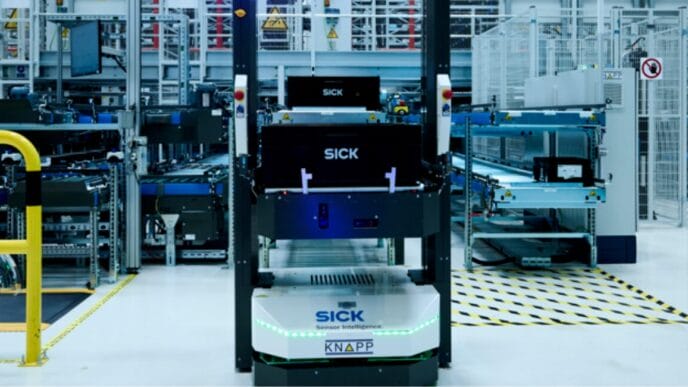
Digitalisation is currently affecting all industries. Processes in the packaging and recycling industries are also set to become smart - with the help of sensors, data processing and communication technologies.
We have worked with the AI specialist Markus Ahorner, Managing Director of Ahorner & Innovators, spoke about the use of artificial intelligence in industry.
pj: Mr Ahorner, chatbots and voice assistants are already part of everyday life for many people, the navigation devices in our cars are learning on their own and autonomous driving is already possible in principle. Artificial intelligence can be found in many things today. Industry 4.0 would be unthinkable without AI. Where is the development heading?

Markus Ahorner: The field of AI in which we work is that of the Machine learning. With machine learning, a computer can generate experience and knowledge from data and, like a human, learn to adapt to new, unprecedented situations. The core behind this is a mathematical algorithm, which changes constantly and automatically when it receives new data.
The great advantage of machine learning is that the hidden information, that are contained in very large amounts of data, in their full complexity quickly. This is often „Pattern recognition“ in „big data“ called. Machines are already superior to humans in this area. If more and more machines are now Internet of Things sensors data volumes will increase rapidly. They have to be processed somehow - and that will only be possible automatically.
pj: What does this look like in detail?
Markus Ahorner: For example, we archive data from a production line that is already controlled automatically today, and use it to train an AI data model. Such an AI model is then able to, to operate the entire system independently and even better than before. This requires as many sensors and data as possible in the system, such as for pressure, temperature or production volume. This is the The core idea of Industry 4.0: Making systems as intelligent and autonomous as possible, and there is still a lot of potential here today.
Once this industrial data from factories has been recorded and networked, it can be AI can digitally map their behaviour and condition, The result is that the processes can react independently to faults and deviations. The results are Automatic predictions and optimisations. In this way, the system gradually becomes autonomous.

pj: There are already examples of the use of AI in the recycling industry. The Alba Group, for example, is testing a sensor-supported robotic gripper arm in a lightweight packaging sorting system that uses artificial intelligence to distinguish and sort out silicone cartridges from other polyethylene packaging - something that standard near-infrared separation devices on the market cannot do. Will there be more adaptive systems in recycling processes in the future?
Markus Ahorner: Sorting work in recycling processes is crying out for AI: the more sensors and data we have, the better the systems can learn and control and monitor their processes independently. Unfortunately, the use of AI systems in the recycling industry is still in its infancy. Where employees sort manually, there is no data at all. With such Near infrared sensors However, with machines that can distinguish between different materials, the machines already generate wonderful data. This data must be stored for a few months, because an AI system is initially trained with historical values.
Generally speaking, the higher the degree of automation in a company, the better it is suited to the use of AI. Our Customers in the chemical industry have already many years ago in Process control technology and data archives and are now ideally prepared for the use of AI. For all others, modernisation or new acquisitions Modern sensor technology are now supplied almost automatically. At the moment, installing new sensors and AI is still a little time-consuming. But if we succeed in standardise the smart factory, costs will also fall.
pj: Federal Economics Minister Peter Altmaier says that artificial intelligence offers enormous opportunities for the economy, while at the same time the use of AI will have a major impact on the world of work and on people. Will AI ultimately destroy too many jobs?
Markus Ahorner: I put forward the following thesis: If you look at the history of industrialisation, humans never really belonged in the production processes. They always had to do the jobs that machines were too stupid to do. In the future, AI will take over the strenuous routine work - even with complex knowledge work - almost completely. This means that it becomes More freedom for people for special tasks and creative solutions to problems. Human labour could then become much less stressful and, above all, more interesting.
Another aspect is the demographic change. We keep getting enquiries from companies that are running out of qualified staff. AI can replace jobs here, which tomorrow will only be difficult to fill with skilled labour can be realised. However, the more that artificial intelligence replaces human knowledge routines, the larger the proportion of the population that will unfortunately be unable to recognise the importance of artificial intelligence in the short term during the transition period. no adequate workplace will find more.
pj: In which industry is the use of artificial intelligence particularly useful?
Markus Ahorner: The Controlling complex processes is nerve-wracking and exhausting in many industries. Yet almost all systems, not just process engineering systems, can be supported by AI. There is a lot of potential here. AI also helps, in the factory to minimise CO2-minimise our carbon footprint, because the systems run more resource-efficiently. It doesn't matter whether it's the Chemical industry, a Steel mill or the Packaging manufacturer is about. Most industrial plants are similar when it comes to the use of AI.
pj:What will the future look like?
Markus Ahorner: I am sure that many factories in the next ten years become more autonomous through artificial intelligence. When building new production facilities, care is already being taken to ensure that AI systems can be used right from the start. For me, that is certain: Artificial intelligence will change the industry forever. It will be the next industrial revolution.