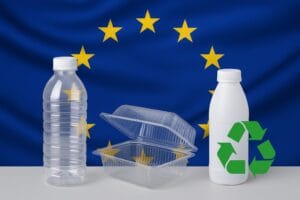
PPWR guidelines bring clarity and criticism
Associations see progress, but call for additional clarifications before the regulation comes into force in August 2026.
Read more " 




A plastic tax burdens consumers and damages the circular economy, criticises the Industrievereinigung Kunststoffverpackungen IK.
„A plastic levy would be passed on by companies to consumers in the form of higher product prices. This means that consumers pay the levy at the checkout.“
Dr Martin Engelmann, Managing Director of the Industrievereinigung Kunststoffverpackungen e.V.
It is incomprehensible to the industry that, in addition to the special single-use plastic levy that will be introduced from 2024, another levy is now to be paid on plastic packaging. „In Germany, the distributors of plastic packaging are already making a significant financial contribution to promoting the recycling of plastic packaging with the fees for the dual systems. In addition, there is an extremely effective collection system for single-use beverage packaging that is subject to a deposit and, from next year, the single-use plastic levy,“ explains Engelmann and explains that companies no longer have any room for further burdens exists.

According to the association, an additional plastic levy would have the wrong ecological steering effect in favour of more poorly recyclable paper composite packaging.
„We are very concerned that such a tax on plastic packaging would massively fuel the trend towards non-recyclable or poorly recyclable paper-plastic composite packaging. The Central Agency Packaging Register and the Federal Environment Agency recently warned of this.“
Dr Isabell Schmidt, Managing Director Circular Economy at IK
The industry proposes instead, to place a greater financial burden on poorly recyclable packaging in a material-neutral way. „Germany needs stronger financial instruments to promote packaging that is easy to recycle,“ explains Schmidt. „This fund model agreed in the coalition agreement The best way to develop the packaging market towards a circular economy in a financially effective and ecologically sensible way is to stagger the licence fees to the dual systems according to ecological criteria,“ says Schmidt.
The IK also criticises the justification for the plastic levy. „The German government is pretending that the so-called EU plastic levy should be passed on to companies. This is grossly misleading,“ explains Engelmann, pointing out that the EU plastic levy merely a method for calculating the contribution of the member states to the EU. „EU membership contributions were increased after Brexit to cover the hole in the EU budget. The additional funds from this so-called EU own resource flow from the national budgets of the member states into the general EU budget without being earmarked for a specific purpose. A „levy“ of these additional contributions to the EU is not necessary. Furthermore, it is not clear why the companies that produce or use plastic packaging should be liable for the consequences of Brexit in the EU budget and the unconstitutional budget management of the German government,“ says Engelmann.