Automatic visual inspection systems provide valuable data for an intelligent factory of the future in the field of pharmaceutical production. At Vitronic, machine vision becomes machine learning.
8 May 2020
Crimp quality inspection on vials: A special sensor enables 360-degree inspection of the caps with just one camera.
(Image: VITRONIC)
In the field of pharmaceutical production, industrial image processing (machine vision) stands for reliable product quality, high efficiency and stable processes. The automatic visual inspection systems used here also provide valuable data for the smart factory of the future. At Vitronic, machine vision becomes machine learning.
Automatic visual inspection systems are taking on increasingly complex inspection tasks. In pharmaceutical production in particular, there are strict legal requirements that must be met and documented throughout the entire filling and packaging process. Safe patient care is our top priority. An important prerequisite for this is 100 per cent tested products.
In the course of this inspection, all defined fault characteristics that can occur in the filling or packaging process must be reliably recognised. This requires an extremely Powerful and intelligent inspection system with hardware and software components, which are optimally harmonised with each other.
Dietmar Karepin, Business Development Manager Healthcare at VITRONIC (Image: VITRONIC)
„The EU-FMD calls for the Seamless traceability in the packaging process. Complete solutions from a single source are in demand, which include quality and assembly inspections as well as track & trace in addition to classic Auto-ID solutions and enable comprehensive documentation.“ Dietmar Karepin, Business Development Manager Healthcare at VITRONIC
Display
Automatic visual inspection systems - uDifferent requirements
The complexity of today's testing requirements is shown by the Inspection of vials. „Modern high-speed filling systems process up to 600 units per minute, so they have to be checked correspondingly quickly. Our quality control covers the entire production process“ emphasises Dietmar Karepin, Business Development Manager Healthcare at Vitronic Dr.-Ing. Stein Bildverarbeitungssysteme GmbH, Wiesbaden.
The test parameters not only include the reliable identification of the smallest particles and fibres. The vials are also inspected for cosmetic defects such as cracks and scratches. In addition, the visual inspection systems check the correct positioning of the stopper and the correct sealing of the vials - the so-called crimping.
Another example of pharmaceutical primary packaging that is inspected using camera-based systems are Blow-Fill-Seal container (BFS for short). „With BFS containers, we check everything immediately after filling and also before packaging,“ explains Karepin. „The Inline testing ensures that faulty containers are immediately removed from production - a key criterion for reliable patient care.“
But Many parenteral packages have their challenges. IV bags, for example, have an irregular shape that makes it difficult to read printed texts, codes and logos. „Here, we rely primarily on high-resolution cameras and sophisticated processes that reliably recognise even the smallest errors,“ adds Karepin.
Extensive test parameters and regulations
The numerous regulations and safety provisions such as the EU FMD, the European Union's Falsified Medicines Directive, are a challenge for pharmaceutical companies. In order to protect against misuse, prescription medicines may only be sold in a Packaging with serial number and original seals are brought to market and the data is stored in a central IT database.
This is a particular challenge for internationally active pharmaceutical companies that have to comply with the different regulations of the individual markets. As a result, their packaging contains more and more information such as labelling, codes and special safety features, some of which are invisible to the human eye. They all have to be detected during optical inspection.
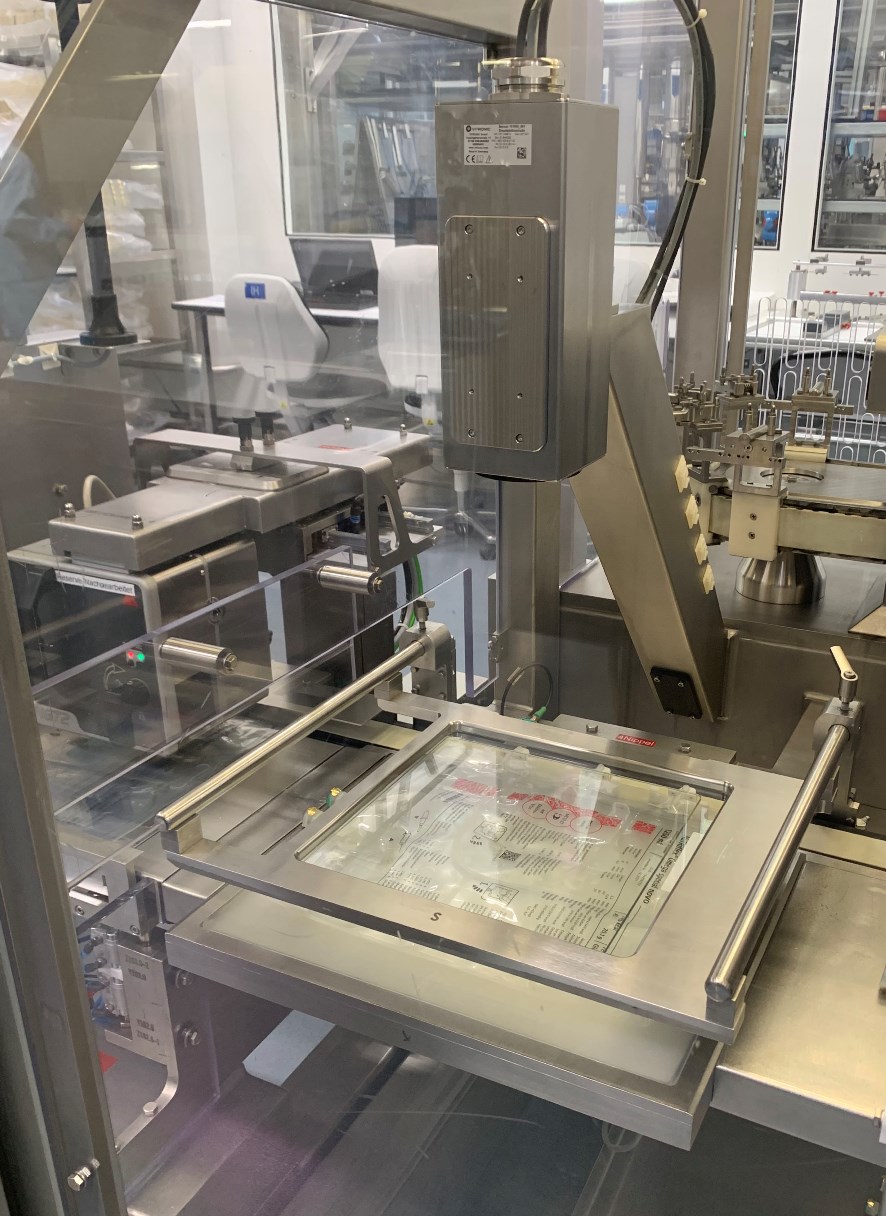
Testing the printing of multi-chamber pouches: The 32-megapixel camera above captures small font sizes on large print areas. (Image: B. Braun)
Intelligent utilisation of test data
The pharmaceutical packaging industry is all about increasingly to process smaller batches. This requires more flexible lines that can be converted within a short space of time. This also requires more flexibility in the testing systems. These must Scalable to different product variants and at the same time a Simple conversion which can also be carried out by the user.
„The data obtained by automatic testing systems offers enormous potential for this. One of the major challenges of the future is to utilise this even more intelligently,“ Karepin is certain. „This is precisely what we are currently focussing on in product development.“
One example is Deep learning methods for individual test applications, which serve to further improve the processes and results in error detection. Particularly promising is the „Closed Loop“, i.e. automatic trend analysis. In the automated application, the information from the inspection is analysed and fed directly back into the machine control system, where it can then automatically correct the machine parameters. „The machine simply adapts itself,“ explains the Business Development Manager.
Simplify data exchange and networking
Machines that can communicate with each other are another key element of Industry 4.0, as this is the only way to ensure the Intelligent factory of the future realise. This requires a common machine language The expert is well aware of the importance of automation systems such as OPC UA: „We support the OPC UA Machine Vision initiative, which simplifies data exchange and networking at the automation level and thus enables more flexible use of vision systems.“
Another prerequisite is standardised interfaces that offer extensive independence from manufacturers' components. For example, the Wiesbaden-based company will introduce a standardised interface in the next release of its basic software Framework this spring. M2M interface, which is based on the OPC UA standard, as a Module for all of its automation solutions and thus redefine the image processing standard for the entire industry.