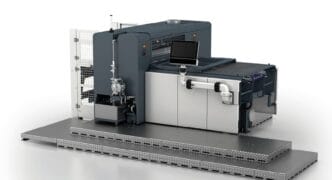
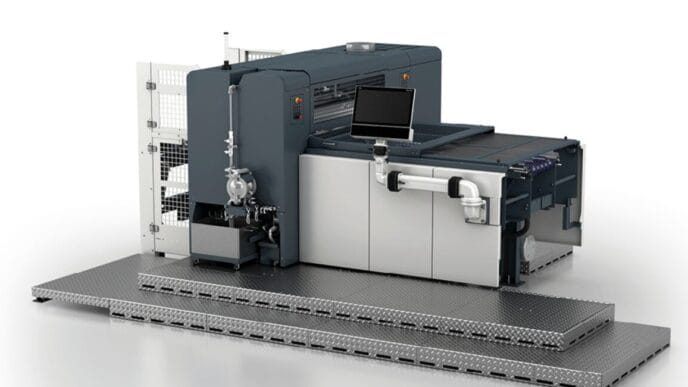
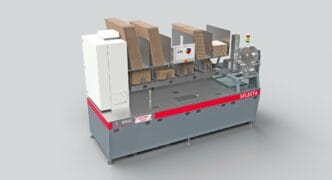
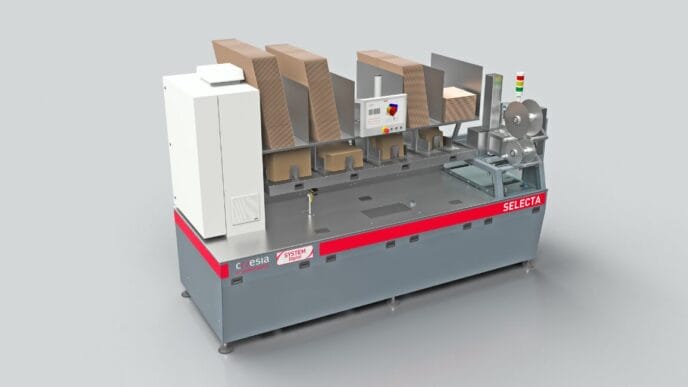
An innovative digital printing machine from Heidelberg enables even smaller companies to print customised three-dimensional objects from batch size 1 for the first time. The necessary precision of the motion sequences and the exact, reliable interaction of the system components are guaranteed by series-proven B&R technology.
Christmas, weddings, birthdays and other celebrations could be so wonderful if it weren't for the tiresome question of finding the right gift. It's no wonder that major sporting goods manufacturers, internet platforms and online retailers have successfully tackled this problem and are now offering customised printed items such as greetings cards or T-shirts. Until now, however, personalisation has been limited to products that have a largely flat surface (maximum 2.5 D) and can therefore be processed with standard printers.
For three-dimensional objects, on the other hand, individualisation was only economically feasible for batches of around ten or more (using pad printing) or for mass products such as drinks or cosmetics bottles due to the high costs involved. Heidelberger Druckmaschinen AG has now ensured that companies can customise Product personalisation in new dimensions can advance.

Customised printing of 3D objects
„In close collaboration with B&R and other leading technology partners, we have developed the Jetmaster Dimension was created. This standard machine makes it possible for the first time to Minimal customisation effort print almost any 3D object with customised texts and photorealistic images quickly and in high quality. This means that even smaller companies can offer customised products from a batch size of 1 at attractive conditions and thus expand their customer base,“ says Dr Bernard Beier, Head of Pre-Development at Heidelberg.
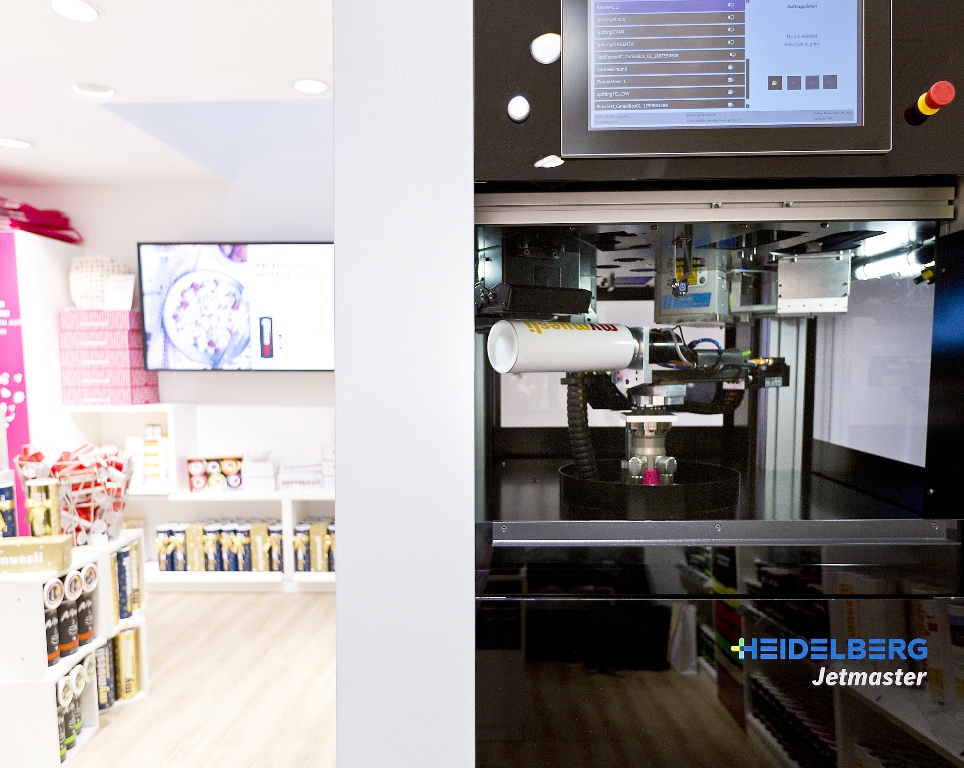
Several companies have already successfully utilised this opportunity. MyMuesli has recently started using a Jetmaster Dimension 250 in its Heidelberg shop. Customers can now not only put together muesli mixes according to their preferences, but also personalise the packaging on site with their own images and text and take them away immediately.
Printing in one pass
„One of the challenges here is that many printed objects, such as the paper cups from MyMuesli, deviate from the ideal shape,“ Dr Beier points out. „Each object is therefore checked before printing measured separately.“ The surface is then prepared with an atmospheric plasma for subsequent printing. To ensure that the printing process is particularly fast, a Single-pass print head (six colours) is used. This means that, unlike standard office inkjet printers, each printing point is only approached once. A LED UV spotlights pre-dries (pins) each colour dot to prevent bleeding. Finally, a UV lamp cures the finished print image completely. The processing cycle is then complete and the object is ready for immediate use.
The Jetmaster Dimension 250 is equipped with a four-axis robot for positioning the print object and rotating it under the various fixed processing stations (measuring, surface pre-processing, printing, curing). The path must be travelled with an accuracy of less than 20 μm in order to achieve the high-quality print image expected by the end customer at a resolution of 300 dpi. This requires absolutely precise control of the robot axes and their synchronisation with the print head control.
Leading technology partners on board
„It was clear to us from the outset that we wanted to realise the machine together with specialists. This approach not only guarantees access to the most advanced technologies, but also promises shorter project lead times. This assessment has been confirmed. It took just ten months from the first CAD drawing to the commissioning of the prototype,“ says Dr Beier.
However, the catalogue of requirements for the drive and control technology defined at the start of the project included far more than just high path accuracy and a flexible, open automation system with which the various subsystems can be integrated into a homogeneous unit with a manageable amount of effort.
Holger Leonhardt, The group manager responsible for 4D technology at Heidelberg, clarifies: „A suitable automation technology for us must not only cover the required range of functions, but must also be able to fulfil the requirements of our customers. suitable for series production be. However, many purchase controls do not fulfil this.“ Heidelberg uses the term 4D printing to describe the customised, flexible and digital printing of three-dimensional objects and other curved surfaces.
A must: automatic updates
For the Heidelberg Manager, series-capable means that the control system can also be commissioned without a development environment and can be configured at runtime. In addition, versioning of the control software, including the associated software tools, must be guaranteed and an automatic update of the control system and the connected automation components must be possible.
The Automation Studio engineering environment has in-built version control. In addition B&R controllers as requested via USB data carrier or via Ethernet with software. Each time the system boots up, it also checks for an update at a definable location and triggers an automatic update if necessary.
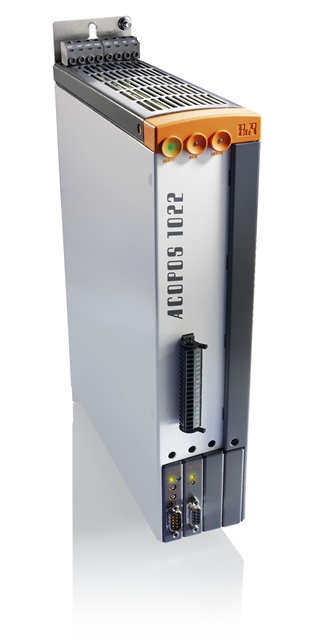
ACOPOS drives In addition, they receive their software centrally from the B&R controller without the need for manual intervention. „As the control software can be configured at runtime and the wiring lists can also be manipulated using the tools provided, we can manage with just one software project for different machine configurations,“ says Leonhardt.
Technology convergence facilitates
This ensured that B&R was awarded the contract by Heidelberg. The integrated, scalable and comprehensive product portfolio also played a key role in ensuring that the ambitious schedule for the development of the Jetmaster Dimension could be met. The Openness and flexibility of the B&R solution The integration of new or different technologies under a single control system plays a key role in this respect.
However, the group leader was equally convinced by the Support Before and during the realisation of the machine: „After less positive experiences with a very large control system supplier, B&R definitely surprised us positively here as well and far exceeded our expectations. The company's employees are experts in their field, well versed in automation issues and able to think their way into our tasks and come up with suitable solutions,“ emphasises Leonhardt.