In the wake of the coronavirus pandemic, more and more consumers around the world are buying their food online. Germany, France, the UK, Italy and the USA alone are expected to record 350 million more orders for food products online in 2020 than last year. The food trade is booming.
This would correspond to an additional turnover of around 36 billion US dollars. The boom is continuing despite the now relaxed coronavirus protection measures. Up to 45 per cent of the current sales growth in this channel is likely to be maintained. In addition, the proportion of online shopping could double in some countries by 2025. The other side of the coin: costs are rising at the same time. Without counter-strategies, companies' profit margins threaten to erode. This is the conclusion reached by the international management consultancy Bain & Company in a recent study, for which, among others, 7,500 Internet customers in Western Europe were surveyed. were.
At the temporary peak of the coronavirus crisis in mid-April 2020, the market share of food purchased online in the UK rose to 12.4 per cent. Last year, it had stood at 8.1 per cent. In France, it increased from 6.0 to 10.2 per cent, in the USA from 5.1 to 6.6 per cent and in Italy from 2.0 to 4.3 per cent. In Germany, this value is at a low level compared to other countries, although it also rose significantly from 1.5 to 2.9 per cent.

„However, the long-awaited online boom also poses a risk for food retailers. This is because most suppliers make a profit from orders delivered to the customer's home or collected from the shop. significantly less than with traditional on-site sales. Nevertheless, food retailers should not forego the promising online business. Those who do so may avoid a short-term drop in profits, but will lose their competitiveness in the long term.“ Miltiadis Athanassiou, Bain Partner and Head of the Retail Practice Group in Europe, Middle East and Africa (EMEA)
Don't ignore the upheaval in the food trade
The long-term success of food sales on the web depends largely on two factors. On the one hand the experiences of end customers play a role. How reliably does the retailer deliver and how fresh is the food ordered? On the other hand the reduction of lockdowns is important. How quickly will policymakers ease the protective measures that currently prevent many shoppers from shopping in bricks-and-mortar grocery stores? The Bain study assumes three scenarios in this regard - another wave of the pandemic, a continuous lifting of restrictions and a rapid return to traditional grocery shopping.
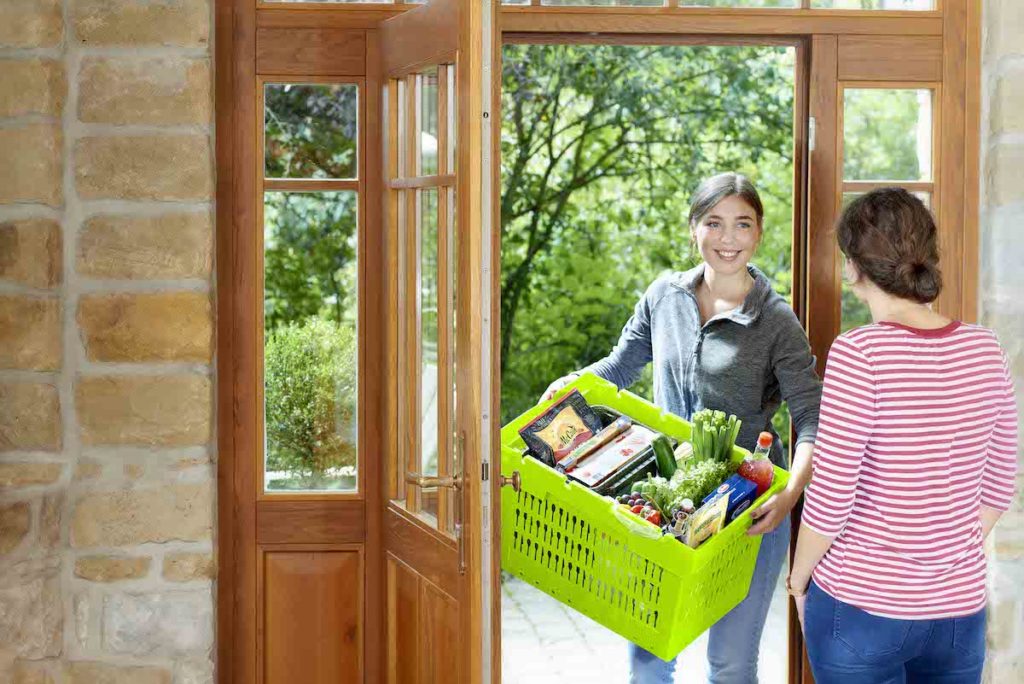
A particularly strong boost for the online grocery business can be expected if the first case materialises. According to the study, the market share in the UK would rise to 14 per cent by 2025, in France to 13 per cent, in the USA to 11 per cent, in Italy to 8 per cent and in Germany to no less than 4 per cent.
„But even without a further lockdown, the online channel is likely to grow faster than predicted before the pandemic. And there is a great risk that grocers and delivery companies will not adapt to this upheaval in time.“ Marie-Therese Marek, Associate Partner at Bain and retail expert
However previous business models cannot be transferred one-to-one to online shopping. Anyone who tries it anyway jeopardises the profit margin of around 2 to 4 per cent that is currently common in the food trade. What's more, there is a risk of a negative operating margin of up to minus 15 per cent if the retailer picks the food ordered in-store and delivers it to the online customer at no extra charge. It is minus 11 per cent if this via a warehouse that is not accessible to customers (darkstore model) takes place. „Even the already widespread click-and-collect solutions, where the goods ordered online are collected by the buyer from the local shop, are only cost-covering under certain conditions,“ says industry expert Marek.
Three strategies for success
In order to secure business success for the future, food retailers should focus on three areas of action:
1. optimise multi-channel model. Industry pioneers cleverly combine online and offline retail. They are increasingly focussing on the dark store model and prioritising automated product selection and packaging over manual activities. They are also rapidly setting up new, decentralised delivery stations.
2. develop profitable sources of revenue. Food retailers and suppliers develop New business strategies, that will bring decisive benefits to both in the long term. These include jointly financed brand campaigns, free sample items for customers who regularly shop online and an intensive exchange of information about their consumption habits.
3. reduce subsidised sales. Retailers share the online costs with customers. A fair, transparent price calculation can increase operating margins by up to 20 per cent, depending on the starting position. This is made possible, for example, by a free minimum purchase volume, discounts for profitable own brands or higher prices for express deliveries.
„The food retailers should now consistently tackle the structural cost problems of their online sales channels and thus create a good starting position for this rapidly growing market,“ emphasises Bain partner Athanassiou. „We need to find a way to win over and retain the many new online shoppers with customised service offerings and at the same time make the online business profitable. Those who succeed in this will also benefit from the continuing high level of online grocery trade in the post-corona period.“
SourceBain & Company Germany