The adhesive materials specialist VPF is expanding its adhesive portfolio with a high-tack hot melt adhesive. The new adhesive HM302 is mineral oil-free, bio-based, has a very low CO2 footprint for hot melt adhesives and has a significantly higher initial tack than all previous VPF adhesives.
The synthetic rubber adhesive was brought to market maturity after extensive test series. The long development process focussed on a special adhesive with high adhesive strength and a low CO2 footprint. The result: the self Very high initial adhesion for a hotmelt adhesive according to FTM9 on glass of more than 40N / 25mm (with an application weight of just 30g/m²) is considered exceptional. At the same time, the shear strengths remain within the range that is easy to process and punch.
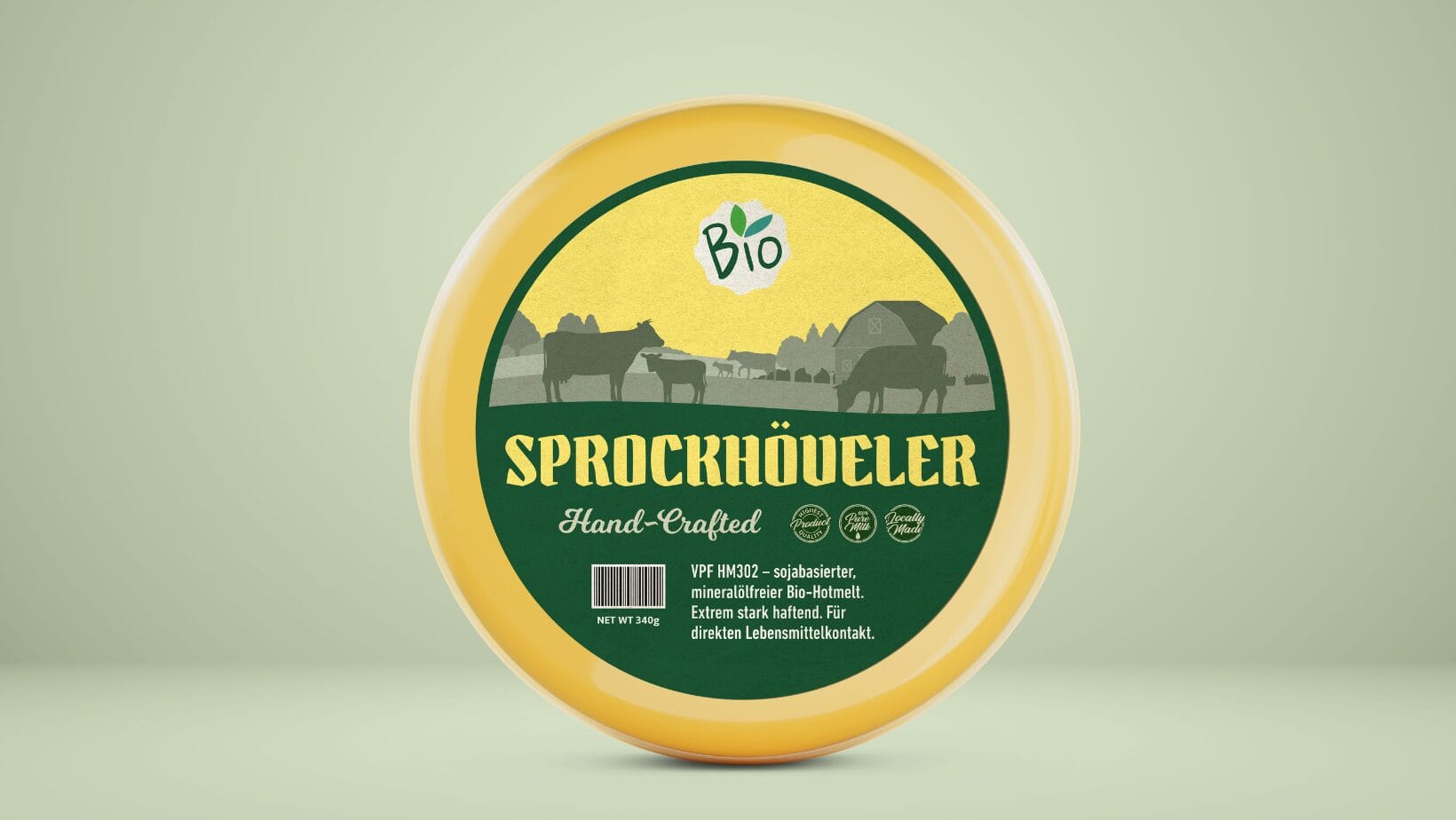
The VPF adhesive HM302 has other important advantages in addition to its outstanding adhesive strength values: The adhesive is absolutely free of mineral oil and can therefore be Can be combined with almost all paper and film face materials. The adhesive is approved for direct food contact and, due to its adhesive strength, is particularly suitable for labelling difficult, even non-polar surfaces - including cheese rind, for example.

The innovative HM302 adhesive has a certified organic content of at least 45 per cent. The Organic content is obtained from soya bean waste, so that there is no conflict with food production. The use of biomass significantly reduces the CO2 footprint of the adhesive and is now only on a par with a standard dispersion acrylate.
Due to its convincing advantages - performance and sustainability - VPF is positioning the new HM302 adhesive as a new standard hotmelt in its product range and is now offering the adhesive for a variety of applications from low minimum quantities. As usual, the adhesive can be Combined with all VPF face materials and cover materials according to the modular principle and, of course, with many more sustainable papers, films and recycled liners.
Source: VPF