Bioplastics: EU regulations put to the test

A revision of the EU directive on packaging and packaging waste is currently being worked on in Brussels. What role should European regulations and national law assign to bioplastics in the creation of a European circular economy?

Numerous regulations with extensive implications for the entire plastics industry have already come into force in Germany this year. Work is currently underway in Brussels on a revision of the EU Packaging and Packaging Waste Directive (PPWD), which will bring further changes. What role should European regulations and subordinate national legislation assign to bioplastics in the creation of a European circular economy?

Bio-based and biodegradable plastics form the bioplastics material group. They are an important building block in the transformation from a linear economy based on fossil raw materials to a circular economy, which relies on renewable resources.

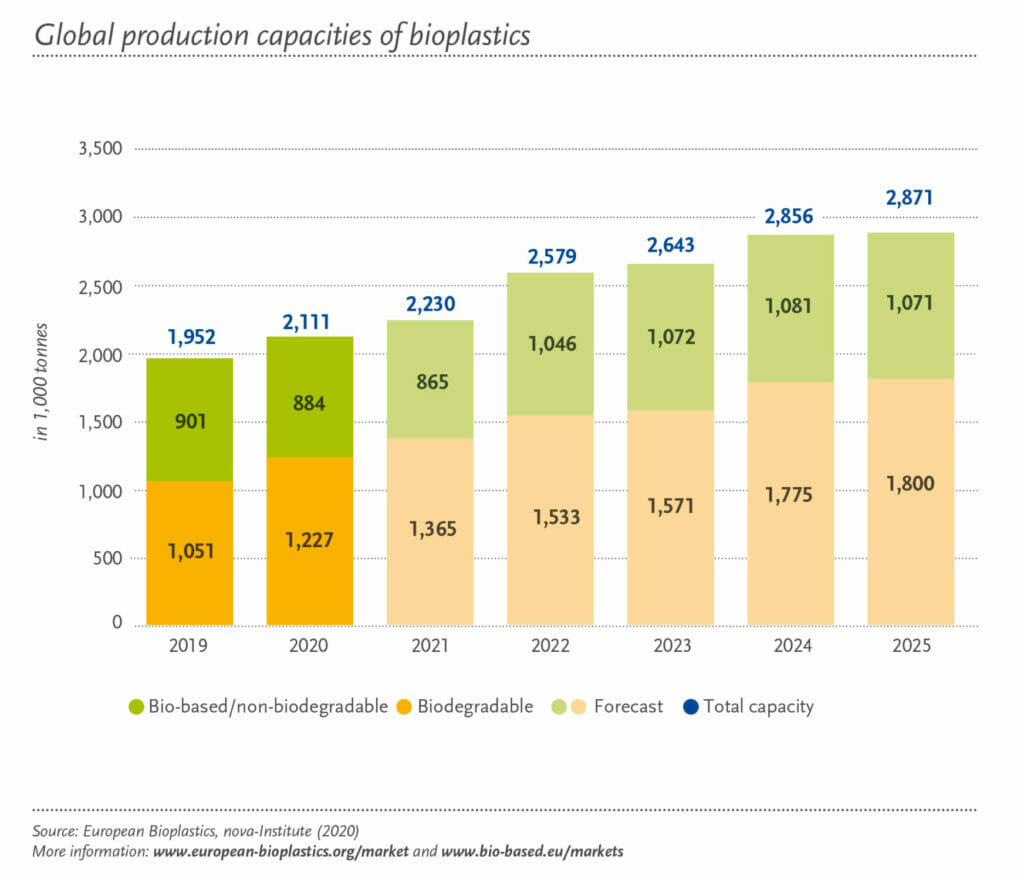
Source: European Bioplastics, nova-Institute (2019)

Bioplastics currently have a share of around one per cent of the more than 368 million tonnes of plastic produced annually. At 47 per cent, packaging is still by far the largest area of application (bioplastics: 0.99 million tonnes). Bioplastic alternatives exist for almost every conventional plastic material or product. The number of bioplastics that have successfully reached market maturity is steadily increasing. Global bioplastics production capacities will also continue to expand and diversify over the next five years. Of particular importance here is a clear legal framework that makes political decisions at European and national level more reliable through greater transparency, thereby increasing planning security for the bioplastics industry.


EU Single-Use Plastics Directive misses target

In the previous year, numerous ordinances and laws were enacted at federal level in order to implement the provisions of the EU Single-Use Plastics Directive (SUPD) by the time it comes into force on 3 July 2021. Among other things, the directive includes a ban on selected single-use plastic products, stricter regulations regarding producer responsibility and a labelling requirement for various single-use plastic products. Even if the original intention of the SUPD to reduce the negative impact on nature caused by plastic waste is to be supported in principle, it largely misses its target.

Display

The same applies to the national regulations for their implementation. The EU directive bans certain single-use plastic products, stating that suitable and more sustainable alternatives are already available. However, it fails to specify these alternatives in more detail. With the alternative materials discussed so far, such as bamboo, straw or bagasse, it is at least questionable whether the final products contain questionable additives after further processing that conflict with existing food safety regulations.

Another weakness of the new restrictions on single-use is the failure to differentiate between conventional plastics and bioplastics, even though the latter have a considerable number of ecological advantages. The implementation of the SUPD in the individual member states is also extremely varied, so that it was necessary to speak of a legislative patchwork early on. This leads to confusion among consumers and industry alike, as well as disrupting the internal market. A premature revision of the directive is therefore becoming increasingly likely.

Taking greater account of the role of bioplastics

The European Commission began revising the Packaging and Packaging Waste Directive (PPWD) and its Essential Requirements at the end of last year. The new regulations on the handling of packaging and packaging waste could once again bring about far-reaching changes for the plastics industry. In a three-month consultation process that ended at the beginning of the year, stakeholder groups were able to provide initial input on the procedure. This was followed by several Commission workshops and an impact assessment study is expected to be published this autumn. The results are to be incorporated into an initial draft revision of the PPWD, which is expected to be presented in spring 2022.

(Image: Pawarun Chitchirachan / shutterstock)

It is important that the current revision process takes sufficient account of the important role that bio-based, biodegradable and compostable plastics can play in reducing environmental and climate impact. Bioplastics help to close both the material cycle and the carbon dioxide cycle. Biodegradable and compostable plastics in particular, which are used for food packaging, support the utilisation of unavoidable waste. A resource that would otherwise be lost unused in landfill or incineration. Bioplastics therefore make an important contribution to creating a complete circular economy.

Central regulatory framework for the plastics industry put to the test

Although it is still too early to make a comprehensive assessment of the impact of the revision on the plastics industry, some key aspects can already be identified. The final version of the definition of recycling will be of particular importance. This will also involve the question of which materials are regarded as circular. For bioplastics, it is particularly important that industrial composting remains part of the definition of recycling. The definition contained in the EU Packaging Directive of 1994 already includes organic recycling, which includes industrial composting. The directive regards mechanical and organic recycling, as well as chemical recycling, as equally important forms of recovery.

Another important aspect of the revision is the discussion about a mandatory proportion of recycled material in all packaging. As an alternative, a bio-based mandatory share should also be promoted to the same extent. In this way, the potential of bio-based packaging to reduce emissions would be sufficiently recognised. The European Waste Framework Directive and the current version of the PPWD already support the use of bio-based resources in the production of packaging. In both cases, the mandatory share could be promoted via the lever of producer responsibility in the form of extended producer responsibility fees.

It remains to be seen what form the revision of the PPWD will ultimately take and what specific impact it will have on the bioplastics industry and the plastics sector as a whole. It will also be interesting to see to what extent the revision ultimately contributes to achieving the objectives of the European Green Deal. However, it is undisputed that the revision of the PPWD is a key piece of regulation for the plastics industry.

Guest author Oliver Buchholz, Head of Communications European Bioplastics e. V.

Further articles on the topic of sustainability

Sustainable packaging in the spotlight at BIOFACH

BIOFACH 2026 in Nuremberg will present a wide range of topics relating to the organic sector. For experts from the packaging industry, the focus will be on aspects such as zero waste, new product developments and sustainable nutrition systems that directly or indirectly influence packaging solutions.
Read more "