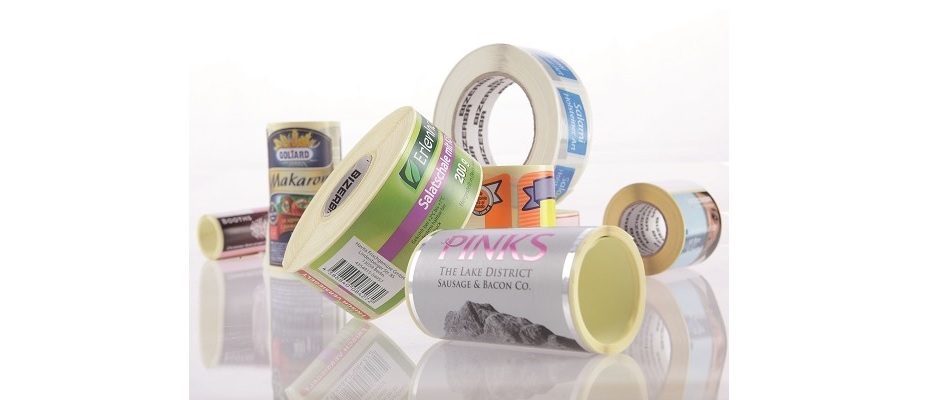
In the case of pre-packaged food, not only the product itself, but also the bag, box and label should be produced in an environmentally friendly way wherever possible. Two factors play a major role here: the manufacturing process and resources. Bizerba utilises a wide range of potential savings for both factors and is focusing on the trend towards greater environmental awareness.
11 August 2020
As a central component of the packaging, labels score highly in important marketing functions, for example with regard to the corporate design, the brand name and the presentation of the product.
In the case of pre-packaged food, not only the product itself, but also the bag, box and label should be produced in an environmentally friendly way wherever possible. Two factors play a major role here: the manufacturing process and resources. Bizerba utilises a wide range of potential savings for both factors and is focusing on the trend towards greater environmental awareness.
Plastic bags for vegetables are gradually being banned from sales, and in some checkout areas they are even being removed without replacement. Instead of putting pre-packed food in the shopping trolley, more and more consumers prefer to buy meat and sausage products at the counter.
But one „environmentally friendly“ food consists not only of the product itself, but also of the packaging and the supposedly smallest part: the label. It is known to fulfil a number of important functions. At the same time, as a production factor in the manufacturing process, it has a considerable influence on costs and efficiency in the manufacturing process. In order to also follow the consumer trend of conscious purchasing, the sustainability of a product must therefore not stop at the food itself, but should ideally continue all the way to the label.
Two aspects are essential for the sustainable production of labels: On the one hand, it is about efficient, cost-saving and environmentally friendly management in production, but on the other hand it is also about choosing the right resources.
Display
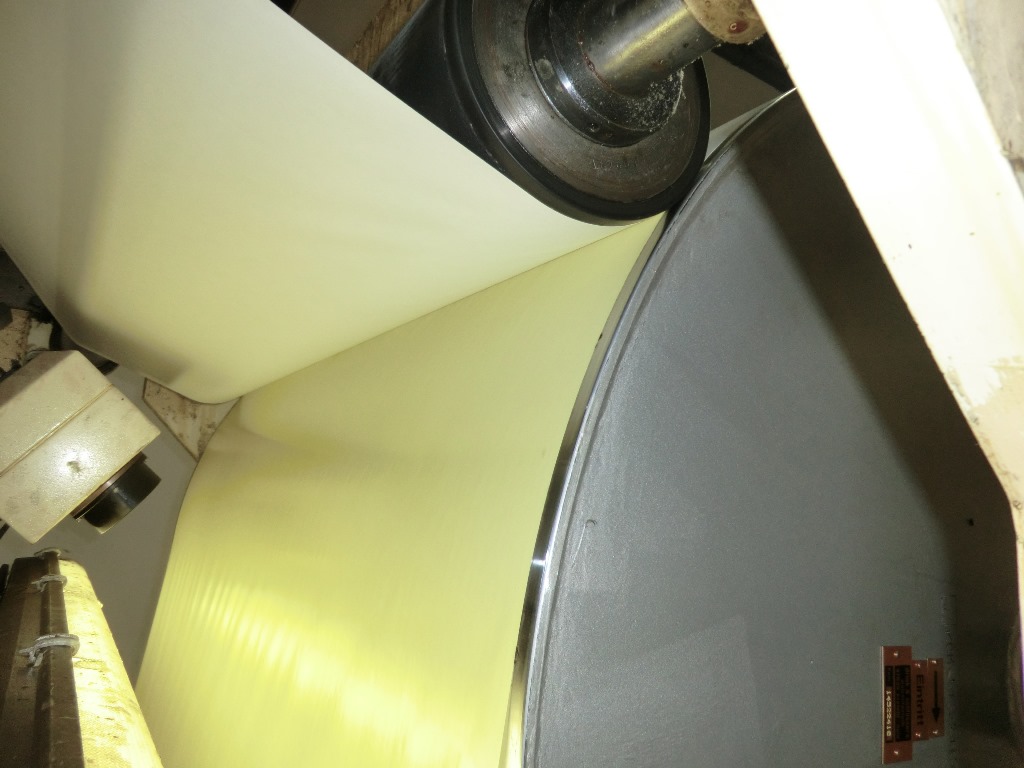
A roller presses the backing paper coming from below and the paper with adhesive coming from above together.
Adhesion at any temperature
The first step on the resource-saving path to the finished label is the production of the laminate. To do this, special heating plates heat the label adhesive, which is then applied to the paper via nozzles and then joined to the backing paper. As the glue plays a key role in the subsequent packaging process, the quantity used must always be in line with the application, otherwise the label may not adhere. For example, if a product deep-frozen The requirements for the adhesive are different if the label is to adhere to a foodstuff that is stored at room temperature.
The so-called „Hotmelt“ adhesive is delivered in drums and only liquefies when heated. It therefore does not require any solvents. „In order to save glue during processing and avoid waste, we use a process that allows us to use 100 per cent of it. without residual residues to utilise this potential,“ says Marc Büttgenbach, Sales Manager Labels and Consumables at Bizerba, explaining the potential for packaging companies.
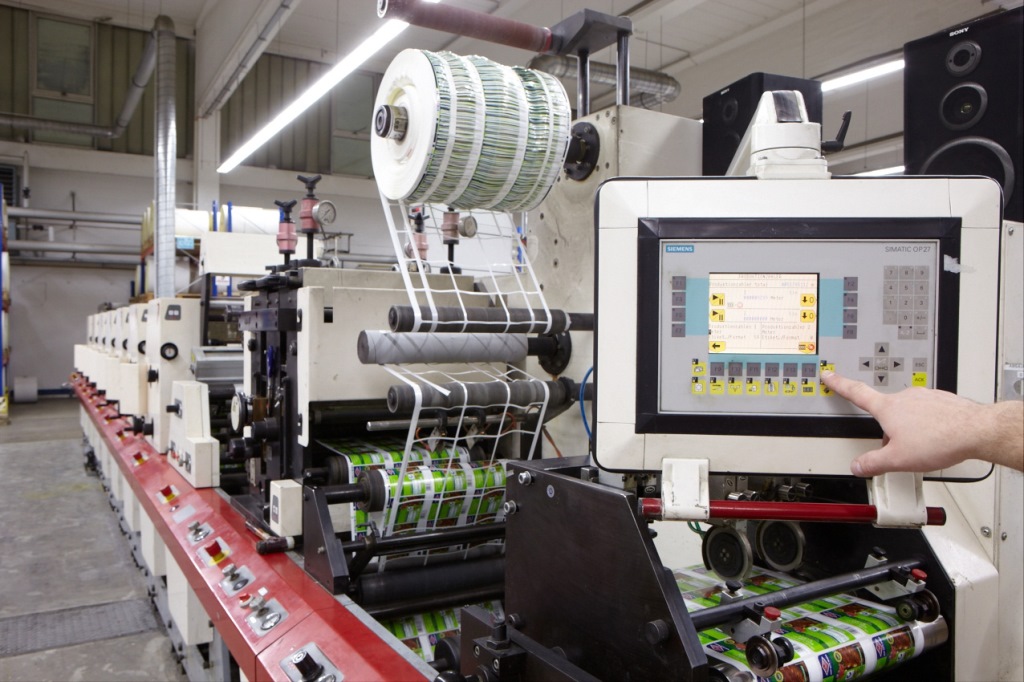
Constant monitoring of the labels prevents annoying misprints.
Planning is everything
The efficient further processing of labels depends on what is known as the material guide. New machines have a much lower material feed within the printing machine than older models. Whereas in the past there was around three times as much material in the machine as it was long, modern systems manage with a maximum material quantity of 1.1 times the length of the printing machine. This significantly reduces the amount of material used, as less laminate is lost in the event of misprints, for example. „By using different machine widths, we can distribute various label formats across the machines in such a way that as little waste as possible is produced. If we also plan the production of labels with the same format and number of printing colours one after the other, we also save on set-up material,“ adds Büttgenbach.
After a special extraction system has removed the cuttings, set-up waste and misprints, the carrier material is either thermally utilised or used in energy-intensive manufacturing processes such as cement production. Another alternative is recycling, i.e. new paper is created from the waste.
„In the medium term, we can save energy in production by purchasing new machines,“ says Büttgenbach. Most of the existing machines are already equipped with Servomotors equipped. The use of LED technology The use of UV light in drying appliances promises further potential energy savings.
Marc Buettgenbach
„Efficient management of resources is essential, as all input materials are initially purchased at a high price. The more material is produced as waste, the more we have to pay for its disposal. That's why we try to produce our labels as resource-efficiently as possible,“ explains Marc Büttgenbach.
Wood and colour
However, efficient and resource-saving processes alone do not produce a sustainable label. That is why there are Certifications, that can help with the choice of sustainable raw materials, such as the FSC certificate for paper. Manufacturers who use this certification must credibly demonstrate that they plant a new tree for every one they cut down. Today, 68 per cent of new paper is made from recycled material. One consequence of this is that the forest population in Germany is currently growing again.
The choice of BP-A and BP-B-free inks is also crucial for sustainable label production, particularly in the food sector. „When selecting the colours, we make sure that we are working with members of the EUPIA (European Printing Ink Association) in order to obtain the highest quality products possible,“ says Büttgenbach. If the company mixes the inks itself, this saves both costs and ink, as no excess quantities are produced. Also important for the food sector is the use of so-called Low migration colours, that have larger particles. Unlike normal colours, these do not „migrate“ through the packaging film.
„If acceptance and willingness to pay increases in the market, there will be a biodegradable label made only from sustainable materials in the future. We are currently experimenting with producing a 95 per cent biological adhesive that can still meet the requirements of cold and heat,“ summarises Büttgenbach.
[infotext icon]Environmentally conscious shopping is a trend that, according to GfK, is being fuelled by the „responsible shopper“ group.
Around 29 per cent of German consumers belong to this group and are predominantly characterised by Conscious purchasing behaviour but only if it is made easy for them.
40 per cent of producers pay more attention to Environmental protection and buy an above-average number of organic and Fairtrade products[/infotext].
Should consumer behaviour continue to shift towards the „responsible stager“ the market will tend more and more towards sustainability. Manufacturers are adapting to this trend and want to offer the „perfect sustainable food“. In order to realise this in the future, it will no longer be enough to simply pay attention to the product and its origin and production. The production of packaging and labelling will also play an increasingly important role.