More than 400 years old and yet not a bit dusty. This is how the Ustersbach Adolf Schmid KG brewery presents itself: the traditional private brewery near Augsburg marks its products with ultra-modern laser and inkjet systems from the portfolio of Bluhm Systeme GmbH, a full-service provider of labelling systems from Rheinbreitbach near Bonn.
Since 1605 the company is privately owned by the Schmid brewing family. The following entry from 1599 can be found in the company chronicle: „... a fairly newly built inn, with a brewery, bakehouses, bathhouses, two barns, stables, dance hall and garden, all located in the centre of the village on the country road.“ The brewer at the time was Wolf Schmid, and his direct descendants still run the private brewery today. The Traditional company is still located in the centre of the village of 1000 souls in the Augsburg region, and the popular inn is still in its original location.
[infotext icon]In the booming 1960s, the small country brewery developed into a progressive business with state-of-the-art equipment. Today, the private brewery in Ustersbach provides an income for 100 employees and has a fleet of more than 20 lorries. The main sales area for the beverages is within a radius of around 100 kilometres around the chimney[/infotext].The „private“ among the large breweries
Josef Geh, Head of Operating Technology, emphasises that despite all the technical innovations and state-of-the-art equipment, Ustersbacher beer is brewed traditionally and by hand in accordance with the purity law dating back to 1516. The brewmasters attach great importance to the choice of raw materials; the brewing water comes from the brewery's own 140 metre deep mineral water well in the heart of the Augsburg Western Forests Nature Park.

It is important that the beer Rest and time to mature to obtain the best beer quality. This is what sets a medium-sized company apart from the large breweries - and is a decisive factor for high beer quality. The highlight in 2015 was receiving the award for the third time in a row with the Federal honour award for highest beer quality.
In addition to a variety of no less than eleven types of beer, the Ustersbach brewery also produces numerous refreshing drinks - for some years now, the portfolio has been complemented by the excellent mineral water from the brewery well. The beverages are filled into kegs and bottles. Bottling takes place on a line from Krones with a Filling capacity of 60,000 bottles per hour.
„Directly at this plant, each individual product must be Ensuring traceability have to be labelled. We were therefore looking for a labelling system that was not only extremely reliable, powerful and flexible, but could also be easily installed in the confined space of the plant,“ explains Josef Geh.
Reliable, flexible and compact
The experts from Bluhm Systeme recommended a CO2-e-SolarMark HD laser with an output of 55 watts. Since then, this laser has been labelling up to 60,000 bottles per hour at Ustersbacher with absolute reliability five days a week. The HD stands for „Heavy Duty“ and means that the device can be used in the most difficult production environments. Thanks to its IP 65 protection, it is not only protected against dust, but also against moisture. In view of the 50 different products to be labelled, the laser is also extremely flexible to use: when changing products, the operator only has to select the corresponding parameter set from the menu of the laser. Control panels select.
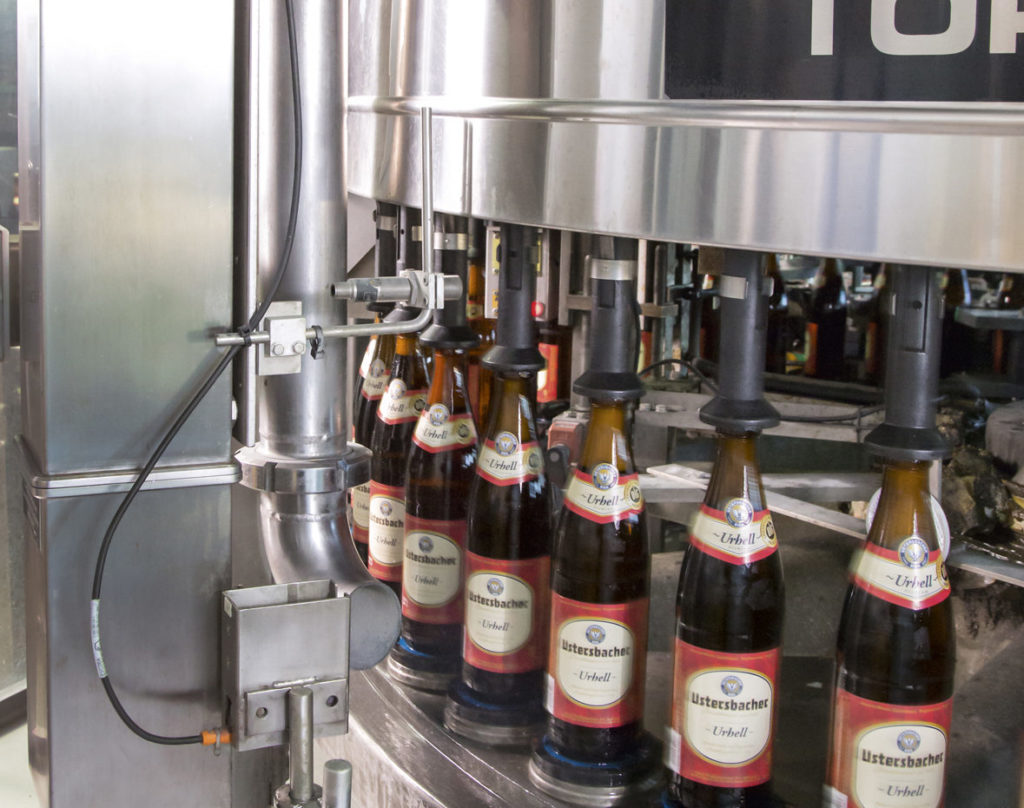
And also with the confined spaces The compact housing is a real help: in order to optimise the positioning of the laser on the system, technicians from Bluhm Systeme, Krones and the Ustersbach brewery developed a modified servo curve table. The filled bottles are labelled and then brought into a position in which they can be ideally marked with a quarter turn.
Thanks to the large Coding window of 100 x 100 millimetres, it was possible to determine the size of each product label in advance. Optimum laser position can be determined. The e-SolarMark codes each bottle in two lines with a best-before date, the production time to the minute and additional batch information. If required, the device can also mark serial numbers, counters, barcodes or logos with laser sharpness at a speed of up to 300 metres per minute.
„Bluhm's labelling systems are well thought out and perfectly adapted to our requirements in all areas,“ emphasises Josef Geh. „Everything has a solid basis.“
Labelling beer keg lids with ink
At the Ustersbach private brewery, not only bottles but also kegs are labelled. The so-called kegs are small beer barrels that are used several times. Therefore, the labelling is only done on the plastic cap. A Linx continuous inkjet printer is used as the labelling system at Ustersbacher: „In most companies, the products to be labelled are fed past the printer on a conveyor belt. In our barrel filling plant, this is done Handling of the drums by a robot“, explains Josef Geh.
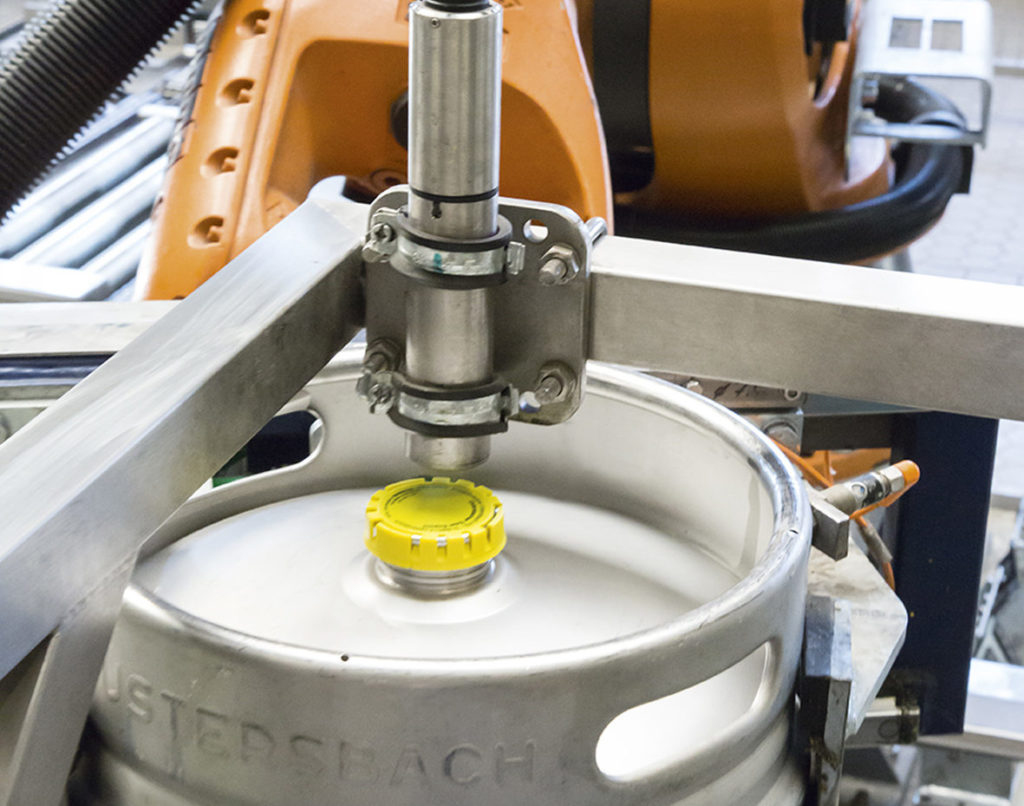
For this purpose, the Linx print head was mounted at a height of around two metres directly next to the kegging system and networked with the robot. The robot takes the filled and freshly sealed beer kegs from the filling line and passes them underneath the print head. At the same time, it sends a signal to the printer to start the labelling process. The print head prints an expiry date, the production time and the number of the filling line on the cap. The robot then places the drum on a dispatch pallet.
„The process is ingenious because we can feed all container sizes past the print head without having to reposition the head,“ says Josef Geh.
Video of the application: Labelling bottles with laser.
Easy to operate and maintain
Apart from this, Linx printers are extremely user-friendly: creating and selecting print texts is easy thanks to the self-explanatory menu navigation very simple. As soon as the consumables fall below a certain fill level, the appliance issues a corresponding message so that there is enough time to refill. When switching on and off, the appliance runs at the touch of a button Automatic cleaning systems The entire system is cleaned of ink and flushed with solvent. All lines and even the nozzle are thoroughly cleaned before the device switches itself off.
Depending on the ink type, the ink and solvent filters only need to be replaced about once a year. With the newer models of Linx printers, this maintenance can be carried out more easily thanks to the so-called Easi-Change®-module - The maintenance of the printer - a kind of filter drawer - can be carried out very easily by the operators themselves. The very latest Linx printer even only needs to be serviced every eighteen months or so.
Bluhm Systeme at the BrauBeviale 2018: Hall 4, Stand 313