
Sustainable packaging for suppliers

The topic of sustainability has also arrived in the automotive industry. Whether reusable materials, their optimised use and recycling or bioplastics: OEMs can make their packaging planning sustainable in various ways. This not only protects the environment, but can also save costs - and improve their image.

The topic of sustainability has also arrived in the automotive industry. Whether reusable materials, their optimised use and recycling or bioplastics: OEMs can make their packaging planning sustainable in various ways. This not only protects the environment, but can also save costs - and improve their image.

If you look around the supermarket, you will find unpackaged goods or goods in environmentally friendly packaging. Sustainable packaging is also gradually finding favour in the automotive industry - because the CO2-footprint is becoming increasingly important. Up to now, cardboard and wood have generally been used as packaging materials for overseas transport, and plastic and steel for overland transport. But there are alternatives. Original equipment manufacturers (OEMs) can build up knowledge on sustainable packaging planning with the right advice.

Three approaches: Reuse, Reduce, Recycle

There are three approaches to more sustainability in packaging planning: Reuse, Reduce, Recycle - reuse, reduce and recycle.

The approach Reuse is already common practice in the industry and means the least effort for OEMs. The quality of the packaging and containers is important here. This is because high-quality packaging lasts longer and protects the parts inside better.

Display

Textile bags or cushions are used instead of packaging made from EPP moulds. This is the approach Reduce. This is because the EEP moulds are precisely adapted to the components and are thrown away when changing derivatives or vehicles. The textile bags and cushions can be used for longer because they are not tied to a specific component - even when changing derivatives.

The approach Recycling Finally, the fact that a lot of packaging made from cardboard, wood, plastic and steel can be recycled is clear to see. It is important that OEMs and their suppliers pay attention to closed loops.
Packaging made from sugar cane, algae or grass

As plastic is still made from crude oil, even with a high recycled content, it will never be 100 per cent sustainable. One solution could be biodegradable packaging made from new raw materials. Bioplastics are of interest to the automotive industry, for example, as a replacement for the polystyrene-like plastic EPP, which is used for large and small load carriers.

A bioplastic alternative can be made from maize, wheat, sugar cane or waste such as husk shells. Depending on the material, 0.5 to five tonnes of plastic can be obtained per hectare of cultivated land. Experiments are also underway with packaging made from fungi or algae. But cardboard made from new raw materials such as grasses is also conceivable.

However, the use of plastic alternatives in the automotive industry is currently limitedBioplastics are still too expensive, are not available in large quantities and are not suitable for every application. Spare parts, for example, have to be stored for years, which rules out self-decomposing packaging.

Lightweight construction and flexible inlays

One promising option for greater sustainability is to adapt packaging planning. Steel is almost impossible to replace - aluminium as a substitute requires more energy to produce. However, the steel containers for bumpers, sills, body parts or windscreens can be designed as lightweight constructions, for example, with floor constructions made of less material. This saves raw materials and weight, and as a result the lorries consume less fuel during transport - which has a positive effect on CO2-consumption.

There is also potential for optimising the interior of the steel mesh boxes: the inlays can be designed to be more easily replaceable or more flexible. OEMs in the USA are experimenting with inlays in the form of foam cushions. As non-moulded parts, they can accommodate variants with deviations or components with different geometries. Another innovative option is coated textile pockets made from cotton and plastic blends, which are sewn to fit the components. They are also not moulded and are suitable for load carriers such as centre consoles, decorative strips or side panels.

Calculating the effects of sustainable packaging planning

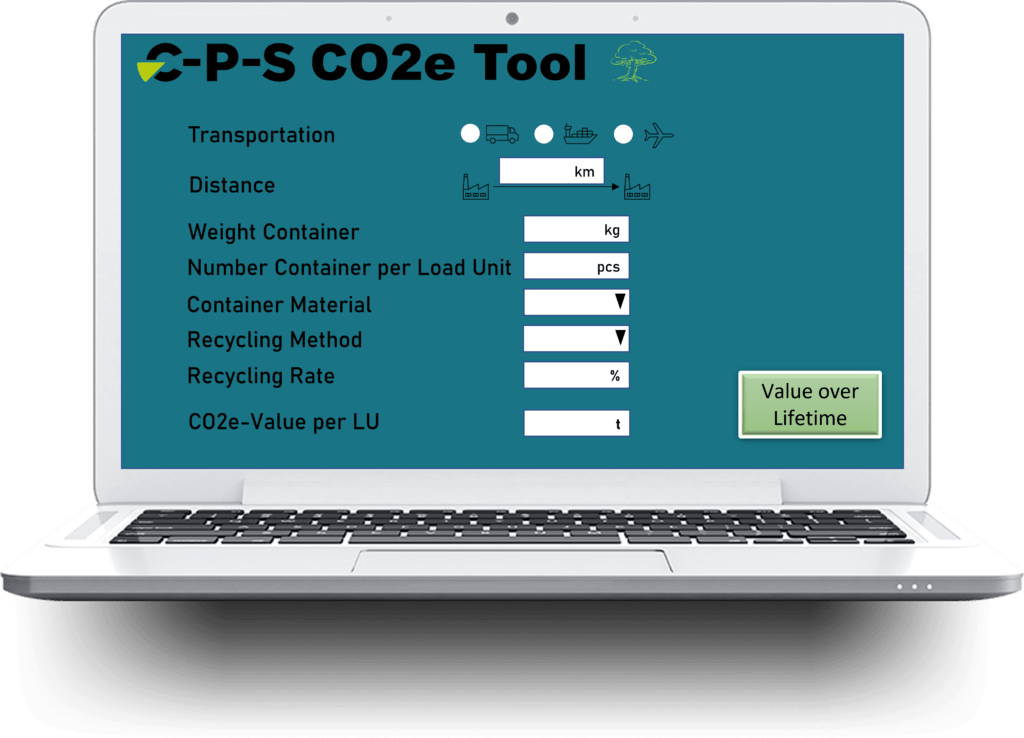
OEMs should and want to make their contribution to environmental issues. However, the path to the goal is not always clear and many do not know how to tackle the issue. The logistics and packaging company C-P-S Group has now developed a calculation method to calculate the CO2-equivalent including all harmful environmental gases from packaging. Manufacturers can also use it to determine what additional costs and savings can be achieved with a lighter, different or recycled material. This makes the topic more tangible and creates transparency.

With the C-P-S tool, OEMs can determine the CO2 footprint of individual packaging.
With the C-P-S tool, OEMs can determine the CO2 footprint of individual packaging. (Image: C-P-S Group)

C-P-S is currently setting up a database for more sustainable packaging planning - an overview of new types of material and their advantages and disadvantages. Because the range is growing and companies like to advertise sustainability. A database can then help to distinguish genuine sustainability from greenwashing.

Save costs, improve image

On the one hand, sustainable packaging planning brings cost benefits for OEMs: The reuse of containers saves on development and new procurement costs; packaging is becoming lighter, so lorries can transport more, which reduces CO2 and also saves money.

The recycling of containers initially requires a little more effort because an inspection is necessary. This eliminates the need for redesigning, conceptualising and approving the containers, which always involves a lot of effort, personnel and travelling. Last but not least, sustainable packaging planning is also an image factor: OEMs that minimise their CO2-footprint can advertise this.

OEMs therefore have a few levers at their disposal to make their packaging planning more sustainableintelligent, rethought containers, alternative materials and the three big Rs - Reuse, Reduce and Recycle. This allows them to benefit from a more environmentally friendly image. They can also save costs, as intelligent containers can be used repeatedly for different parts.

http://www.c-p-s.de

A guest article by Ingmar Wunderlich, Head of Logistics C-P-S Group and Kai Hofscheier, Senior Specialist Packaging Planning

More news from the packaging and packaging materials sector