According to a Civey survey, Germans have an ambivalent attitude towards plastics and their use. On the one hand, consumers consider plastics to be indispensable in many areas, but on the other hand they are often associated with environmental pollution.
On the one hand, they appreciate the special advantages of plastics and their indispensability in many areas. They also see the Progress in areas such as recycling and the circular economy, and they are aware of their own contribution to this, for example by separating waste correctly.
On the other hand, plastic packaging often associated with environmental pollution. And the contribution of plastics to resource conservation and climate protection is also little known. These are the results of a Civey survey commissioned by the Industrial Association for Plastic Packaging and the plastics producers' association PlasticsEurope Germany.

Plastics are indispensable in many industries
More than 60 per cent of those surveyed Plastics are indispensable in the medical and healthcare sector, The computer and electronics sector accounted for 54.5 per cent and vehicle construction for 47.4 per cent, followed by the household and hygiene sector with 38.4 per cent and the food sector with just under 31 per cent.
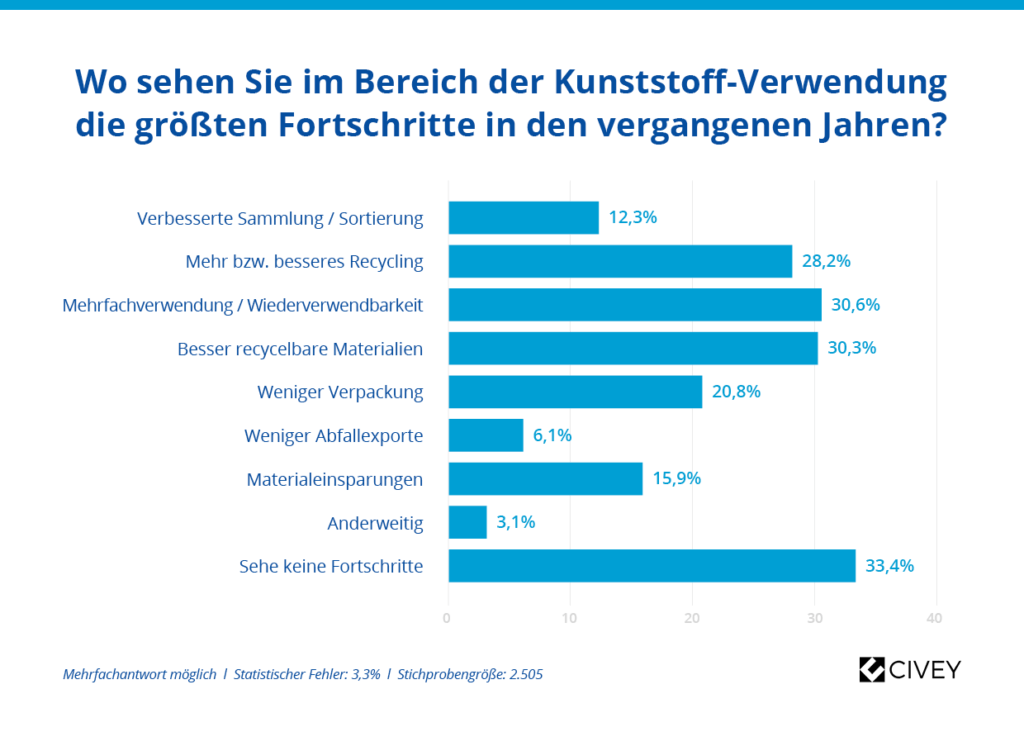 Progress in recycling
When asked about the greatest advances in the use of plastics, around 30 per cent of consumers believe that the plastic material used is easier to recycle. 28 per cent of respondents also see progress in the reusability or recyclability of plastics. Just under a third stated that no progress had been made.
Potential for conserving resources not realised
The combination of plastics and their active contribution to resource conservation is only known to slightly more than 10 per cent of citizens. And only just under 15 per cent say that plastics contribute to climate protection.
 The biggest problem with the use of plastics is identified by 63.5 per cent of respondents as in marine pollution seen. The second most common problem, at around 57 per cent, is the Microplastics, followed by careless littering in third place with around 47 per cent.
Civey survey: continued educational work necessary
„Unfortunately, the term plastic often with the negative aspects which are particularly visible at the end of use. This is why plastic is often seen as an enemy of the environment. In reality, plastic packaging is sustainable and climate-friendly,“ says Mara Hancker, Managing Director of the Industrievereinigung Kunststoffverpackungen e.V. „The results of the survey therefore confirm that we should continue our educational work and open communication. A differentiated view is urgently required and generalised plastic bashing is inappropriate. After all plastic as such is not the problem, but how we deal with it. A rethink is needed here - from the industry to the consumer.“
„Many people don't understand why plastic is one of the most important materials for climate and environmental protection. Our task is to answer the many questions and face the criticism, but also to explain why we urgently need plastics for wind turbines, electric cars and recyclable consumer products.“ Ingemar BühlerManaging Director of PlasticsEurope Deutschland e. V.
 Hygiene particularly important for packaging
For more than 40 per cent of respondents, hygiene aspects of product packaging are particularly important. 38.3 per cent consider the protective function of the packaging - For example during transport - are particularly important. 57 per cent of consumers also state that they use plastic packaging most often to keep food fresh for longer.
Two further positive aspects of plastic packaging, such as a longer durability and lower weight, is only appreciated by just under 20 per cent of respondents.
Source: IK Industrial Association for Plastic Packaging