New EU measures put metal packaging industry under pressure
European industry associations warn of considerable competitive disadvantages.
The trade magazine for the packaging industry
According to a survey conducted by YouGov on behalf of Visable, small and medium-sized companies are concerned about the winter and the high energy costs, inflation and staff shortages. More than half of those surveyed would also like nuclear power to be available for longer.
A survey by the Institute YouGov conducted on behalf of B2B platform operator Visable among decision-makers in small and medium-sized enterprises: German companies are worried about a difficult winter with rising energy costs, inflation and staff shortages. The "double whammy", the The government's aid package is rated as "good and balanced" by only 8 per cent of respondents. Peter F. Schmid, CEO of Visable and client of the survey, sees clear signs of a recession: "If the fears of SMEs materialise, this would cause serious and lasting damage to the German economy."
The survey "How will SMEs get through the winter of 2022/23?" was conducted from 11-18 October 2022 and takes into account the latest developments in German politics - for example, the "double whammy" and the issue of nuclear power plant lifetimes. On both topics the opinion of the companies obviously differs greatly from the current political decisionsThe government's aid package is not convincing and, according to respondents, nuclear power should not only be used as a short-term crisis breaker, but should remain available for longer. The survey was conducted before Chancellor Scholz put his foot down, extending the lifespan of nuclear power plants that have not yet been shut down until mid-April 2023 and ending the dispute within the coalition.

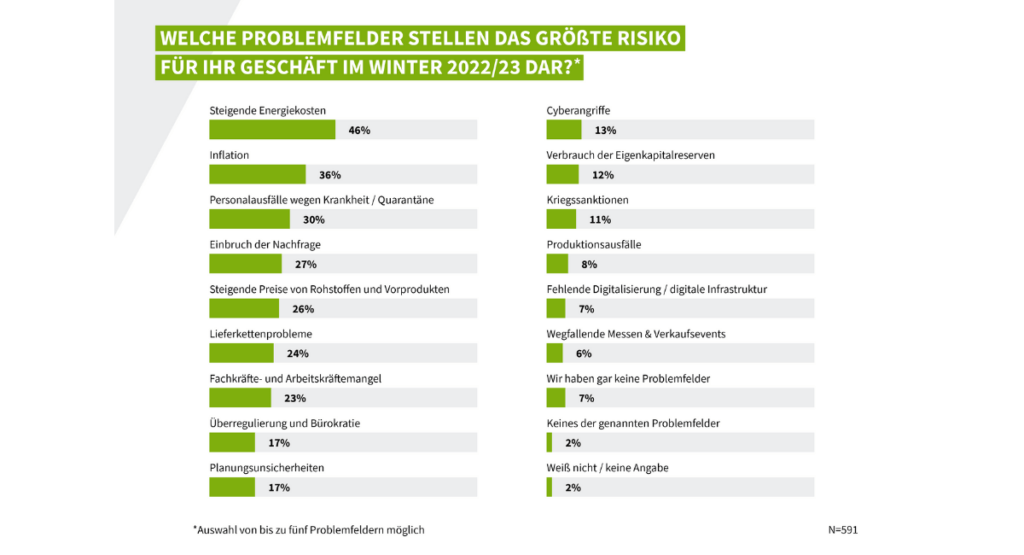
Overall, one in three companies (33 per cent) assesses the risk of a restriction of operations in the coming winter as "high" or "rather high". Almost One in twenty companies (4 per cent) considers the risk of insolvency to be "high"One in ten (10 per cent) still think it is "rather high". At 46 per cent, rising energy costs are clearly the biggest concern. This is followed by inflation at 36 per cent and staff absences due to illness/quarantine at 30 per cent - coronavirus is still a serious risk factor. The A slump in demand (27 per cent), rising prices for raw materials and primary products (26 per cent) and supply chain problems (24 per cent) are frequently cited as worrying problem areas. called.
"We see a strong concatenation of various crisis areas: The energy problem, exacerbated by the consequences of the war in Ukraine, inflation, the continuing stagnation of globalised supply chains and the effects of the coronavirus crisis, which has not yet been overcome, are leading to a very difficult short-term economic outlook. It is good that the government is intervening, albeit late, to provide support - but German companies are expecting even more support. So far, it's not booming yet."
Peter F. Schmid

SMEs are very committed to taking countermeasures and are definitely on the "energy-saving team": 43 per cent have planned energy-saving measures. This is by far the most frequently mentioned approach to reducing costs. 12 per cent also want to switch their energy supply to renewable energies. 19 per cent plan to reduce business trips, 16 per cent want to push ahead with digitalisation. However, the fact that 17 per cent of companies want to suspend planned investments for the time being is not a good sign for the development of Germany as a business location. Almost one in five companies (18 per cent) also stated that they do not intend to take any special measures.

Finally, the companies were asked about the expected loss of profits in 2022 due to inflation and rising energy prices. In each case, 19 per cent expect losses of 1-10 per cent and 11-20 per cent. Almost three quarters of companies (71 per cent) believe that they will at best be able to maintain their 2021 earnings, but not increase them. A "silver lining on the horizon" is also barely visible for 2023 - only 19 per cent of companies expect profits to increase slightly (16 per cent) or significantly (3 per cent). There are still 68 per cent who also believe that they will at best maintain their previous year's result in 2023, but not increase it can. Nevertheless, the proportion of companies expecting a drop in profits in 2023 has fallen slightly compared to 2022, from 46 per cent to 39 per cent.
Source: Visible

European industry associations warn of considerable competitive disadvantages.

The study makes it clear that packaging plays a central role in sustainability assessment.

The Federal Environment Agency has issued a general ruling on the legal categorisation of food packaging for 150 gram sausages.

The EU winter package recognises the crisis in plastics recycling, but does not provide any immediate help, criticises the BDE and calls for binding „Made in Europe“ targets.

A network of more than 1,000 take-back centres is to be established by the time the system is launched.

The aim is to establish packaging as a lead market for the European plastics recycling industry.