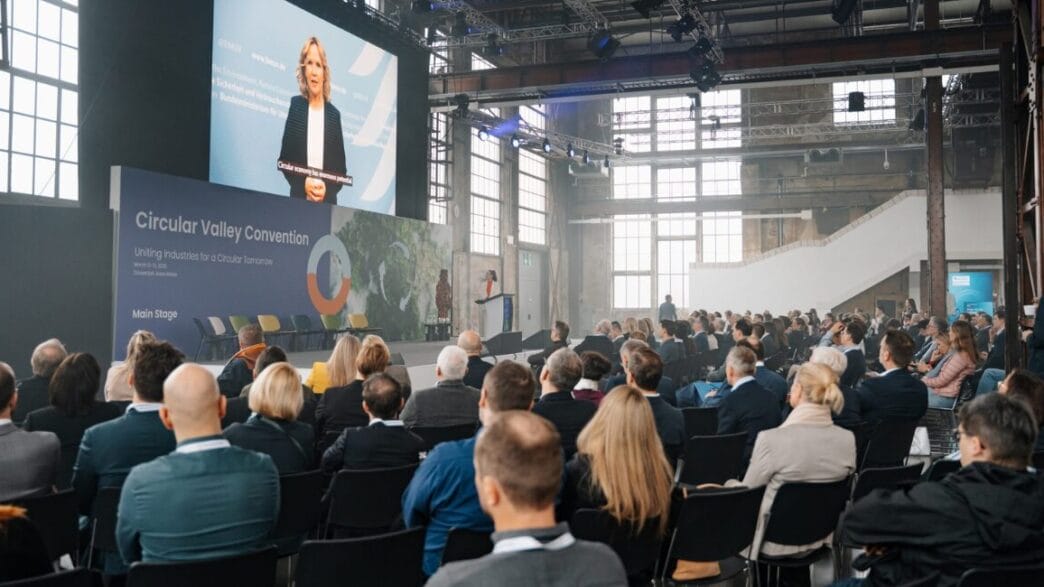
At the Circular Valley Convention 2026, representatives from politics, industry, science and civil society will discuss how early R-strategies can accelerate the transition to a circular economy. The event on 11 and 12 March 2026 at Areal Böhler in Düsseldorf will focus on the Refuse, Rethink, Redesign and Reduce approaches and their importance for resource conservation, resilience and competitiveness.
The Circular Valley Convention 2026 will focus on how the circular economy can help to reduce dependencies and make industrial value creation more sustainable. The event will bring together high-ranking players from top politics, leading industrial companies, science and civil society and will deliberately focus on early interventions along the value chain. The focus on Refuse, Rethink, Redesign and Reduce aims to avoid or minimise the use of resources as early as the product and system design stage, it says.
Political and industrial perspectives on the circular economy
Federal Environment Minister Carsten Schneider will provide political impetus by speaking at the convention on the status of the National Circular Economy Strategy. In his contribution, he categorises the role of the circular economy for environmental, economic and industrial policy and highlights its importance for securing critical raw materials and for Germany's economic resilience.

The industrial perspective is represented by the co-hosts of the Circular Valley Convention. Frank Meyer (Henkel), Talke Schaffranek (BASF), Dr Ralf Düssel (Evonik), Dr Hendrik Wehr (Vorwerk) and Dr Timo Flessner (Bayer) will discuss how the circular economy can be strategically anchored in companies. Topics to be discussed include internal company transformation processes, new business models and the implementation of circular approaches from product development to the entire value chain. In addition to their contributions at the conference, the participating companies will also have their own exhibition stands where they will present specific solutions.
Early R strategies as a lever for conserving resources
The Circular Valley Convention will focus on early R-strategies, which are regarded as a key lever for resource conservation and system change. In this context, Matthias Lesch (Pöppelmann), Prof Dr Welf-Guntram Drossel (Fraunhofer IWU), Tobias Albers (Kearney), Prof Dr Dr Robert Schlögl (Alexander von Humboldt Foundation), Dr Maike Albers-Malkus (NRW.Bank) and Ingo Noppen (Wupperverband), among others, will talk about how products, processes and infrastructures can be rethought from the ground up. The focus will be on the question of how the use of resources for products that are not needed can be avoided from the outset.
The programme will be complemented by contributions from academia and civil society. Reiner Hoffmann, Chairman of the German Council for Sustainable Development, Prof. Dr Channing Robertson from Stanford University and Prof. Dr Dr Christoph Schmidt, President of the RWI - Leibniz Institute for Economic Research, will shed light on the circular economy as a transformation process for society as a whole that goes beyond purely technological or industrial issues.
Dr Carsten Gerhardt, Chairman of the Circular Valley Foundation, emphasises that the focus on Refuse, Rethink, Redesign and Reduce makes it clear that the decisive course for circular value creation is being set very early on. The Circular Valley Convention brings together those who are shaping this change.
Source: Circular Valley Convention