Anyone travelling through Europe in the summer quickly realises that deposit systems are not the same everywhere and there is a lack of uniform standards. But this is exactly what is set to change in the EU. In future, all member states are to collect plastic drinks bottles across the board - ideally via a deposit system. The German Plastic Packaging Association IK has now carried out a deposit check.
The PPWR stipulates that 90 per cent of single-use plastic bottles and metal cans should be collected separately by the beginning of 2029. This is routine for countries like Germany, but a big step for others. Because in many EU countries There is still a lack of nationwide returns, clear standards and digital tracking.
Europe in a deposit check
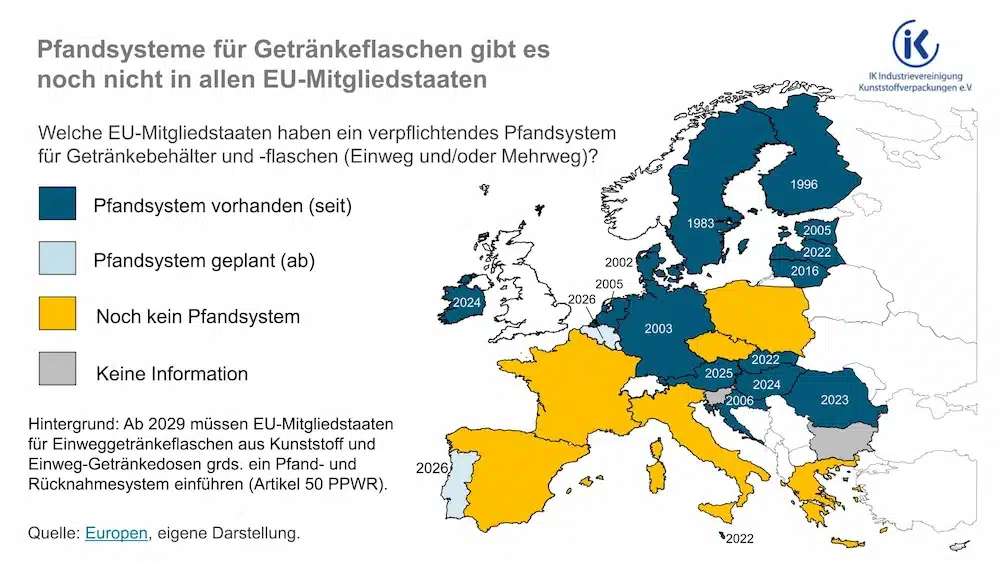
In many holiday destinations within the EU, there are collection containers where empty plastic bottles can be disposed of in an environmentally friendly way. However, a look at the map of Europe shows that Deposit systems for drinks bottles are by no means standard everywhere. While countries such as Germany (since 2003), Sweden, Finland and Denmark have been successfully using deposits for years, many southern and eastern European countries are still lagging behind.

Particularly striking: large markets such as Spain, Italy and France have so far No mandatory deposit system although large quantities of disposable packaging are produced and sold there. Also in Poland and the Czech Republic There is currently no nationwide take-back system, while Portugal and Belgium plan to introduce it by 2026.
Other European countries show how it can work: Sweden operates the oldest deposit system in Europe It has been collecting PET bottles, glass bottles and cans since 1984 and achieves return rates of around 85 per cent. Also Finland, where a comprehensive system for disposable and reusable packaging has been in place since 1996, achieves one of the highest rates in Europe at around 97 per cent. In Denmark (since 2002), the return rate is also over 90 per cent. Estonia (since 2005) and Lithuania (since 2016) achieve response rates of over 85% and 90% respectively - and show that even smaller markets can be successfully organised.
Other countries with functioning systems are Croatia (since 2006), the The Netherlands (since 2005), Malta (since 2022), Romania (since 2023) and the Slovakia (since 2022).
Other countries in Europe have concrete plans: in Austria is set to launch a new single-use deposit system in 2025, while Portugal and Belgium are aiming for 2026. Also Ireland and Scotland are in the preparation phase.
Deposits in Germany: two systems, one cycle
Behind the 25 cent disposable bottle, but also behind the There is also a deposit system behind the many glass bottles and stable reusable PETs - only with return for refilling instead of recycling.
In Germany these two deposit systems exist side by side, the product cycle for reusable bottles and the material cycle for disposable bottles. And with great success: 76 per cent of all bottled drinks in Germany are filled in returnable or non-returnable bottles. This shows how established and effective the system already is. In 2022 alone, 13.7 billion litres of drinks were sold in returnable bottles in Germany, around 73% of which were in glass bottles and 27% in plastic bottles. At the same time, 18.5 billion litres were sold in single-use bottles subject to a deposit in the same period, mainly made of plastic.
Source: Industrievereinigung Kunststoffverpackungen IK