Possibilities and limits of digital printing - Competence Centre Digital Printing of the DFTA at the HTWK
Digital printing is already being used in packaging development and promises good results in combination with innovative marketing. However, the potential and possibilities are still far from being fully explored and the transformation towards Economy 4.0 is expected to give rise to new business models.
23. July 2020
Customised mass production - only possible with digital printing.
Digital printing is already being used in packaging development and promises good results in combination with innovative marketing. However, the potential and possibilities are still far from being fully explored and the transformation towards Economy 4.0 is expected to give rise to new business models.
Through a long-term co-operation of the Flexographic Printing Trade Association (DFTA) with the Leipzig University of Applied Sciences (HTWK) The construction of the new Competence Centre Digital Printing (CCD) in Leipzig. With this forward-looking step, the DFTA is expanding its expertise and responding to the growing importance of industrial digital printing in the packaging industry. The aim is to offer the 350 members of the trade association a comprehensive and active knowledge and communication platform and to coordinate joint projects in digital industrial printing.
Digital printing processes
The term digital printing stands for a variety of different technologies, all of which have the unique selling point of being able to transfer digital data from a database directly onto a substrate without a fixed printing form. The two most important industrial processes are Electrophotography and the Inkjet process. The electrophotography process uses the electrostatic principle to colour and simultaneously image a rotating roller. The printing material is dry or liquid toner. With each rotation, the roller is coloured anew and can transfer a new print image. After colour transfer, the toner layer is fixed to the substrate by heated rollers and delivers excellent printing results. The inkjet process transfers printing materials using fine nozzles that place picolitre-sized droplets precisely on the substrate. The print heads, on which thousands of such nozzles are combined, work either with heating elements to generate the droplets or with pressure waves produced by piezo elements.
Prof. Dr Ing. Eugen Herzau
„Digital printing demands a digital transformation towards an economy 4.0. It is a driver of fusion, merging marketing with technology to create new sales structures and is not limited to individual sectors or industries,“ emphasises Prof. Dr.-Ing. Eugen Herzau, Department of Packaging Technology, HTWK Leipzig.
Display
Digital printing in use
Digital printing has been used in the packaging industry for many years. Small continuous inkjet systems are used for labelling bottles, cans or cardboard composite packaging. In the area of labelling, such as on shampoo bottles or cosmetic jars, the electrophotography process generally scores highly. For some time now, the Direct inkjet printing on corrugated cardboard for folding boxes, displays and folding crates in very short runs and sometimes on an industrial scale. The process realises orders that would be uneconomical in flexographic printing and thus expands the scope of many companies. The possibilities of using this technology to realise new Markets with a high economic volume are particularly relevant for manufacturers in the packaging industry and an argument for users to take a close look at digital printing.
The change in technology shows a clear trend. The reasons are obvious: flexibility and scalability.
Applications in the packaging sector
The possibilities offered by digital printing in the packaging industry are so diverse that it seems almost impossible to fully realise the potential. The extremely diverse market of machine and technology providers and the possibilities of highly integrated marketing are only just beginning to be realised. Start of a development phase and will establish themselves as new business models in the coming years. However, some examples already show how digital printing can be successful in combination with innovative marketing.
Example: MyMuesli
Internet start-up mymuesli sells customised muesli online that customers can put together themselves. A digital printing machine from Heidelberg was installed in the company's first shop, which can print a customised image consisting of various views of Heidelberg and freely selectable text directly onto the cylindrical shape of the muesli tin.
Example: Coca-Cola
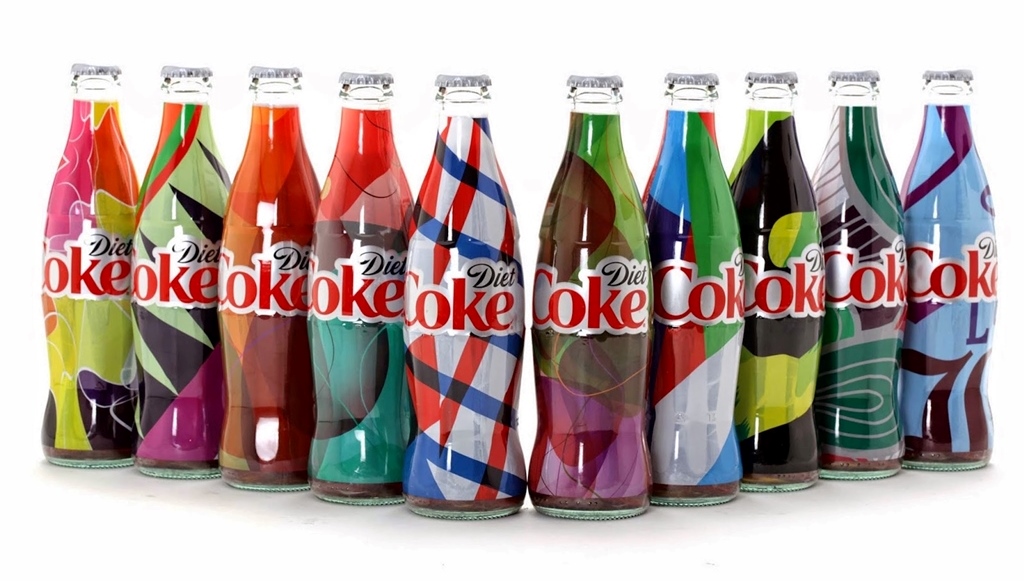
The Europe-wide campaign „share a coke with ...“ is followed by a special edition of sleeve labels with unique motifs. To this end, software constantly generates new motifs from a huge image file so that each printed image only exists once.
Coca-Cola special edition
Example: Scannable packaging
HP is developing prepress software that creates scannable print motifs for packaging, similar to a QR code. The machine-readable code is incorporated into the motif with the message „If you take a photo of the packaging with your smartphone, you will immediately receive additional information on your device“.
Technical solutions
Due to the high technical complexity of an inkjet system and its sensitivity to the smallest changes, manufacturers of digital printing presses are pursuing the approach of developing machines that can be adapted to a wide range of applications. Black box are similar. Adjustment options for the process parameters by the operator are severely limited and guarantees are only given for certified components and consumables, including printing stock and substrate. For a printer who is used to adjusting the recipe of a printing ink or making settings on mechanical components, this is a completely new experience.
The disadvantage of this self-contained concept is that fierce competition can develop between users of the same models, as there are no technological differences between them. Only those who can realise a highly innovative and effective marketing concept with a suitable customer base and great efforts in acquisition can set themselves apart. The black box is contrasted by a high-contrast counter-design: the Do-it-yourself philosophy. Some manufacturers work closely with their customers (users such as print shops). Co-operations The manufacturers open up their print head controls, as was the case between Heidelberg and Fujifilm during the development of Primefire. The manufacturers open up their print head controls, as was the case with the co-operation between Heidelberg and Fujifilm during the development of the Primefire, or issue development kits to facilitate the integration and fine-tuning of the components by the user.
Simon Lober
„The current state of digital printing technology in the graphic arts industry is just the tip of the iceberg. There is potential not only in our own industry. Challenges are not only technical, but also entrepreneurial in nature, Simon Lober, Project Coordination, Competence Centre Digital Printing, DFTA/HTWK.
Potential and challenges
Technically, digital printing and, in particular, inkjet printing still have a few hurdles to overcome for mass distribution in the packaging industry. Questions about resistance to high temperatures and mechanical stress, for example in the case of Sealing and sterilisation processes, must be discussed. Chemical adjustments to the printing material in terms of print quality, ink impressions or adhesion to the respective substrates must be optimised. But also approvals for Direct food contact, high abrasion resistance for transport packaging as well as data protection and handling are aspects that could previously only be realised within narrow framework conditions. Standardisation is only of limited help in digital printing. A deep understanding of the differences to conventional printing processes and a business plan are important in order to occupy an existing niche or establish a new printing service in the packaging industry.
Trends and visions
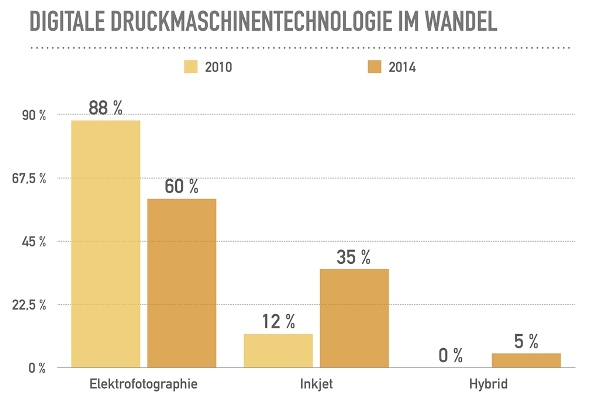
Within 20 years, over 3,000 digital labelling and packaging printing machines had been installed worldwide by 2015. From 2010 to 2014, the inkjet process experienced a rapid rise compared to electrophotography - with an upward trend. It increased its market share from twelve to 35 per cent in the same period. Hybrid machines were and will probably remain a marginal phenomenon. While this technology was not yet known on the market in 2010, it was only five per cent in 2014.
The typical native resolution of inkjet printheads, which is currently 1,200 x 1,200 dpi, is not expected to increase drastically over the next few years. With piezo printheads, development is focussed on durability and increasing the precision of droplet volumes and their positioning. Printheads with a thermal actuator are to become Greyscale-capable and thus gain an important function that they have lacked up to now compared to piezo printheads.