Digital product passports form the data basis for a sustainable circular economy. They allow products to be tracked along the entire supply chain. The COPPA project is currently developing a platform for a digital product passport for food. And dhe St. Pölten University of Applied Sciences is researching in a series of projects how digital product passports can be implemented and what sustainability effects they have.
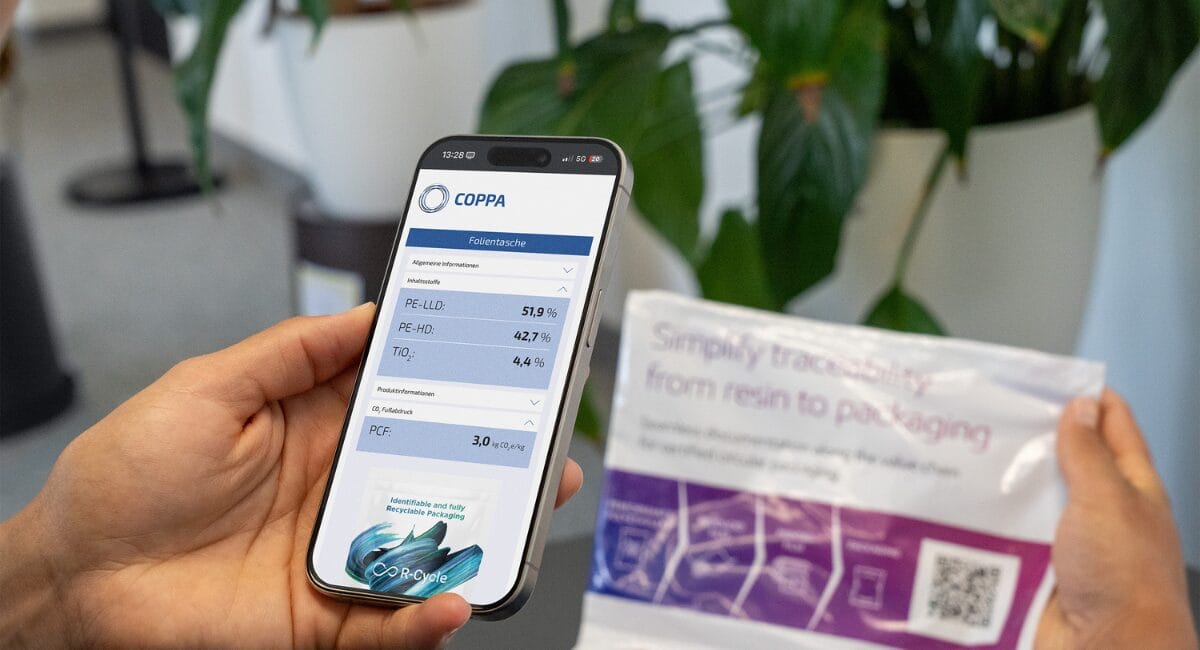
Digitalisation and transparent product passports can make a decisive contribution to the safe use of recycled plastics in the food packaging sector. This is where the COPPA project, in which the SKZ Plastics Centre is also involved, comes in. Together with six partners, the Würzburg-based institute is developing a digital platform that enables Presentation of the material composition of a product and the origin of the materials is possible. An additional direct calculation of the CO2 footprint is also possible.
„The aim of the COPPA project is to contribute to the development of an open Circular Collaboration Platform (CPP) so that secondary materials for and from food packaging can be reused safely and in line with requirements, the carbon footprint can be automatically output and the recycled content of the packaging can be technically validated.“ Sophia Botsch, Scientist at the SKZ
Digital product passports in practice
The St. Pölten University of Applied Sciences is also conducting research in a number of projects, how digital product passports can be implemented and what sustainability effects they have. The projects are dedicated to the areas of plastics, electronics and food.

Digital product passports allow a wide variety of products to be tracked along the entire supply chain are made. This leads to greater product safety, makes production more efficient and reduces environmental impact. In their Research projects St. Pölten University of Applied Sciences is therefore investigating how digital product passports can be put into practice and contribute to greater sustainability.
„The effective integration and management of environmental data on raw materials, composition and manufacturing of products is a basic prerequisite for establishing a circular economy and business models inspired by it.“
Tassilo Pellegrini, Co-Head of the Institute for Innovation Systems at St. Pölten UAS
Better recycling of plastic
In the „DPP4ALL“ research project, which has already been completed, the Institute for Innovation Systems at the St. Pölten UAS has analysed the Technical, legal and organisational implications of a digital product passport for plastics manufacturing and processing companies.
In order to drive the transition towards a sustainable circular economy, waste management and waste processing companies need precise information about the type and composition of the plastic in question. In this way, processing into high-quality recycled plastic waste that are competitive with new goods.
Sustainable business model for the electrical industry
In the ECO-TCO project, Tassilo Pellegrini is investigating how data from a digital product pass for circular and ecologically sustainable electronic products and can be used to compare the life cycle costs of different product variants.
The St. Pölten UAS is also coordinating a research project to develop a prototype for a digital product passport for food supply chains using the example of soya beans.
„There are several hurdles to overcome in the practical implementation of a digital product passport. On the one hand, the complexity of the supply chains is challenging, and on the other, it must be ensured that the various technical systems and organisations can communicate with each other.“
Alexandra Anderluh from the Carl Ritter von Ghega Institute for Integrated Mobility Research at St. Pölten UAS
Sources: St. Pölten University of Applied Sciences / SKZ Plastics Centre