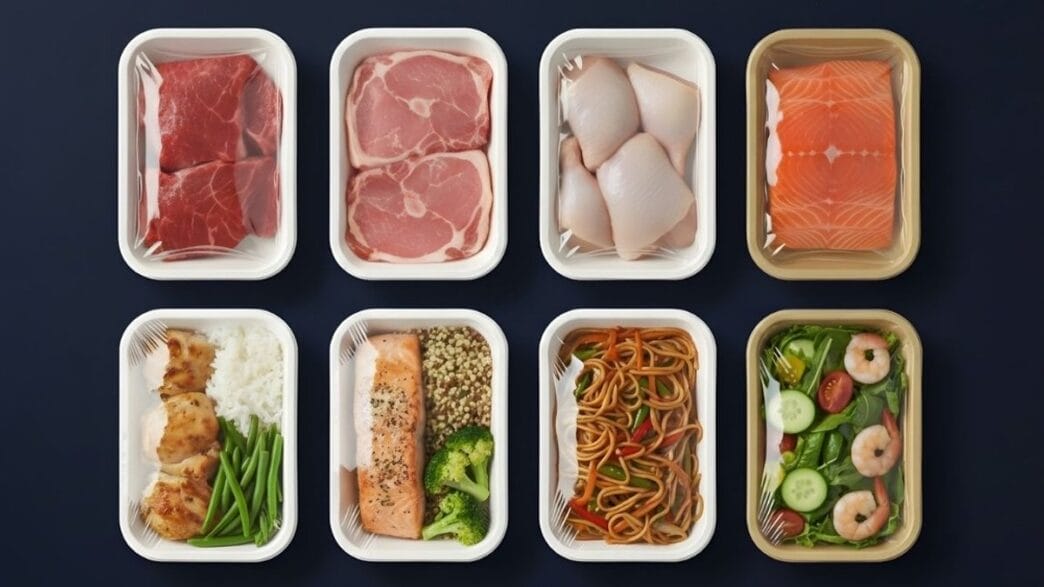
When food manufacturers are looking for sustainable packaging alternatives, they often come up against the technical limits of fibre trays. Traditional wet moulding has limitations in terms of surface quality, design freedom and production speed. The Swedish company Yangi now wants to overcome these hurdles with its Cellera technology and is launching what it claims is the first production-ready, dry-formed fibre tray for the food industry.
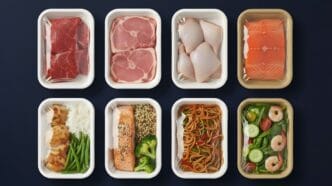
The new tray is suitable for meat, fish, delicatessen and ready meals. It has been tested for use in chilled and frozen environments as well as in the microwave and oven. According to Yangi, it retains its shape, strength and stability throughout typical consumer use.
Technology replaces wet process with precise airflow moulding
At the heart of the innovation is the Cellera platform, which the company describes as a turnkey dry-forming technology. The system combines precise double-drum airlaid forming with in-line pad forming and precision transfer technology. The aim is to achieve maximum fibre control and optimised material utilisation.

The decisive difference to conventional pulp moulding: Cellera completely eliminates the wet stage. „Dry forming represents a fundamental shift in fibre packaging production and replaces wet pulp processes with a precise, scalable and design-flexible approach,“ explains Anna Altner, founder of Yangi.
The technology enables cycle times of 4-6 seconds and therefore industrial production on a large scale. At the same time, tighter tolerances, consistent quality and lower energy and water consumption are to be achieved.
Functionality for MAP packaging and various barriers
The fibre trays have sealing capabilities and are compatible with modified atmosphere packaging (MAP). This supports shelf life targets for protein and ready meal applications. The material is made from renewable, responsibly sourced virgin fibres with a PFAS-free composition.
For demanding applications, a functional laminate can be selectively applied. Recyclability depends on the laminate chosen, with certain structures designed to be compatible with existing paper recycling systems.
„The tray can be used as designed or customised to meet specific product, barrier and design requirements,“ says Hanna Rudel, Chief Commercial Officer at Yangi. „It gives brands and converters the flexibility to adopt fibre-based packaging that is purposeful, high quality and high performing without compromising on design, functionality or cost.“
Design options and sustainability benefits
The trays are available in bleached and unbleached variants, and the size can be customised to the required format. They support embossing and high-resolution digital printing over the entire surface - including the sides - as well as a labelling-capable surface.
According to Yangi, the dry-moulded trays have a CO2 footprint that is around 80 per cent lower than that of plastic alternatives. The integrated fibre chemistry also ensures that the shell has the right external properties.
For packaging manufacturers and brands looking for alternatives to wet-formed fibres, Altner says the launch signals „the arrival of dry forming as the new benchmark in fibre-based packaging“. The company is positioning its technology as an industry-ready solution that offers packaging manufacturers and converters the operational stability they need to scale with confidence.
Source: Yangi