According to a recent dvi survey, almost half of those surveyed believe that packaging has become significantly more sustainable in their experience. The functionality of packaging has also improved.
The representative population survey commissioned by the German Packaging Institute e. V. (dvi) shows, according to the dvi, that the development of sustainable packaging solutions is recognised and welcomed by consumers.

„The industry's innovation work is particularly important with regard to the Sustainability of packaging unbroken. We therefore wanted to know whether and to what extent people are aware of this work. What do people think about the development of packaging in terms of sustainability, functionality and convenience?“ Kim ChengManaging Director of the German Packaging Institute e. V.

Sustainable packaging scores points
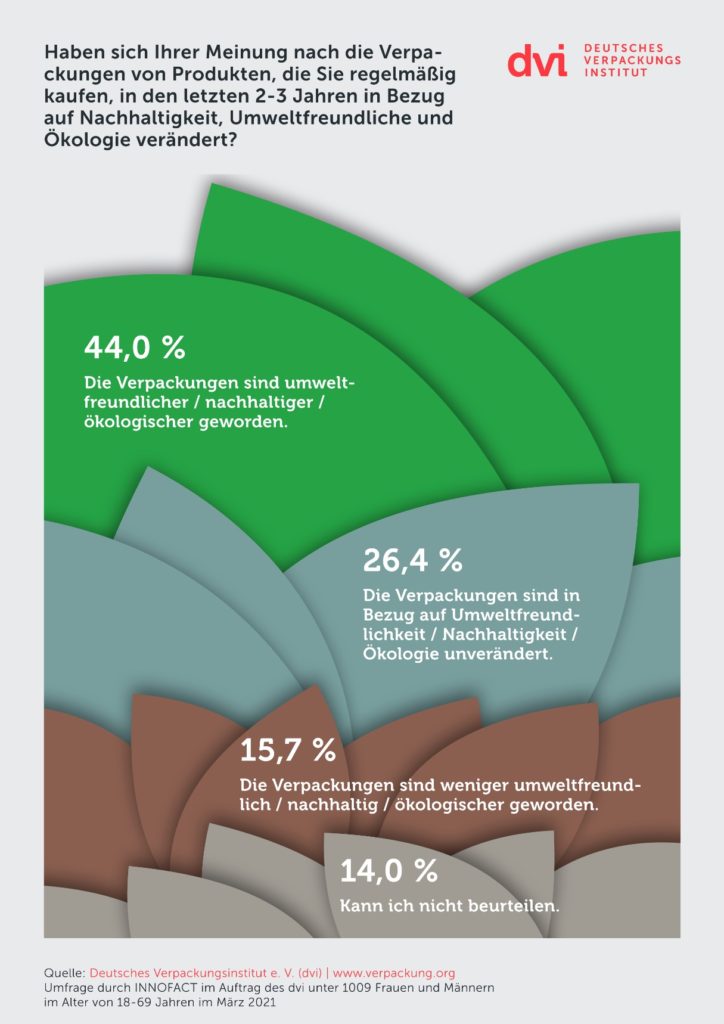
After all 44.0 per cent of respondents state that, in their experience, packaging has become more sustainable in the last two to three years. In contrast, however, 15.7 per cent see a step backwards in terms of environmental friendliness, while 26.4 per cent see a step backwards in terms of sustainability. No changes and 14.0 per cent are of the opinion that they cannot judge the development.
The fact that progress in environmental friendliness not at the expense of functionality and convenience say 49.8 per cent of respondents. 24.8 per cent even see significant Progress in terms of hygiene, product protection, safety and convenient handling. Only 14.9 per cent feel that there has been a setback in this area, while 10.6 per cent of respondents are unable to assess the development. Kim Cheng is pleased that „the numerous and diverse sustainable innovations in the industry in recent years have been well received by consumers.“
Recycling and eco-balance are crucial
Nevertheless, the dvi Managing Director more Need for action in terms of the circular economy: „Recycling is the decisive factor. However, we also need an objective and generally applicable model for assessing the sustainability of packaging. There is no way round this Life cycle assessments over. A real life cycle assessment includes, for example, the materials used in production, the amount and type of energy used in production and also in recycling, the weight and volume of the packaging as a factor in transport, the transport routes within the value chain, the use of water or chemicals for production or cleaning in the case of reusable packaging - and this for several life cycles of the packaging if necessary. These life cycle assessments must ultimately be Federal Environment Agency be made possible. Politicians must not duck away here. They must decide which factors are decisive for the assessment of sustainability and to what extent.“
„Convenience“ for disposal
She points out that the circular economy only works as a team of Economy, politics and consumers works. She also demands that packaging should clearly indicate to consumers how it are to be disposed of and that the packaging components made of different materials can be easily separated in private households wherever possible. This „convenience“ in disposal is important for consumers and contributes to the successful implementation of the circular economy.
Source: German Packaging Institute e. V.