


Meal bag: Edible wrapping for food

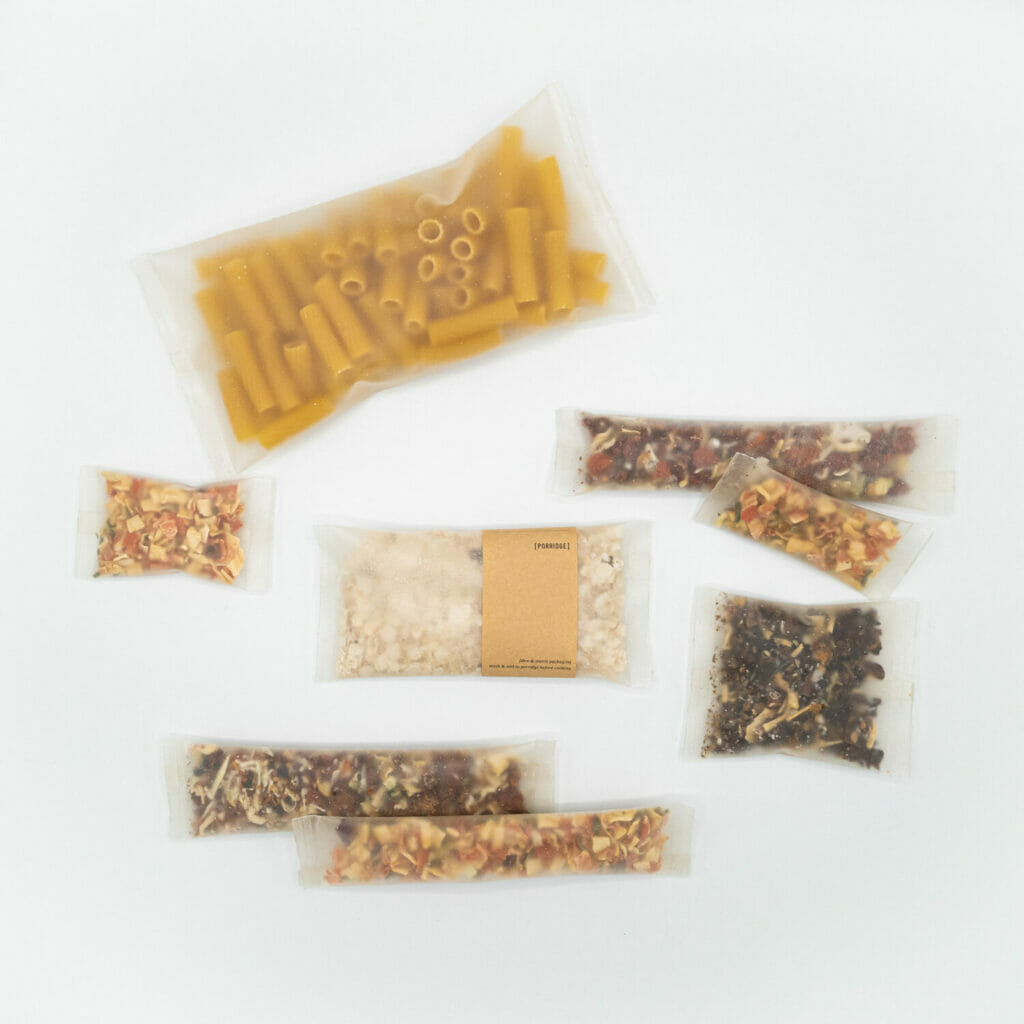
The Meal Bag by young product designer Amelie Graf is made of starch and cellulose, can be cooked with food and then becomes part of the meal.

Food packaging is indispensable: it protects products on their way from the manufacturer to the consumer, extends their shelf life and, in the best case scenario, is recycled at the end. A young product designer has now developed packaging that can even be cooked with the food and then becomes part of the meal.

Amelie Graf calls her edible food packaging, which is mainly made from corn starch, the Meal Bag. She used the material as part of her Master's thesis in the degree programme Product and Fashion Design at the Berlin University of the Arts developed. „I spent a lot of time looking at how people approach the topic of materiality. Today, most work is done digitally and I wanted to get close to the material again,“ says the product designer. „My father is a sculptor and I initially experimented with stone, crushed it and reassembled it with epoxy resin. However, as the binder is toxic and does not degrade, I wanted to find an alternative and tried corn starch.“ The result was the recipe for the Meal Bag, whose main ingredients are starch and cellulose.

All ingredients are suitable for food applications. This means that spaghetti, pulses, spices or dried vegetables can be packed in the meal bag and then cooked together with it. The edible packaging is airtight and to a certain extent moisture-resistant. It dissolves in hot water, and Thanks to the maize starch, the husk can be used as a sauce thickener when cooking or can be added as a source of fibre and energy. Alternatively, it can also be disposed of in home compost, where it decomposes within a few days. „The Meal Bag therefore offers many possibilities for a closed material cycle.“

Amelie Graf Meal Bag
The meal bag can also be cooked and then becomes part of the meal. (Image: Amelie Graf)

Unpackaged

But can packaging that can be touched by anyone in the shop and then be eaten be hygienic?

Display

„I'm often asked about the issue of hygiene. However, most bacteria are killed during preparation at over 60 degrees Celsius, which is why the meal bag also works as sales packaging. Before further processing, it is simply washed like vegetables and forms the basis for sauces, for example. But it also offers a middle ground in the unpackaged shop. Zero-waste shops are becoming increasingly popular, but the packaging-free concept is not so easy for many people to integrate into their everyday working lives. It requires advance planning and bringing suitable containers for loose food. My solution could be an alternative here - unpackaged, so to speak.“

Amelie Graf, Product designer

With her concept, Amelie Graf also wants to encourage people to rethink the way they deal with packaging and to a higher appreciation of materials contribute. The prototype is ready and the designer would now like to realise the concept with an industrial partner. Interested parties from the B2B sector have already enquired.