Environmentally friendly labelling saves on packaging
Plastic packaging could soon be a thing of the past for suitable organic products: Eosta, one of the world's leading trading companies for organic fruit and vegetables, has launched the first products with natural labelling on the market together with the Swedish supermarket chain ICA.
28. June 2018
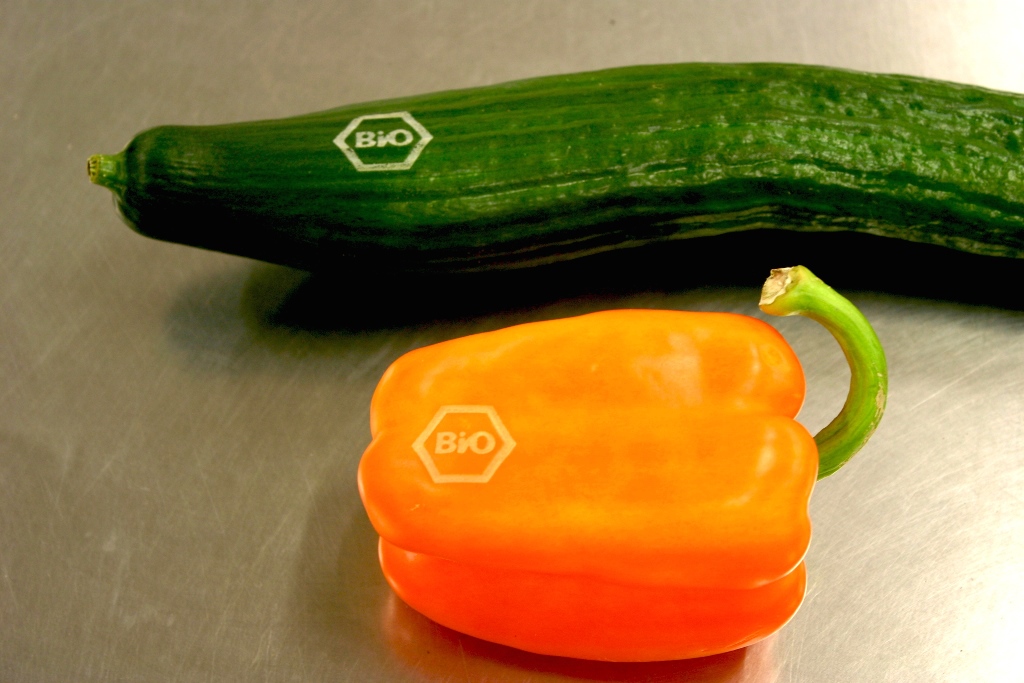
Organic products can now be sold loose and still remain recognisable as organic.
Plastic packaging could soon be a thing of the past for suitable organic products: Eosta, one of the world's leading trading companies for organic fruit and vegetables, has launched the first products with natural labelling on the market together with the Swedish supermarket chain ICA.
Stickers, e.g. with the organic logo or the EU organic seal, can be a substitute for primary packaging, but they also require the use of paper, inks, varnishes or adhesives. With the new method of „Natural labelling“ Nature & More now has an organic seal or customer logo directly on a fruit which can be eaten as normal with or without the peel. The process has been approved and declared safe by the independent Dutch organic certifier Skal and all authorities responsible for food safety. No new chemical compounds are created during the process and shelf life is not negatively affected.
The advantages of the new method are obvious: Nature & More expects to save considerable quantities of Save packaging material. It also supports measures against Food waste. In future, supermarket customers will be able to buy exactly as many avocados or sweet potatoes as they really need and will no longer have to buy larger packaging units.
Paul Hendriks, packaging expert at Nature & More, is very satisfied with the new method:
Display
Paul Hendriks
„Natural labelling closes the gap between recognisability as an organic product and saving packaging material. We are delighted that we have taken the initiative here together with ICA and are bringing naturally labelled products to the shops.“
We wanted to know a little more about this and asked the specialist a few questions.
pj: Mr Hendriks, how does natural labelling work?
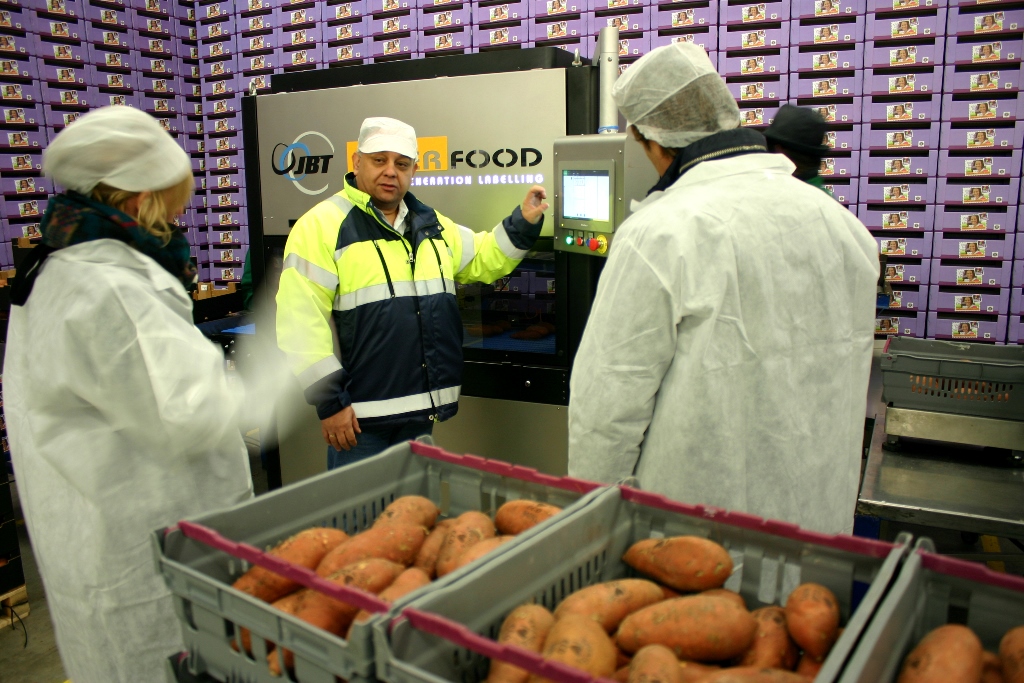
Paul Hendriks: This is a contactless method, which is completely harmless. Pigments in the outermost layer of the shell are removed with a focussed beam of light. No additional additives or contrast agents are used. The process only takes place on the surface of the fruit and has no effect on the flavour, smell, shelf life or appearance of the fruit. The fruit can be eaten as normal with or without the skin, even the labelled area is safe to eat.
pj:How long has this technology been around?
Paul Hendriks: The basic method was Patented in 1997. From 2009, it was already being used in Australia and New Zealand - but only for conventional goods and with the use of contrast agents to increase the visibility of the label on the fruit. This is of course unthinkable in the organic sector. That's why it took us another eight years to develop the process together with our Technology partner LaserFood for organic fruit and vegetables. Laser labelling was approved by the EU in 2013.
Using a low-energy CO2 laser, corresponding points on the outermost skin of the fruit are heated very locally so that the colour pigment only evaporates at this point.
pj: Why has Eosta decided to do this now?
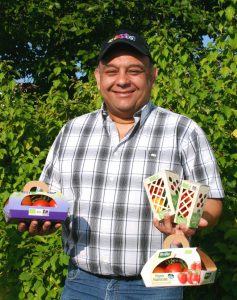
Paul Hendriks: We have been looking for alternative packaging materials for a long time. Years of development work and investment precede natural labelling. At the same time, we have also brought sustainable packaging made from bioplastics or versatile cardboard trays onto the market - as well as environmentally friendly packaging based on agricultural waste such as sugar cane fibre. We only pack our products if there is no other option, but in this case we always opt for the most environmentally friendly packaging material or the smallest possible packaging. Yes, we are convinced that organically produced products do not need to be packaged. Because the best packaging is still the fruit itself. That's why we are so happy with natural labelling.
pj:For which products is this solution suitable?
Paul Hendriks: It is suitable For almost all types of fruit and vegetables. The natural labels are particularly effective on avocado, cucumber, sweet potato, ginger, mango, apple, kiwi and coconut, but also on many other fruits. Stickers that kept falling off the product due to the uneven skin of avocados or soil residue on sweet potatoes are now a thing of the past. Citrus fruits and pomegranates are unfortunately unsuitable as their peel replaces the removed pigments.
Almost all types of fruit and vegetables are suitable for this type of labelling.
Natural labelling is interesting for retailers who offer both conventional goods and organic fruit and vegetables, as it allows organically produced products to be labelled as such without having to be packaged in plastic film. For retailers who only offer organic produce, for example, an avocado could be labelled „ready to eat” using light labelling, or the country of origin of a sweet potato could be made visible directly on the skin. This opens up new possibilities, Communicate transparency and added value directly on the fruit.
[infotext icon]According to LaserFood's calculations, the amount of CO2 produced during natural labelling is only 0.2 per cent of the amount released during the production of a sticker of the same size[/infotext].
pj:What goals are being pursued for the future?
Paul Hendriks: Above all, we want to continue to campaign for plastic packaging based on mineral oil to disappear from shops. The current test phase, in which we are jointly with the Swedish supermarket chain the Acceptance of naturally labelled organic products among end consumers has got off to a very promising start. Other retail partners, including German food retailers, have already shown great interest, so we hope to be able to make „natural labelling“ available to them once the test phase is complete. The advantages of the new method are obvious: in 2015, for example, we delivered 725,380 packs of organic avocados to Swedish ICA supermarkets. We used 217 km of plastic film with a width of 30 cm for this. This corresponds to 2,042 kg of plastic. The CO2 emissions generated during production are equivalent to travelling around the world 1.3 times by car.
[infotext]Nature & More is the Eosta brand. The company has already been honoured several times with international sustainability awards for its transparency system, which allows the origin of products to be traced back to the producer.